

Stomach Pain Emergency Room: When You Need More Than a Heating Pad
You know this feeling. The pain in your stomach has gone from annoying to alarming. You’ve tried antacids, a heating pad, lying in different positions—nothing helps. Now it’s 2 AM and you’re searching “stomach pain emergency room” wondering if this is serious enough to go.
Stop. Some stomach pain really does need the emergency room. Here’s how to know if yours does.
Here’s what you need to know: The emergency room is the right choice for stomach pain when it’s severe, sudden, or accompanied by danger signs like fever, blood, rigid abdomen, or inability to keep anything down. The ER has CT scans and labs to identify appendicitis, bowel obstruction, and other emergencies—things that can’t be diagnosed any other way. When stomach pain is serious, the ER isn’t overkill—it’s exactly what you need.
Urgent Care vs. ER: What’s the Actual Difference?
This distinction matters enormously for stomach pain. The emergency room has capabilities that urgent care simply doesn’t: CT scans, ultrasound, surgical consultation, and the ability to diagnose serious conditions immediately.
Here’s how to assess whether you need an ER for your stomach pain:
P — Pain Characteristics: How severe? How did it start? Warning signs: severe pain (7-10/10), sudden onset, worst pain ever, pain that wakes you from sleep.
A — Accompanying Symptoms: What else is happening? Warning signs: fever, blood in vomit or stool, rigid abdomen, severe bloating, unable to pass gas.
I — Intake/Output: Can you eat and drink? Are your bowels working? Warning signs: can’t keep anything down, no bowel movements for days, no passing gas.
If you have warning signs in any category, the emergency room is the right choice. Find a 24-hour emergency room near you.
Emergency rooms have CT scanners that can see appendicitis, bowel obstruction, gallstones, kidney stones, and other serious causes of stomach pain. They have IV medications for severe pain and nausea. They have surgical backup if you need an operation. Urgent care has none of these capabilities.
When It Might Not Need the ER
Not all stomach pain requires the emergency room. Some situations can safely wait for your regular doctor or be handled at urgent care. Here’s when the ER might not be necessary.
Stomach Pain That May Not Need the ER
Mild pain • No fever • No blood • Passing gas normally • Not worsening
The key word is mild and stable. When symptoms are manageable and not worsening, it may be okay to wait. But stomach pain is unpredictable—if something feels wrong, the ER is the safer choice.
When Stomach Pain Needs the Emergency Room
Some stomach pain presentations are clear emergencies. Here’s when you should go to the emergency room. Our severe abdominal pain emergency care team says these require immediate attention:

Emergency
Severe or Sudden Pain
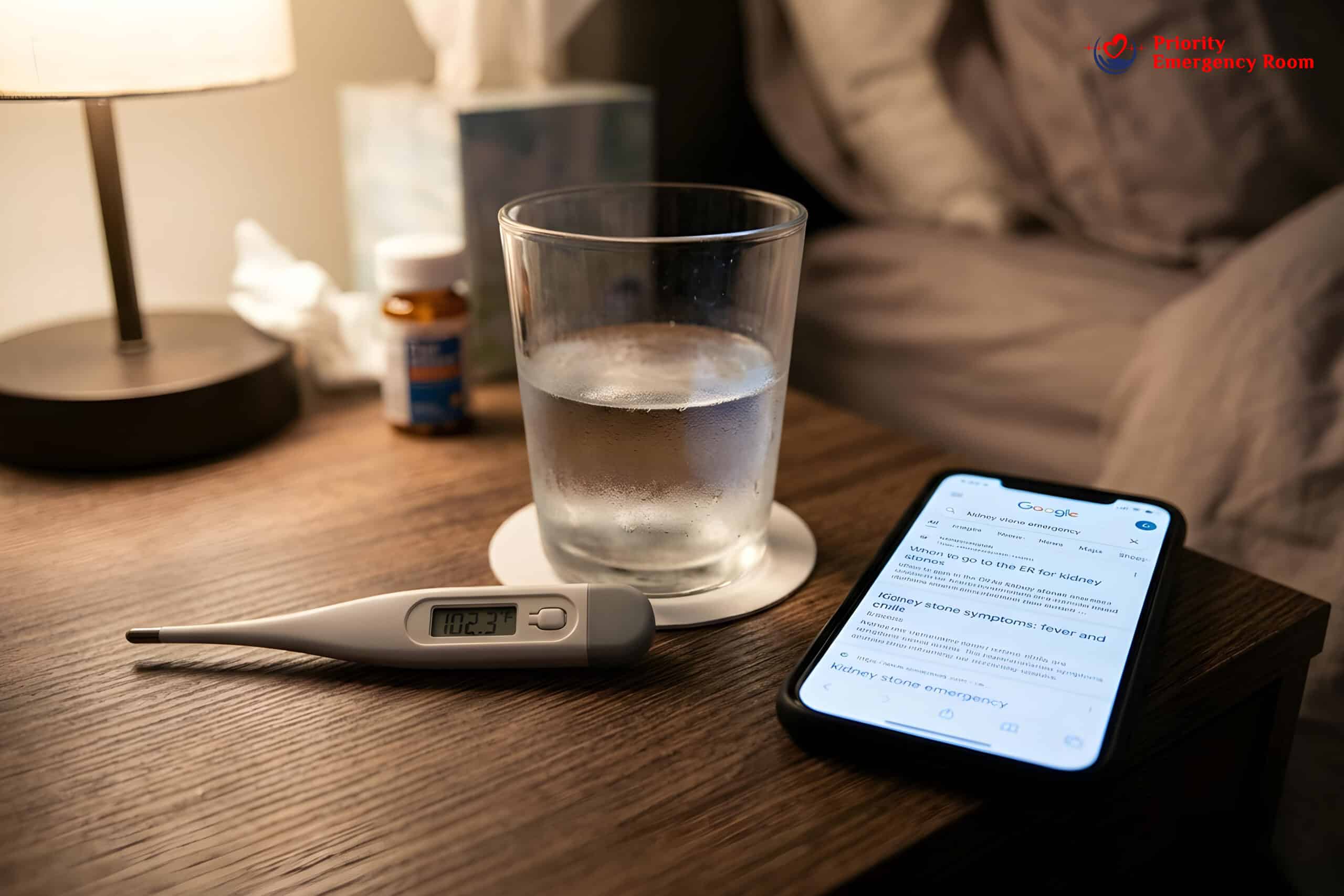
Pain that’s the worst you’ve experienced, came on suddenly, or has you unable to move. Sudden severe stomach pain can indicate ruptured organs or surgical emergencies.
Emergency
Fever with Stomach Pain
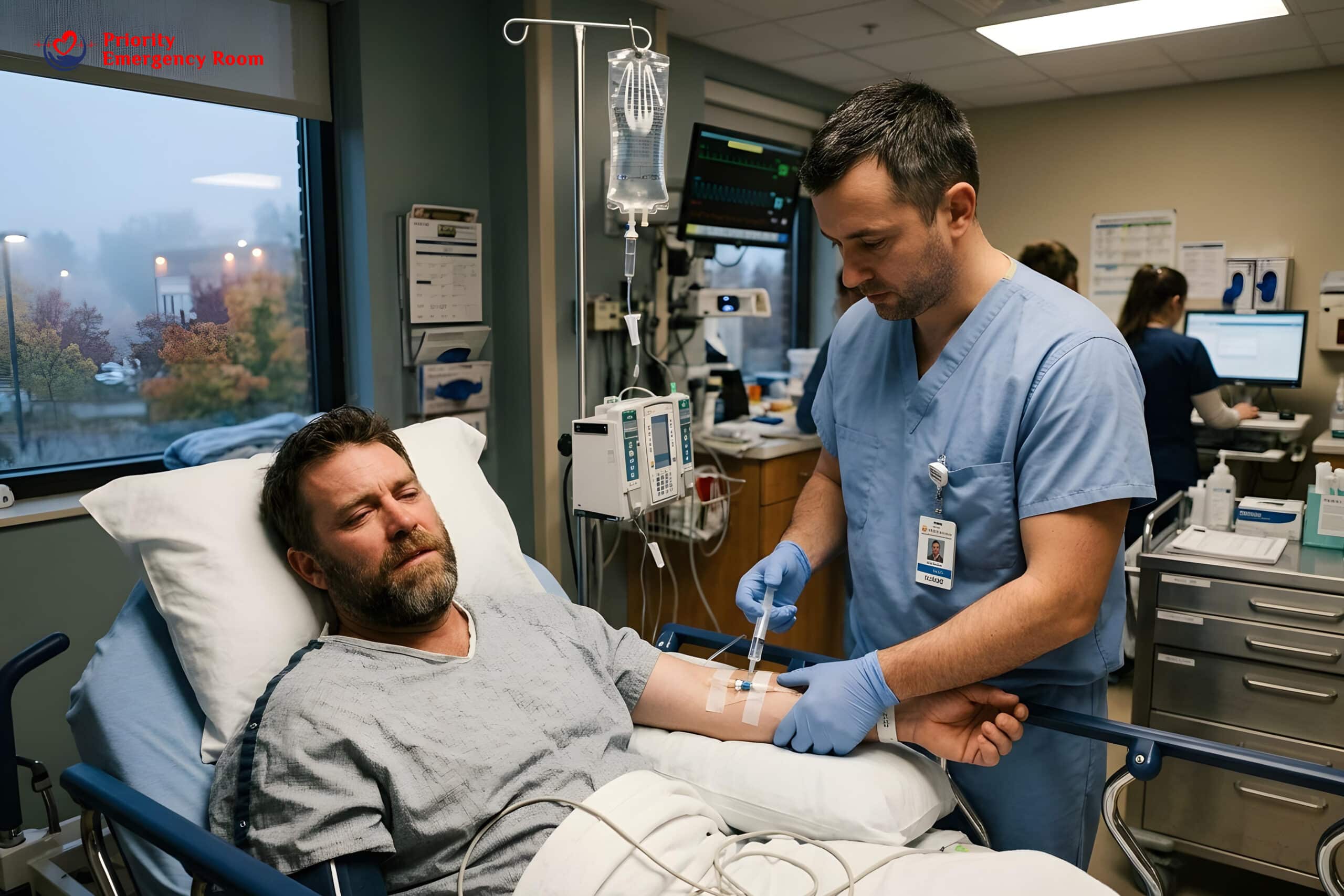
Fever combined with stomach pain suggests infection—possibly appendicitis, diverticulitis, or cholecystitis requiring IV antibiotics or surgery.
Emergency
Blood in Vomit or Stool
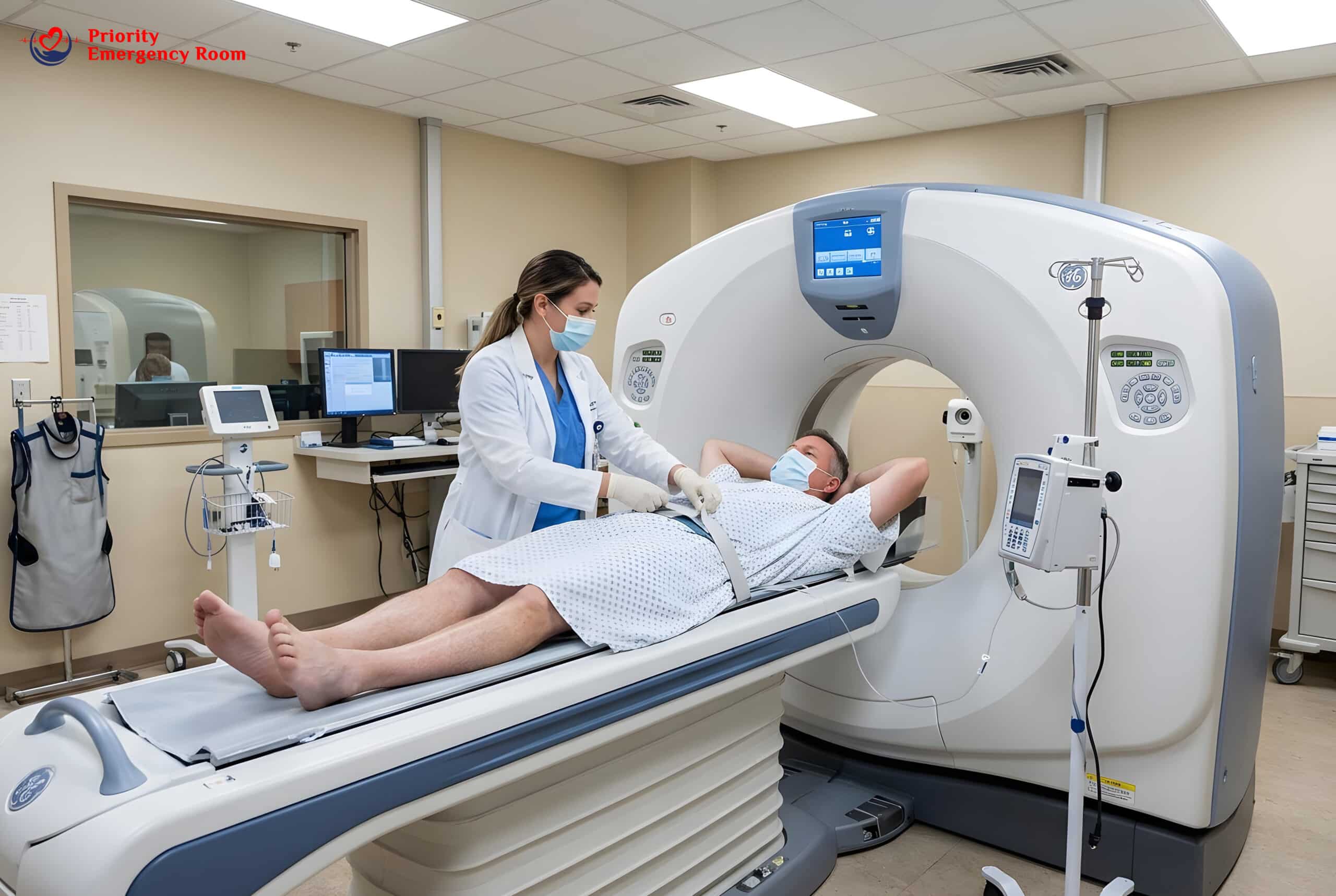
Vomiting blood (red or coffee-ground), bloody stool, or black tarry stool indicates internal bleeding requiring immediate intervention.
Emergency
Can’t Keep Anything Down
Persistent vomiting preventing any fluid intake leads to dehydration and may indicate obstruction. You need IV fluids and evaluation.
Trust Your Instincts
If your stomach pain feels serious—even if you can’t explain why—go to the emergency room. Many serious conditions start with vague symptoms. It’s always better to be evaluated and reassured than to wait too long.
Built for Reliability When It Matters Most
When you need an emergency room for stomach pain, you need real answers fast. Here’s what makes Priority ER different:
The Difference at 2 AM
Hospital ER
3+ hours
Average wait in Texas
Priority ER
Minutes
Straight to a room
CT & Ultrasound
On-site, results in minutes
Full Lab
No waiting for off-site results
Real ER
Board-certified ER physicians
Same capabilities as a hospital ER.
Without the chaos.
What to Expect When You Arrive
Here’s how a Priority ER stomach pain visit typically unfolds:
Your Priority ER Visit
From arrival to answers
0-2 minutes
2-5 minutes
5-15 minutes
15-45 minutes
45-90 minutes
Immediate Greeting (0-2 min)
You’re greeted immediately. No waiting room delays.
Private Room (2-5 min)
Straight to a private treatment room.
Exam & IV Started (5-15 min)
Physician examination, IV started for fluids and medication.
Imaging & Labs (15-45 min)
CT scan or ultrasound on-site. Blood and urine tests in our lab.
Diagnosis & Plan (45-90 min)
Results reviewed, diagnosis explained, treatment provided or referral arranged.
Compare that to a hospital ER: hours of waiting before imaging, more hours for results. At Priority ER, you have answers fast.²
When Stomach Pain Needs Real Answers
Board-certified emergency physicians. On-site CT and ultrasound. Complete lab testing. IV pain management. Zero wait time.
Priority ER Locations
All locations have CT and ultrasound imaging, complete lab services, and board-certified emergency physicians.
🌵 Odessa (West Texas)
3800 E 42nd St, Suite 105
Odessa, TX 79762
Serving Odessa, Midland, Gardendale, Greenwood & the Permian Basin
🏛 Round Rock (Austin Area)
1700 Round Rock Ave
Round Rock, TX 78681
Serving Round Rock, Cedar Park, Pflugerville, Georgetown & North Austin
⭐ McKinney (North Dallas)
5000 Eldorado Pkwy
McKinney, TX 75072
Serving McKinney, Frisco, Allen, Prosper & Collin County
🏙 Pantego (Arlington)
1607 S Bowen Rd
Pantego, TX 76013
Serving Arlington, Pantego, Grand Prairie & Mid-Cities DFW
🌊 Rockwall (East Dallas)
2265 N Lakeshore Dr #100
Rockwall, TX 75087
Serving Rockwall, Heath, Rowlett, Fate & Lake Ray Hubbard area
The Bottom Line on Stomach Pain and the Emergency Room
When you’re searching “stomach pain emergency room,” you need to know: the ER is the right choice for severe, sudden, or complicated stomach pain. CT scans can identify appendicitis, bowel obstruction, and other emergencies that can’t be diagnosed any other way.
Go to the ER if pain is severe, if there’s fever, blood, rigid abdomen, or if you can’t keep anything down. Priority ER has on-site imaging and complete labs—without hospital ER wait times.
When stomach pain is serious, come get real answers.
Medical References
- American College of Emergency Physicians. (2024). “Clinical Policy: Evaluation of Adult Patients with Acute Abdominal Pain.” ACEP Clinical Policies. Retrieved from https://www.acep.org/
- American College of Radiology. (2024). “ACR Appropriateness Criteria: Acute Abdominal Pain.” ACR Guidelines. Retrieved from https://www.acr.org/
- American College of Surgeons. (2024). “Emergency General Surgery Guidelines.” ACS Resources. Retrieved from https://www.facs.org/
- American Gastroenterological Association. (2024). “Abdominal Pain Guidelines.” AGA Practice. Retrieved from https://gastro.org/
- Priority ER Internal Data. (2024). “Annual Statistics: Abdominal/GI Presentations.” Quality Assurance Report.
- Mayo Clinic. (2024). “Abdominal Pain.” Mayo Clinic Patient Care. Retrieved from https://www.mayoclinic.org/
- National Institute of Diabetes and Digestive and Kidney Diseases. (2024). “Digestive Diseases.” NIDDK Health Information. Retrieved from https://www.niddk.nih.gov/
- Healthcare Cost and Utilization Project. (2024). “ED Visits for Abdominal Pain.” HCUP Statistical Brief. Retrieved from https://hcup-us.ahrq.gov/
- Texas Department of State Health Services. (2024). “Emergency Department Statistics.” Regional Health Report. Retrieved from https://www.dshs.texas.gov/