

Urgent Care Pain Medication: Why the ER Is Better for Serious Pain
You’re in significant pain and need relief. You’re wondering: should you go to urgent care for pain medication, or do you need the emergency room? Can urgent care even help with serious pain?
Stop. Urgent care and emergency rooms have very different capabilities when it comes to pain management. Understanding the difference can save you a wasted trip—and hours of unnecessary suffering.
Here’s the truth about urgent care pain medication: Urgent care centers can prescribe some oral pain relievers, but they cannot provide IV pain medication, don’t have diagnostic imaging to find the cause of serious pain, and aren’t equipped to handle severe pain conditions like kidney stones, severe injuries, or uncontrolled pain. For serious pain that needs real treatment, you need an emergency room like Priority ER.
Urgent Care vs. ER: Pain Medication Capabilities
This is where urgent care and emergency rooms differ significantly. Understanding these limitations can help you get the right care.
What Urgent Care CAN Do for Pain:
- Prescribe oral pain medications (OTC-strength or prescription)
- Treat minor injuries with topical anesthetics
- X-ray simple fractures (some locations)
- Recommend OTC pain management strategies
What Urgent Care CANNOT Do for Pain:
- Provide IV pain medication (ketorolac, morphine, etc.)
- Perform CT scans to diagnose cause of abdominal or back pain
- Manage severe pain requiring continuous monitoring
- Treat conditions that cause severe pain (kidney stones, appendicitis, etc.)
- Provide sedation for painful procedures
For truly severe pain, oral medication often isn’t enough. IV pain medication works within minutes and can be precisely dosed and repeated. IV ketorolac (Toradol) is highly effective for kidney stone pain. IV opioids can manage severe injury pain. These are only available at emergency rooms, not urgent care.
When Urgent Care Might Help with Pain
Urgent care can be appropriate for mild pain situations where oral medication and basic treatment will suffice. Here’s when urgent care might work.
Pain Situations Urgent Care Might Handle
Mild pain • Known cause • Oral meds sufficient • No emergency symptoms
The key question: Is your pain manageable with oral medication, or do you need something stronger? If oral meds aren’t cutting it, urgent care can’t help you—you need the ER.
When Pain Needs the Emergency Room
These pain situations require the emergency room—not urgent care. Urgent care simply doesn’t have the capabilities to help you. Our emergency care team treats these daily:
ER Needed
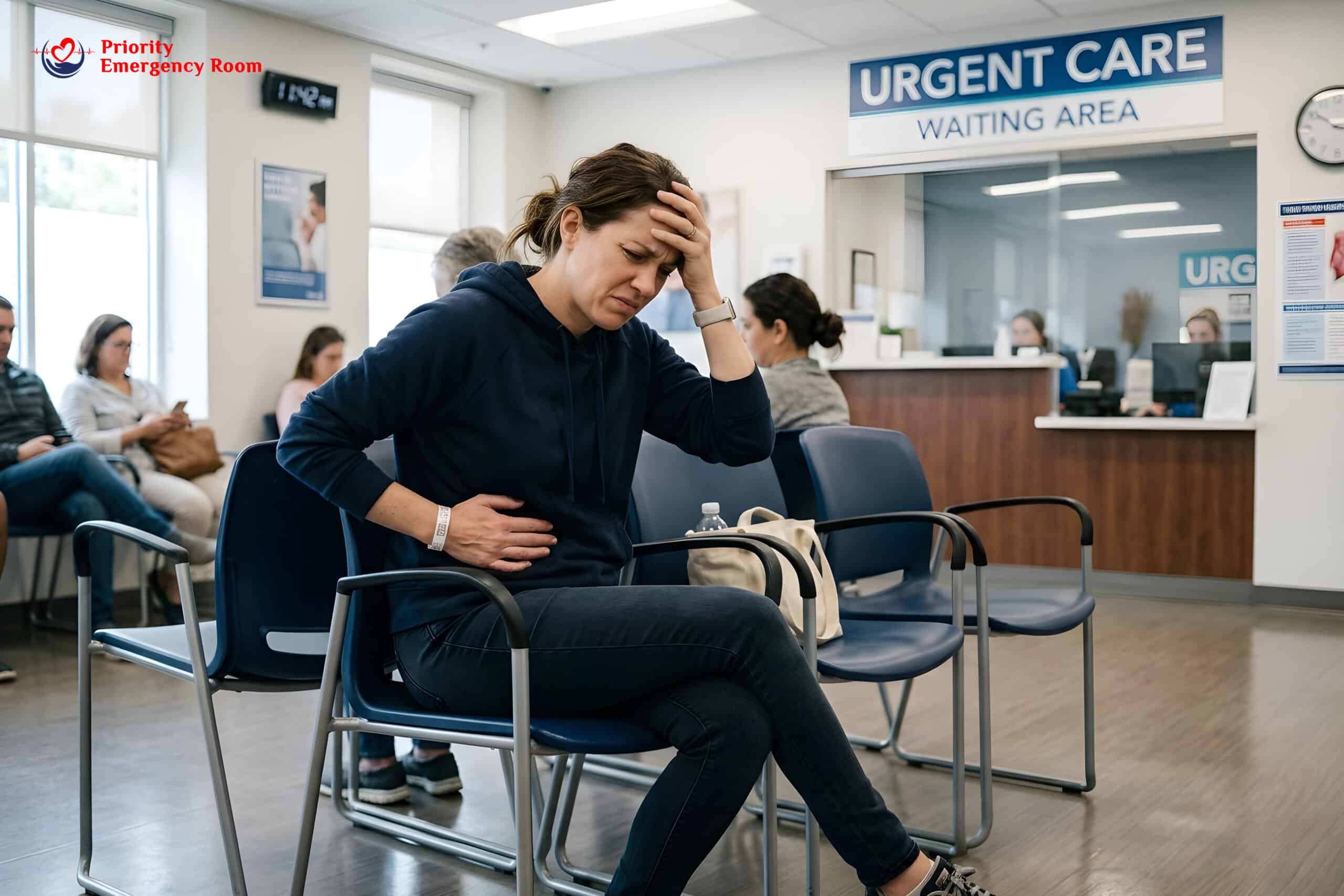
Severe Pain (7-10 on Scale)
Pain that’s truly severe—making you unable to function, writhing, or crying out—requires IV medication that urgent care cannot provide.
ER Needed
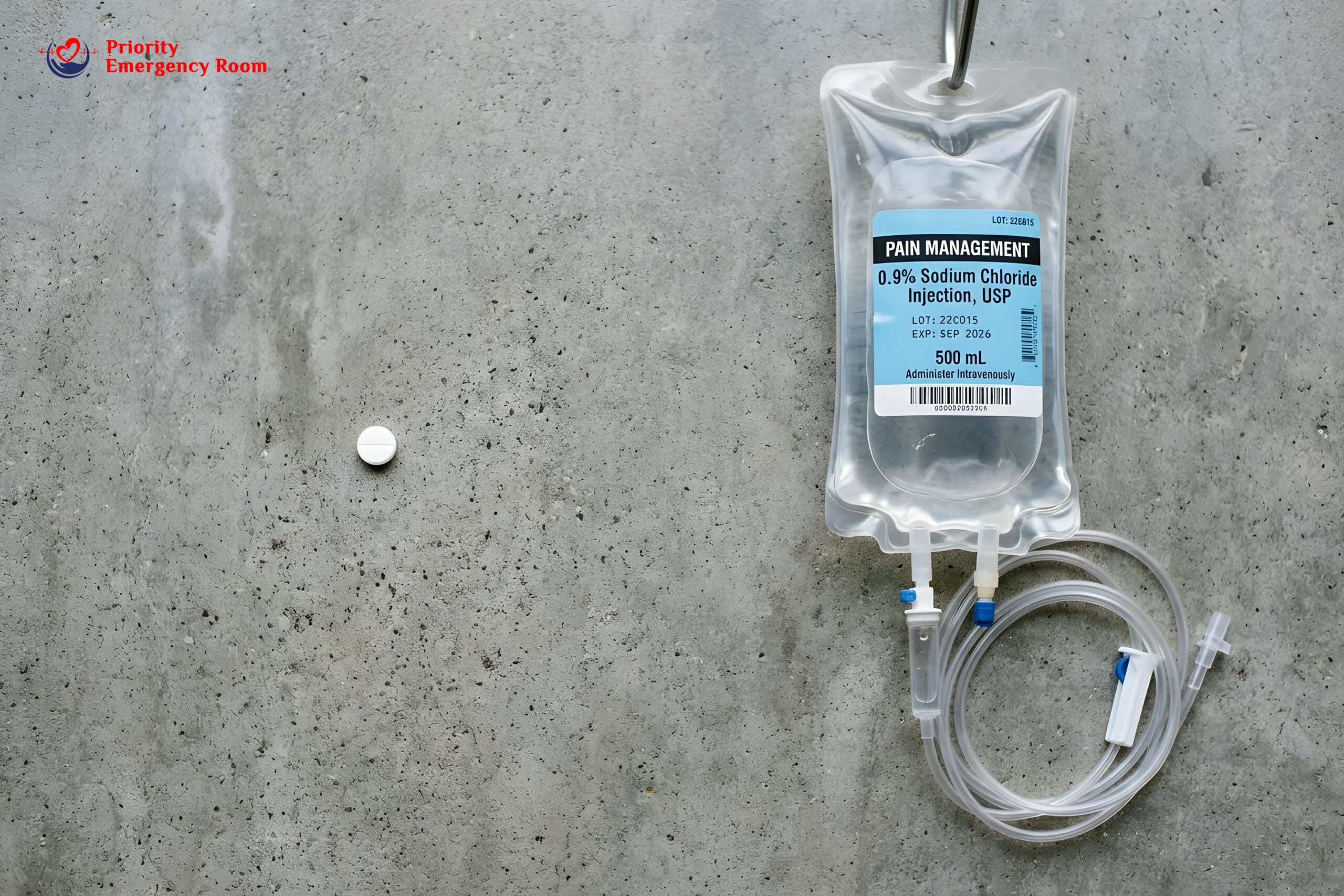
Kidney Stone Pain
Kidney stones cause some of the most severe pain possible. You need IV pain medication (ketorolac, morphine), CT scan, and possibly urology intervention. Urgent care can’t help.
ER Needed
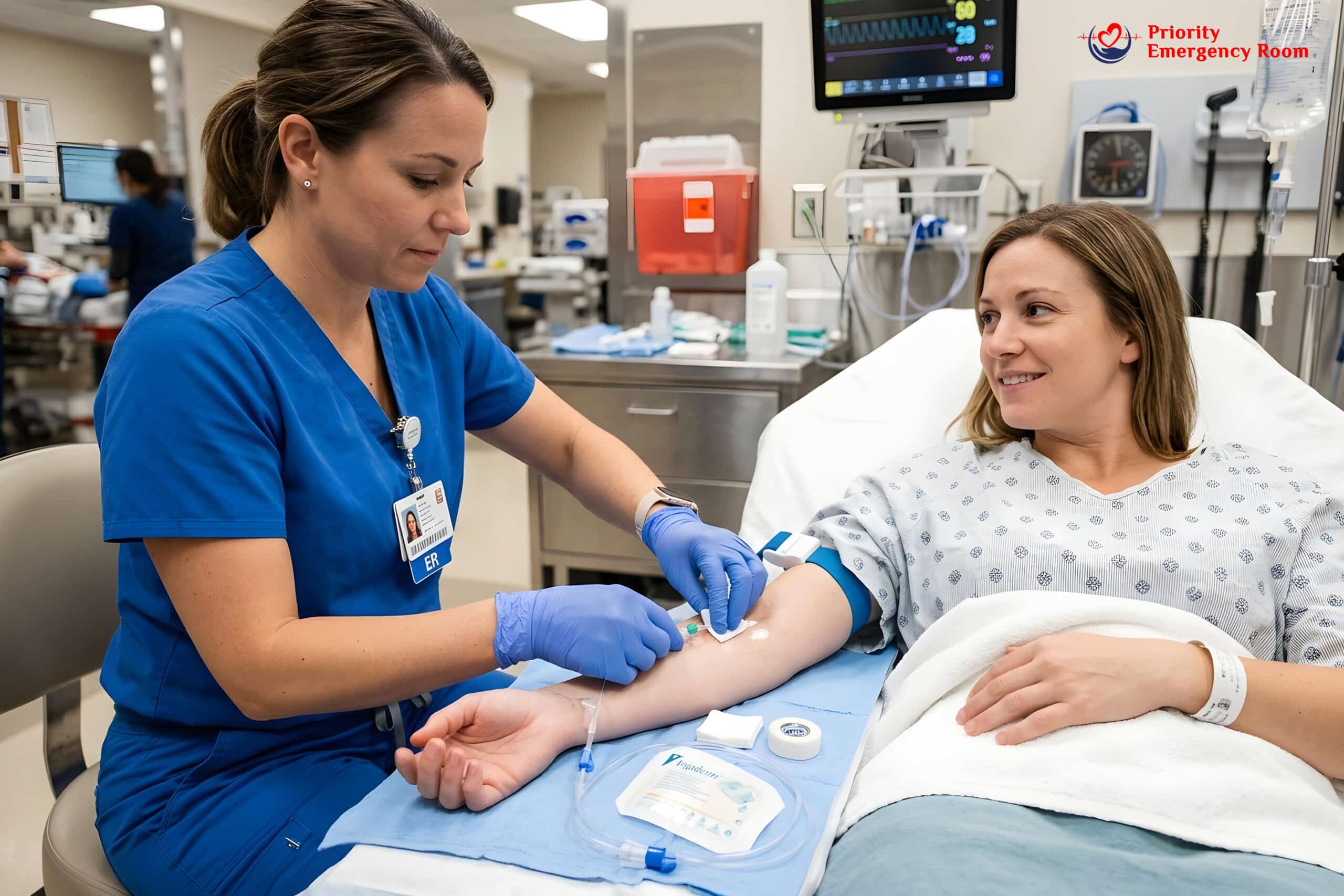
Severe Abdominal Pain
Severe stomach pain needs CT scan to rule out appendicitis, gallstones, or obstruction—plus IV pain medication. Urgent care can do neither.

ER Needed
Chest Pain
Chest pain needs EKG, cardiac enzymes, and possibly CT to rule out heart attack or pulmonary embolism. This is an emergency—urgent care cannot evaluate this safely.
The Simple Test
Ask yourself: “Is my pain severe enough that I need IV medication?” If yes, go to the ER. Ask yourself: “Do I need imaging to figure out what’s causing my pain?” If yes, go to the ER. Urgent care is for minor pain with known causes—not for serious pain management.
Real Pain Management Capabilities
When you need more than urgent care can offer, Priority ER has complete pain management capabilities:
The Difference at 2 AM
Urgent Care
Oral Meds Only
Limited capabilities
Priority ER
Full IV & CT
Complete pain management
IV Meds
Fast-acting relief
CT Scanner
Find the cause
Real ER
Full capabilities
More capabilities than urgent care.
Shorter waits than hospital ER.
What to Expect When You Arrive
Here’s how a Priority ER pain management visit unfolds:
Your Priority ER Visit
From arrival to relief
0-2 minutes
2-5 minutes
5-15 minutes
15-45 minutes
45-90 minutes
Immediate Greeting (0-2 min)
You’re greeted immediately. No waiting in pain.
Private Room (2-5 min)
Straight to a private treatment room.
IV & Evaluation (5-15 min)
IV started, physician evaluates your pain and orders appropriate tests/treatment.
Imaging & Meds (15-45 min)
CT or X-ray if needed, IV pain medication administered. Relief begins.
Feeling Better (45-90 min)
Pain controlled, diagnosis made, discharge with follow-up plan.
At Priority ER, you get real pain relief—not a prescription for the same pills that weren’t working. Find a 24-hour emergency room near you.²
When Urgent Care Isn’t Enough
Board-certified emergency physicians. IV pain medication. CT scanner. Full diagnostic capability. Real pain relief, fast.
Priority ER Locations
All locations have IV pain medication, CT scanners, and board-certified emergency physicians for comprehensive pain management.
🌵 Odessa (West Texas)
3800 E 42nd St, Suite 105
Odessa, TX 79762
Serving Odessa, Midland, Gardendale, Greenwood & the Permian Basin
🏛 Round Rock (Austin Area)
1700 Round Rock Ave
Round Rock, TX 78681
Serving Round Rock, Cedar Park, Pflugerville, Georgetown & North Austin
⭐ McKinney (North Dallas)
5000 Eldorado Pkwy
McKinney, TX 75072
Serving McKinney, Frisco, Allen, Prosper & Collin County
🏙 Pantego (Arlington)
1607 S Bowen Rd
Pantego, TX 76013
Serving Arlington, Pantego, Grand Prairie & Mid-Cities DFW
🌊 Rockwall (East Dallas)
2265 N Lakeshore Dr #100
Rockwall, TX 75087
Serving Rockwall, Heath, Rowlett, Fate & Lake Ray Hubbard area
The Bottom Line: Urgent Care Pain Medication Has Limits
Urgent care can prescribe oral pain medication for minor pain, but cannot provide IV medication, CT scans to diagnose the cause of pain, or manage severe pain conditions. For serious pain that isn’t controlled by oral meds, you need the emergency room.
Priority ER has IV pain medications, on-site CT scans, and board-certified emergency physicians—real pain management that urgent care can’t provide. Wondering about ER vs urgent care costs? We can help explain your options.
When urgent care isn’t enough, come get real relief.
Medical References
- American College of Emergency Physicians. (2024). “Pain Management in the Emergency Department.” ACEP. Retrieved from https://www.acep.org/
- Urgent Care Association. (2024). “Scope of Urgent Care Services.” UCA. Retrieved from https://www.ucaoa.org/
- American Academy of Emergency Medicine. (2024). “Emergency Pain Management Guidelines.” AAEM. Retrieved from https://www.aaem.org/
- American Pain Society. (2024). “Pain Assessment and Management.” Retrieved from https://www.americanpainsociety.org/
- Priority ER Internal Data. (2024). “Pain Management Statistics.” Quality Assurance Report.
- Centers for Disease Control and Prevention. (2024). “National Ambulatory Medical Care Survey.” Retrieved from https://www.cdc.gov/
- Texas Medical Board. (2024). “Prescribing Guidelines.” Retrieved from https://www.tmb.state.tx.us/
- Healthcare Cost and Utilization Project. (2024). “Pain-Related ED Visits.” Retrieved from https://hcup-us.ahrq.gov/
- Texas Department of State Health Services. (2024). “Emergency Department Statistics.” Retrieved from https://www.dshs.texas.gov/