

Kidney Stone Pain at 2 AM. The ER Can Help Right Now.
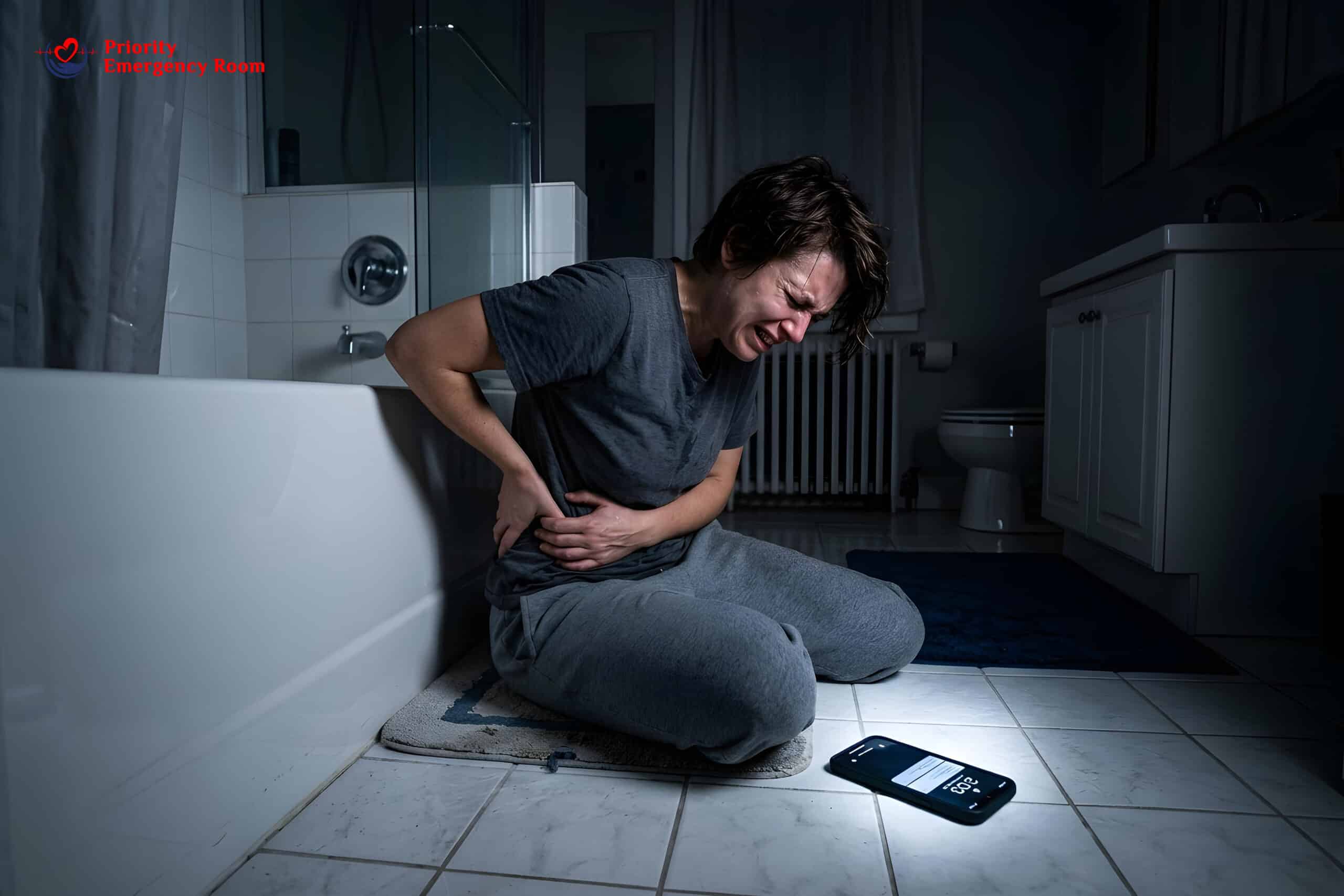
You know this feeling. That sudden, searing pain in your back or side that makes you double over. The waves of agony that have you pacing the floor because sitting still is impossible. You’re already searching “kidney stone ER” while fighting through the worst pain of your life.
Stop. Before you try to tough it out or head to the wrong place, you need to know something that could change everything about the next few hours.
Here’s what most people don’t realize: Urgent care clinics can’t provide the IV pain medication, CT imaging, or comprehensive lab work that kidney stones often require. When kidney stone pain becomes unbearable, when fever appears, or when you can’t urinate—you need a real ER, not urgent care.
Urgent Care vs. ER: What’s the Actual Difference?
This isn’t about what sign is on the building. It’s about what’s inside the building—and whether they can actually help you at 2 AM when kidney stone pain strikes.
Emergency physicians use a rapid assessment approach to evaluate kidney stone severity. You can use the same approach at home.
P — Pain Level: Is your pain manageable with over-the-counter medication? Can you find any comfortable position? Warning signs: pain so severe you can’t sit still, pain radiating to groin, pain causing vomiting.
U — Urinary Symptoms: Are you able to urinate normally? Is urine color relatively normal? Warning signs: inability to urinate, heavy blood making urine red or brown, severe burning with urination.
S — Systemic Signs: Is your temperature normal? Are you keeping fluids down? Warning signs: fever over 101°F, shaking chills, persistent vomiting, confusion or weakness.
If all three look manageable, your kidney stone may be appropriate for urgent care or home management. If any one of these looks concerning, seek emergency care immediately.
Many clinics advertise “24 hours” or “extended hours” but actually close at 9 or 10 PM. Before you drive across town at 2 AM, verify they’re actually open. Every Priority ER location is truly open 24 hours a day, 365 days a year—including Christmas, Thanksgiving, and every other night when kidney stones decide to strike.
When Urgent Care is Totally Fine
Not every kidney stone requires the ER. Urgent care clinics exist for a reason, and they can handle many kidney stone situations without the full power of an emergency room. Save yourself time and money when the situation calls for it.
Kidney Stone Situations Appropriate for Urgent Care
Stable vital signs • No fever • Able to keep fluids down
The key word is manageable. When symptoms are tolerable and you’re able to stay hydrated and urinate—urgent care or your doctor can help. But when things escalate, when your instincts say this is different, that’s when you need emergency-level care.
When You Need the Kidney Stone ER Right Now
People who’ve had kidney stones know. There’s a difference between “uncomfortable” and “something’s really wrong.” Trust that instinct. Here’s what our emergency care team says warrants immediate ER care:
Emergency
Severe, Uncontrollable Pain
Pain so intense you can’t sit still, can’t find relief in any position, or that causes you to vomit from intensity alone.

Emergency
Fever Over 101°F
Fever with kidney stone pain signals possible infection. Combined with chills or shaking, this can indicate sepsis—a life-threatening emergency.
Emergency
Inability to Urinate
If you haven’t urinated in several hours despite drinking fluids, a stone may be completely blocking your urinary tract. This requires immediate intervention.
Emergency
Heavy Blood in Urine
While some blood is common with kidney stones, urine that is bright red, contains clots, or looks like cola indicates significant bleeding requiring evaluation.
Trust Your Instincts
If something feels really wrong—even if you can’t explain why—go to the ER. You know your body better than anyone. That gut feeling exists for a reason.
Built for Reliability When It Matters Most
When kidney stone pain strikes at 2 AM, you need certainty—not “maybe” or “we’ll see.” Here’s what makes Priority ER different:
The Difference at 2 AM
Hospital ER
3+ hours
Average wait in Texas
Priority ER
Minutes
Straight to a room
CT Scans
On-site, results in minutes
Full Lab
No waiting for off-site results
Real ER
Board-certified ER physicians
Same capabilities as a hospital ER.
Without the chaos.
What to Expect When You Arrive
Knowing what happens next can help you feel calmer despite the pain. Here’s how a Priority ER kidney stone visit typically unfolds:
Your Priority ER Visit
From arrival to answers
0-2 minutes
2-5 minutes
5-15 minutes
15-30 minutes
30-60 minutes
Immediate Greeting (0-2 min)
You’re greeted the moment you walk in. No clipboard, no waiting for someone to notice you’re in pain.
Private Room (2-5 min)
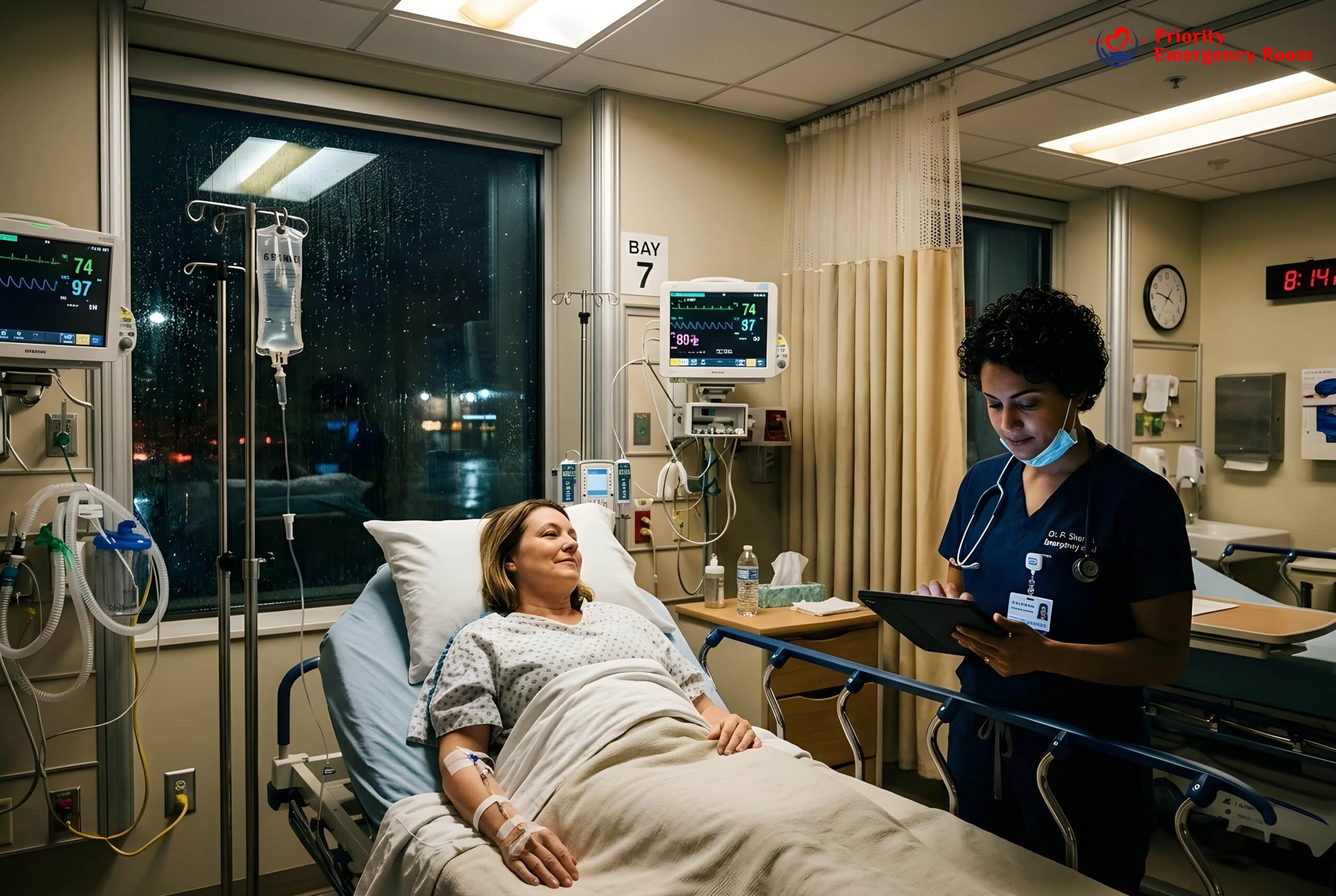
You go straight to a private treatment room. No suffering in a crowded waiting area.
Pain Control Started (5-15 min)
IV pain medication begins—typically ketorolac (Toradol) and other medications that actually work for kidney stone pain.
CT Scan & Labs (15-30 min)
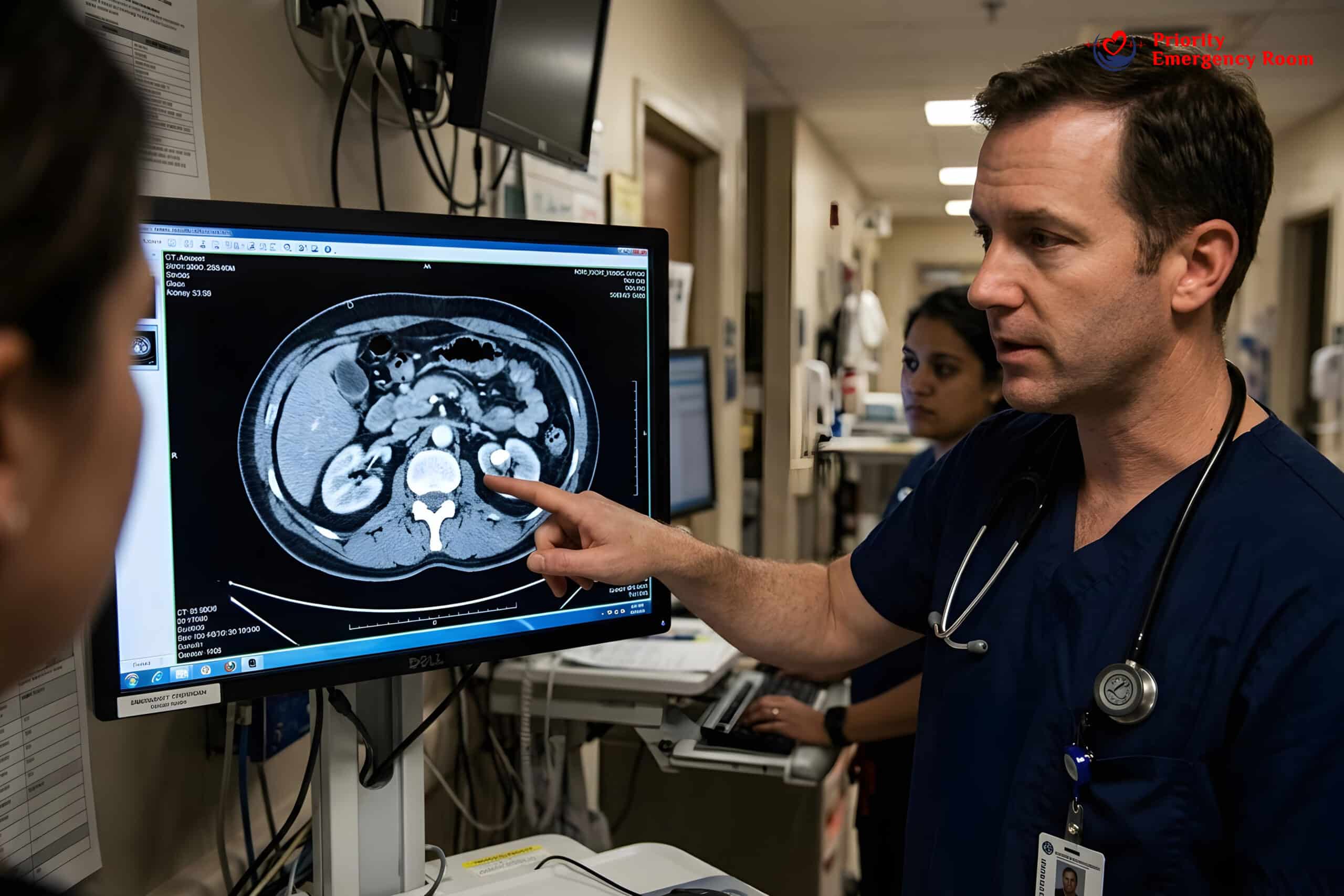
On-site CT scan locates your stone, measures its size, and identifies any blockage. Labs check kidney function and infection markers.
Diagnosis & Treatment Plan (30-60 min)
Your doctor explains your results, provides treatment, and creates a plan—whether that’s passing the stone at home or urology referral.
Compare that to a typical hospital ER: wait for triage, wait for a room, wait for pain medication, wait for CT results, wait for lab results… You could spend 4-6 hours in agony for the same care that takes under an hour at Priority ER.²
When Kidney Stones Need Emergency Care
Board-certified emergency physicians. On-site CT scans. IV pain management. Full lab on-site. Zero wait time. This is what real kidney stone emergency care looks like.
Priority ER Locations
All locations are equipped with CT imaging, full laboratory services, and staffed by board-certified emergency physicians ready to treat kidney stone emergencies.
🌵 Odessa (West Texas)
3800 E 42nd St, Suite 105
Odessa, TX 79762
Serving Odessa, Midland, Gardendale, Greenwood & the Permian Basin
🏛 Round Rock (Austin Area)
1700 Round Rock Ave
Round Rock, TX 78681
Serving Round Rock, Cedar Park, Pflugerville, Georgetown & North Austin
⭐ McKinney (North Dallas)
5000 Eldorado Pkwy
McKinney, TX 75072
Serving McKinney, Frisco, Allen, Prosper & Collin County
🏙 Pantego (Arlington)
1607 S Bowen Rd
Pantego, TX 76013
Serving Arlington, Pantego, Grand Prairie & Mid-Cities DFW
🌊 Rockwall (East Dallas)
2265 N Lakeshore Dr #100
Rockwall, TX 75087
Serving Rockwall, Heath, Rowlett, Fate & Lake Ray Hubbard area
The Bottom Line on Kidney Stone ER Visits
When you’re searching “kidney stone ER” while doubled over in pain, you’re scared and you need help fast. The last thing you need is to go somewhere that can’t actually help—or worse, that closed two hours ago.
Know the difference: urgent care handles manageable kidney stone pain. Emergency rooms handle the serious stuff—the severe pain, the fevers, the blocked urinary tracts. And Priority ER gives you full emergency room capabilities—on-site CT scans, complete lab work, IV pain management—without the chaos and wait times of a hospital ER.
When your body tells you something’s really wrong, trust it. And come to a place that can actually help.
Medical References
- American Urological Association. (2024). “Medical Management of Kidney Stones: AUA Guideline.” Journal of Urology. Retrieved from https://www.auanet.org/
- American College of Emergency Physicians. (2024). “Clinical Policy: Critical Issues in the Evaluation and Management of Adult Patients Presenting to the Emergency Department with Suspected Renal Colic.” ACEP Clinical Policies. Retrieved from https://www.acep.org/
- National Institute of Diabetes and Digestive and Kidney Diseases. (2024). “Kidney Stones.” NIDDK Health Information. Retrieved from https://www.niddk.nih.gov/
- American College of Radiology. (2024). “ACR Appropriateness Criteria: Acute Onset Flank Pain—Suspicion of Stone Disease.” ACR Guidelines. Retrieved from https://www.acr.org/
- Priority ER Internal Data. (2024). “Annual Emergency Department Statistics: Kidney Stone Presentations.” Quality Assurance Report.
- European Association of Urology. (2024). “EAU Guidelines on Urolithiasis.” EAU Guidelines. Retrieved from https://uroweb.org/
- Mayo Clinic. (2024). “Kidney Stones: Diagnosis and Treatment.” Mayo Clinic Patient Care. Retrieved from https://www.mayoclinic.org/
- Healthcare Cost and Utilization Project. (2024). “Emergency Department Visits for Kidney Stones.” HCUP Statistical Brief. Retrieved from https://hcup-us.ahrq.gov/
- Texas Department of State Health Services. (2024). “Emergency Department Wait Time Statistics.” Regional Health Report. Retrieved from https://www.dshs.texas.gov/