

Do I Need to Go to the ER for a Kidney Stone? Here’s How to Know.
You know this feeling. That sharp, intense pain in your side or back has you wondering if you need emergency care—or if you’re overreacting. You’re searching “do I need to go to ER for kidney stone” because you want to do the right thing, but you’re not sure what that is.
Stop. You’re not overreacting. Kidney stone pain is real, and sometimes it does need emergency care. Here’s exactly how to decide.
Here’s the quick answer: You need the ER if pain is severe and uncontrollable, if you have fever, if you can’t urinate, or if you can’t keep fluids down. These situations require IV medication, imaging, or both—things only an ER can provide. For milder symptoms, home care may work, but when in doubt, get evaluated. Kidney stones can cause serious complications.
Home Care vs. ER: What’s the Actual Difference?
Many kidney stones pass on their own—but some don’t, and some cause dangerous complications. The question isn’t whether kidney stones ever need the ER; it’s whether YOUR kidney stone needs the ER right now.
Use this quick assessment:
P — Pain Level: Can you manage pain with over-the-counter medication? Can you rest between waves? Go to ER if: pain so severe you can’t sit still, can’t find relief, OTC meds not working.
U — Urinary Function: Are you able to urinate normally? Is there just a little blood? Go to ER if: can’t urinate for several hours, heavy bleeding, clots in urine.
S — Systemic Signs: Is your temperature normal? Keeping fluids down? Go to ER if: fever over 101°F, chills, persistent vomiting, confusion.
If you can say “yes” to manageable pain, normal urination, and no fever—you may be okay at home. If ANY of these concern you, go to the ER. Our 24-hour emergency room is always ready to help.
If something feels really wrong—even if you can’t explain exactly why—go to the ER. You know your body. Kidney stones can cause serious complications including kidney damage and life-threatening infection. It’s always better to be evaluated and reassured than to wait and develop problems.
When Home Care is Totally Fine
Many kidney stones—especially small ones under 5mm—pass on their own within days to weeks. Here’s when you can reasonably try home management.
When You Can Manage at Home
Manageable pain • No fever • Keeping fluids down • Urinating normally
The key word is manageable. When you can control pain, stay hydrated, and urinate normally—home care often works. But the moment things escalate or warning signs appear, don’t hesitate to go to the ER.
When You Need the ER
Some kidney stone situations definitely require emergency care. Here’s when you should go to the ER without hesitation. Our emergency care team says these situations need immediate attention:

Go to ER
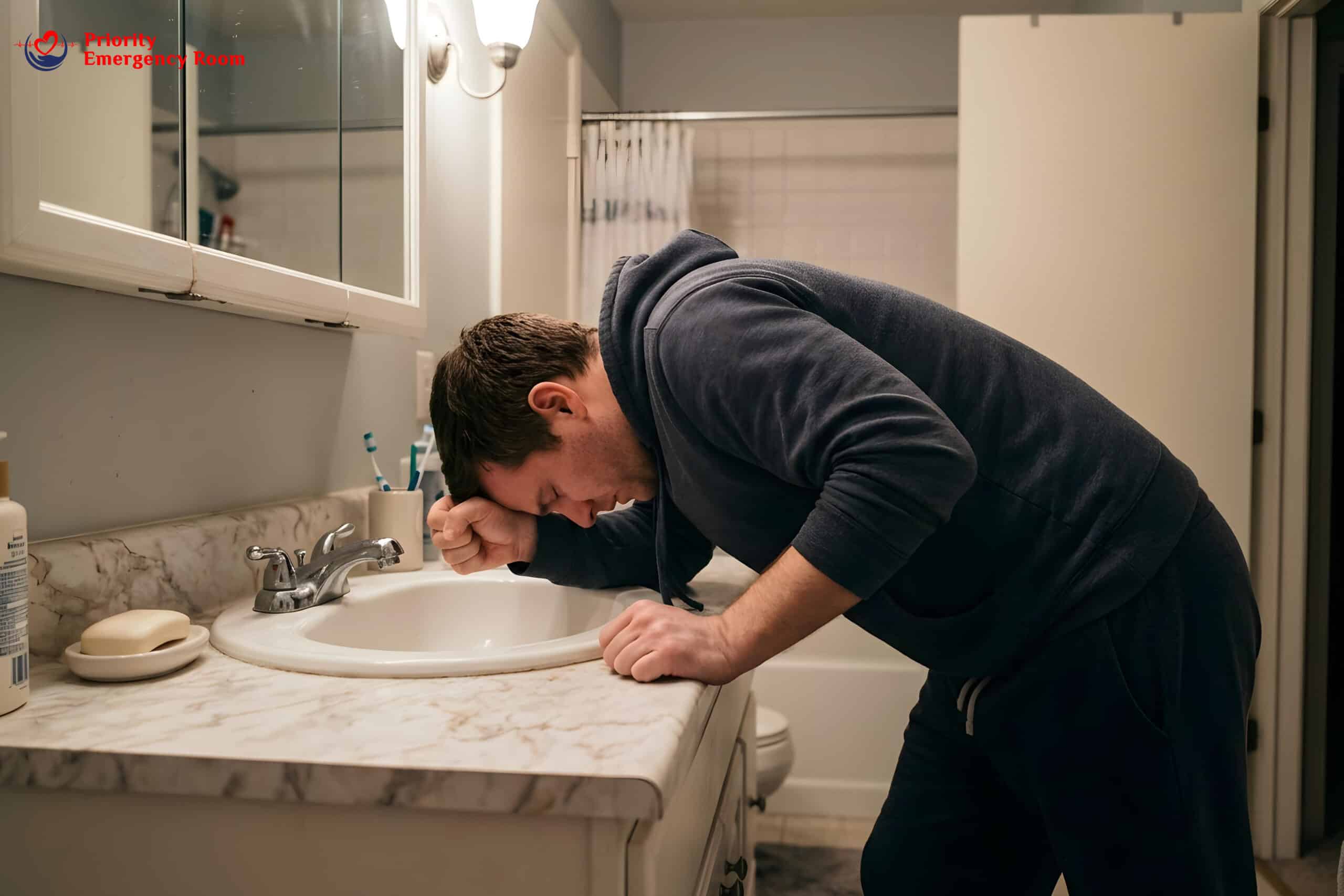
Severe, Uncontrollable Pain
Pain so intense you can’t sit still, can’t find any position of relief, or OTC medications aren’t making a dent. The ER has IV pain meds that actually work.

Go to ER
Fever Over 101°F
Fever with kidney stone pain is a red flag for infection. This can rapidly become life-threatening sepsis requiring IV antibiotics immediately.
Go to ER
Inability to Urinate
If you haven’t urinated in several hours despite drinking fluids, the stone may be completely blocking your urinary tract—risking permanent kidney damage.
Go to ER
Persistent Vomiting
If you can’t keep any fluids or oral medications down, you’ll become dehydrated—making stone passage harder and potentially damaging your kidneys. Learn more about dehydration and vomiting treatment.
When in Doubt, Go
If you’re unsure whether you need the ER, it’s usually better to go. The ER can quickly determine if you’re safe to manage at home or if you need intervention. Don’t suffer at home wondering if you’re making the right call.
Built for Reliability When It Matters Most
When you decide you need the ER for your kidney stone, you need certainty—not “maybe” or “we’ll see.” Here’s what makes Priority ER different:
The Difference at 2 AM
Hospital ER
3+ hours
Average wait in Texas
Priority ER
Minutes
Straight to a room
CT Scans
On-site, results in minutes
IV Pain Meds
Real relief, fast
Real ER
Board-certified ER physicians
Same capabilities as a hospital ER.
Without the chaos.
What to Expect When You Arrive
Knowing what happens can help you feel calmer despite the pain. Here’s how a Priority ER kidney stone visit unfolds:
Your Priority ER Visit
From arrival to answers
0-2 minutes
2-5 minutes
5-15 minutes
15-30 minutes
30-60 minutes
Immediate Greeting (0-2 min)
You’re greeted the moment you walk in. No waiting in pain.
Private Room (2-5 min)
Straight to a private treatment room. No crowded waiting area.
Pain Control Started (5-15 min)
IV pain medication begins—the kind that actually works for kidney stone pain.
CT Scan & Labs (15-30 min)
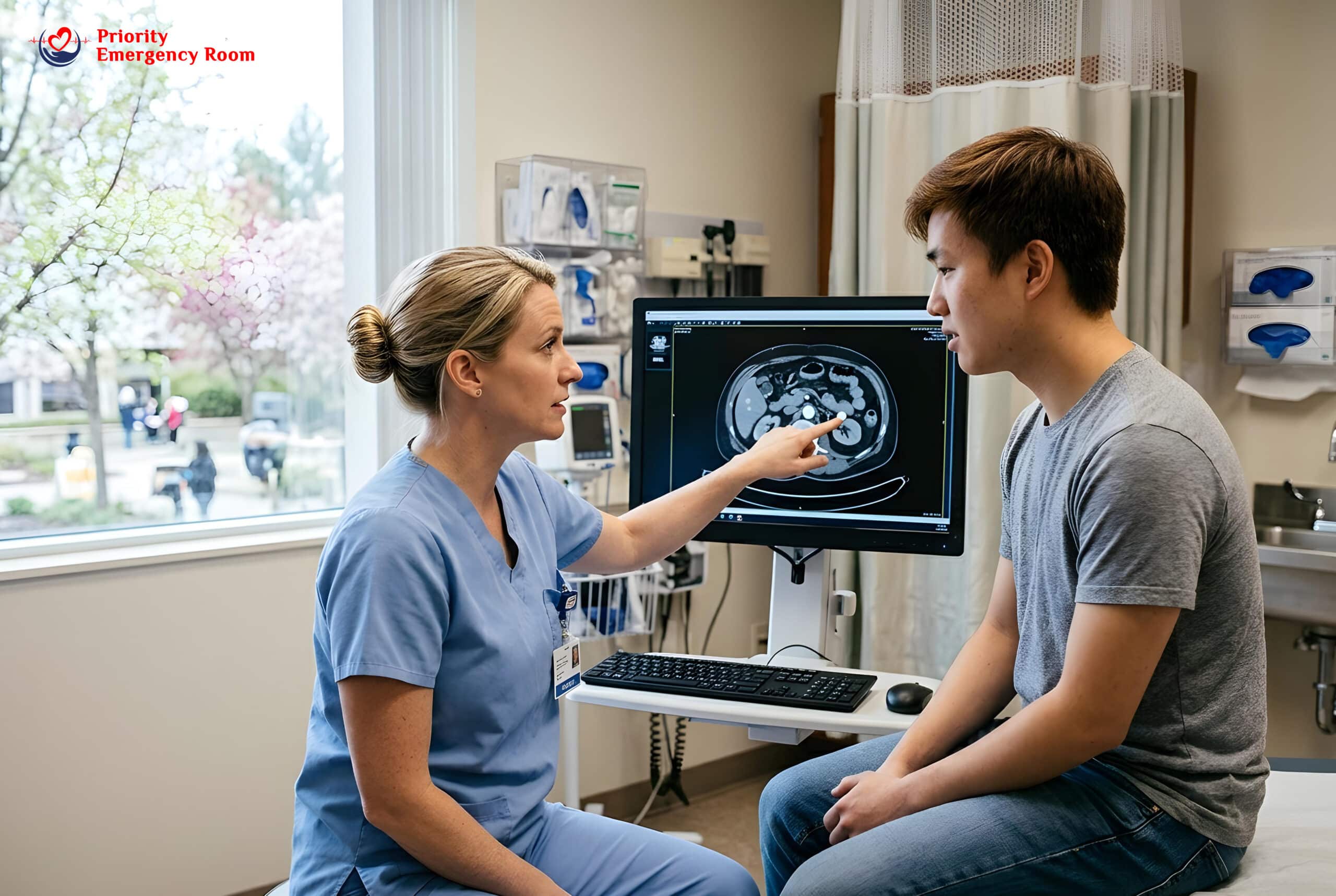
CT scan shows stone size and location. Labs check kidney function and infection.
Diagnosis & Plan (30-60 min)
You know exactly what’s happening and have a treatment plan before you leave.
Compare that to a hospital ER: hours of waiting in agony before seeing a doctor. At Priority ER, you have answers and relief in under an hour.²
When You Decide You Need the ER, We’re Ready
Board-certified emergency physicians. On-site CT scans. IV pain management. Zero wait time. This is what kidney stone emergency care should look like.
Priority ER Locations
All locations have CT imaging, comprehensive metabolic panel testing, and board-certified emergency physicians ready to treat kidney stone emergencies.
🌵 Odessa (West Texas)
3800 E 42nd St, Suite 105
Odessa, TX 79762
Serving Odessa, Midland, Gardendale, Greenwood & the Permian Basin
🏛 Round Rock (Austin Area)
1700 Round Rock Ave
Round Rock, TX 78681
Serving Round Rock, Cedar Park, Pflugerville, Georgetown & North Austin
⭐ McKinney (North Dallas)
5000 Eldorado Pkwy
McKinney, TX 75072
Serving McKinney, Frisco, Allen, Prosper & Collin County
🏙 Pantego (Arlington)
1607 S Bowen Rd
Pantego, TX 76013
Serving Arlington, Pantego, Grand Prairie & Mid-Cities DFW
🌊 Rockwall (East Dallas)
2265 N Lakeshore Dr #100
Rockwall, TX 75087
Serving Rockwall, Heath, Rowlett, Fate & Lake Ray Hubbard area
The Bottom Line: Do You Need the ER?
When you’re searching “do I need to go to ER for kidney stone,” you’re trying to make the right call. Here’s the simple answer: go to the ER if pain is severe, if you have fever, if you can’t urinate, or if you can’t keep fluids down. For milder cases, home care may work—but when in doubt, get evaluated.
Priority ER provides full emergency capabilities—on-site CT scans, blood and urine testing, IV pain medication—without hospital ER wait times.
When you decide you need the ER, we’re ready.
Medical References
- American Urological Association. (2024). “Medical Management of Kidney Stones: AUA Guideline.” Journal of Urology. Retrieved from https://www.auanet.org/
- American College of Emergency Physicians. (2024). “Clinical Policy: Evaluation and Management of Suspected Renal Colic.” ACEP Clinical Policies. Retrieved from https://www.acep.org/
- National Institute of Diabetes and Digestive and Kidney Diseases. (2024). “Kidney Stones.” NIDDK Health Information. Retrieved from https://www.niddk.nih.gov/
- American College of Radiology. (2024). “ACR Appropriateness Criteria: Acute Onset Flank Pain.” ACR Guidelines. Retrieved from https://www.acr.org/
- Priority ER Internal Data. (2024). “Annual Emergency Department Statistics: Kidney Stone Presentations.” Quality Assurance Report.
- European Association of Urology. (2024). “EAU Guidelines on Urolithiasis.” EAU Guidelines. Retrieved from https://uroweb.org/
- Mayo Clinic. (2024). “Kidney Stones: Diagnosis and Treatment.” Mayo Clinic Patient Care. Retrieved from https://www.mayoclinic.org/
- Healthcare Cost and Utilization Project. (2024). “Emergency Department Visits for Kidney Stones.” HCUP Statistical Brief. Retrieved from https://hcup-us.ahrq.gov/
- Texas Department of State Health Services. (2024). “Emergency Department Wait Time Statistics.” Regional Health Report. Retrieved from https://www.dshs.texas.gov/