

Chest Pain at 2 AM. Is This a Heart Attack? Don’t Wait to Find Out.
You know this feeling. That pressure in your chest that woke you from sleep. The tightness that won’t go away. The cold sweat forming on your forehead. You’re already searching “chest pain emergency” while trying to convince yourself it’s probably nothing—just indigestion, stress, maybe you slept wrong.
Stop. Don’t talk yourself out of getting help. This is one situation where being wrong costs you nothing, but being right and waiting could cost you everything.
Here’s what you need to know right now: Chest pain is always treated as an emergency until proven otherwise. Every minute matters when it comes to your heart. The ER has the EKG, blood tests, and imaging to tell you within minutes whether this is a heart attack—and if it is, treatment starts immediately. If you’re having chest pain with any concerning symptoms, call 911 or get to an ER now. Not in an hour. Now.
Urgent Care vs. ER: What’s the Actual Difference?
This isn’t about convenience. It’s about what each facility can actually do—and when it comes to chest pain, that difference can save your life.
Urgent care clinics don’t have EKGs, cardiac monitoring, or the ability to run troponin tests that detect heart attacks. Emergency rooms do. For chest pain, there’s really no question: you need an ER. If you’re wondering whether urgent care can handle chest pain, the answer is that they’ll likely send you to the ER anyway.
Here’s how to quickly assess your chest pain:
P — Pain Character: Does it feel like pressure, squeezing, or tightness? Is it sharp and stabbing, or dull and heavy? Warning signs: pressure, squeezing, elephant-on-chest feeling, burning.
R — Radiating: Does the pain stay in one spot or spread? Warning signs: pain spreading to left arm, jaw, neck, back, or both arms.
A — Associated Symptoms: Is it just chest pain, or are there other symptoms? Warning signs: shortness of breath, sweating, nausea, dizziness, feeling of doom.
If you have ANY of these warning signs, this is a chest pain emergency. Call 911 or get to an ER immediately.
If you think you might be having a heart attack, call 911. Paramedics can begin treatment in the ambulance and alert the ER so they’re ready when you arrive. If someone else can drive you to the nearest ER faster than waiting for an ambulance, that’s okay too—but don’t drive yourself.
When It Might Not Be an Emergency
Not all chest pain is a heart attack. Some chest pain has other causes that, while uncomfortable, aren’t immediately life-threatening. However, the only way to know for sure is through proper medical evaluation.
Chest Pain That May Have Other Causes
Sharp pain • Reproducible with movement • No associated symptoms
The key word is uncertainty. If there’s any doubt in your mind, get evaluated. The tests that rule out a heart attack take minutes, and the peace of mind is priceless.
When Chest Pain Needs the ER Right Now
These are the warning signs that mean you need emergency care immediately. Don’t wait. Don’t second-guess yourself. Here’s what our emergency care team says demands immediate ER care:

Emergency
Pressure, Squeezing, or Tightness
Feels like an elephant sitting on your chest, a tight band around your chest, or someone squeezing your heart. This is the classic heart attack symptom.

Emergency
Pain Spreading to Arm, Jaw, or Back
Chest pain that radiates to your left arm, both arms, jaw, neck, or back is a major warning sign of a heart attack in progress.
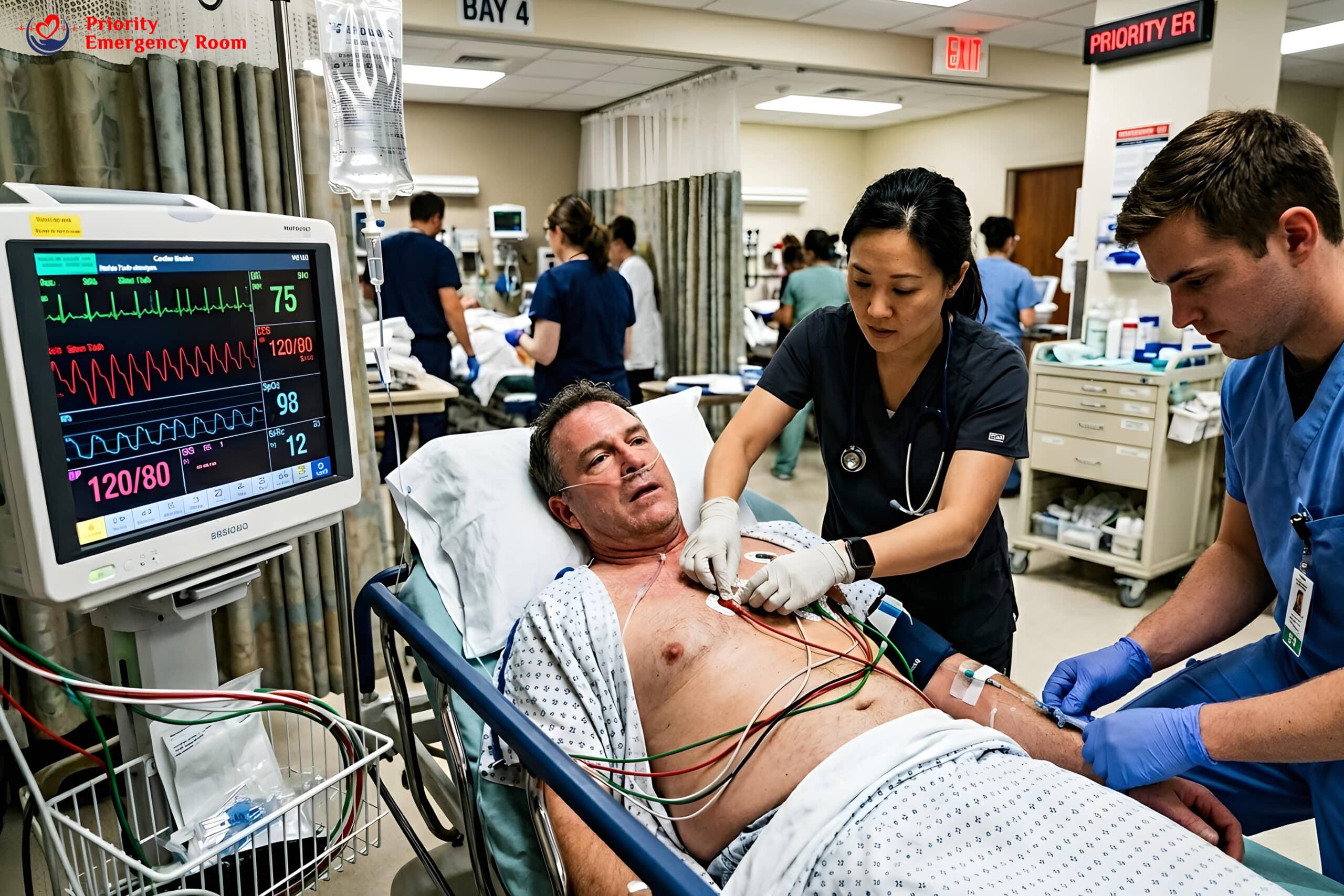
Emergency
Shortness of Breath
Difficulty breathing along with chest pain—whether you’re exerting yourself or at rest—is a critical warning sign requiring immediate evaluation.
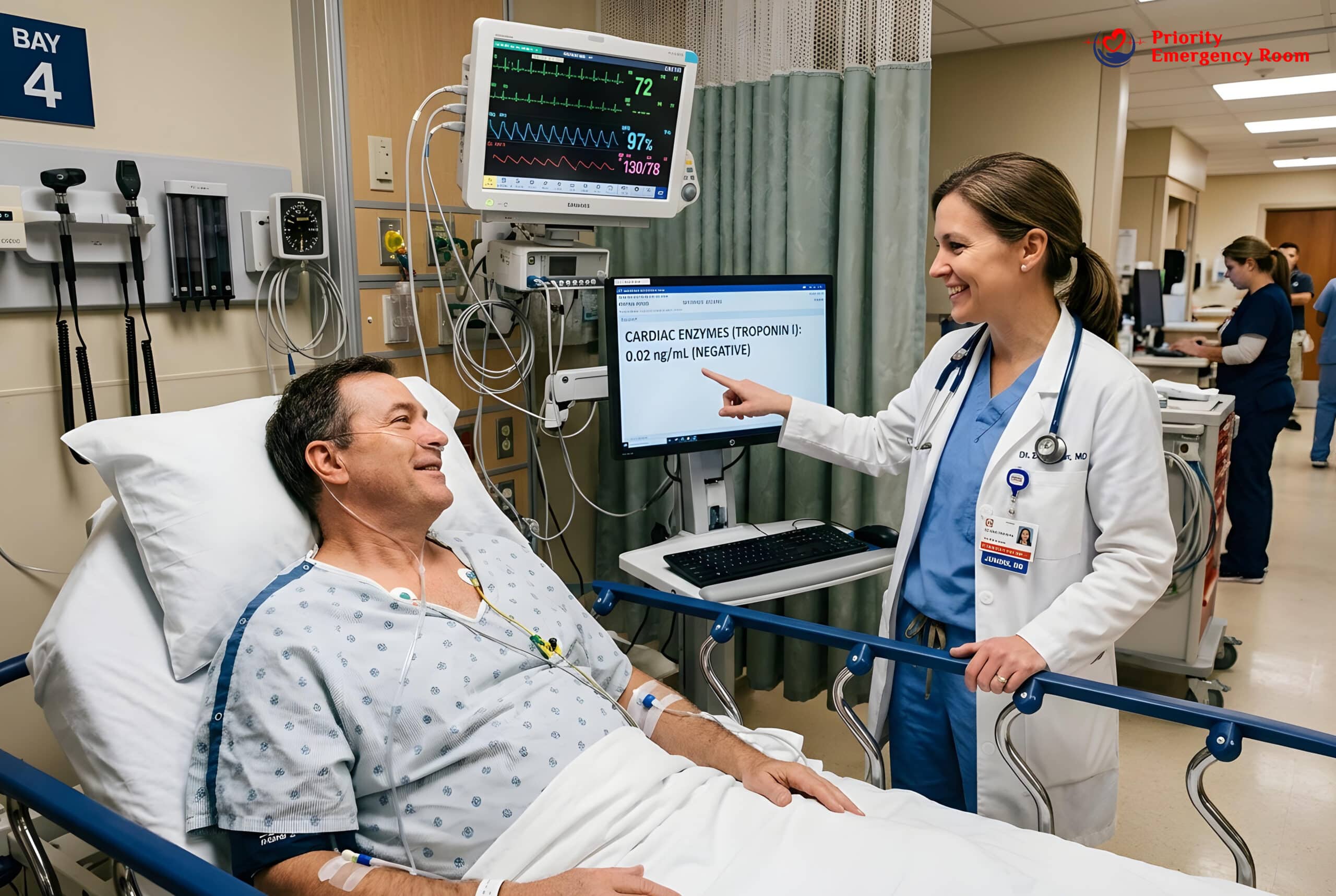
Emergency
Cold Sweats or Clammy Skin
Breaking into a cold sweat for no apparent reason, especially with chest discomfort, is your body’s alarm signal that something is seriously wrong.
When in Doubt, Get Checked Out
Every emergency physician will tell you: they’d rather see 100 patients with chest pain that turns out to be nothing than miss one heart attack. Don’t worry about being embarrassed or wasting anyone’s time. Your life is worth the trip.
Built for Reliability When It Matters Most
When you’re having chest pain, every minute counts. You need certainty—not “maybe” or “we’ll see.” Here’s what makes Priority ER different:
The Difference When Minutes Matter
Hospital ER
3+ hours
Average wait in Texas
Priority ER
Minutes
Straight to a room
Immediate EKG
Results in minutes
Cardiac Labs
Troponin testing on-site
Real ER
Board-certified ER physicians
Same capabilities as a hospital ER.
Without the chaos.
What to Expect When You Arrive
When you arrive at Priority ER with chest pain, you’re our top priority. Here’s how your visit typically unfolds:
Your Priority ER Visit
From arrival to answers
0-2 minutes
2-5 minutes
5-10 minutes
10-15 minutes
30-60 minutes
Immediate Triage (0-2 min)
Chest pain patients are seen immediately. No waiting room. You’re taken straight back for evaluation.
EKG & Monitoring (2-5 min)
An EKG is performed immediately to check your heart rhythm. You’re placed on continuous cardiac monitoring.
Blood Draw & IV (5-10 min)
Blood is drawn for troponin and other cardiac markers. IV access is established for medication if needed.
Physician Evaluation (10-15 min)
The physician performs a complete evaluation, reviews your EKG, and may order additional imaging.
Results & Treatment (30-60 min)
Lab results return, diagnosis is made, and treatment plan is created—whether that’s reassurance, medication, or transfer for intervention.
Compare that to a typical hospital ER where chest pain patients can still wait hours to be seen. At Priority ER, you’re in a treatment room with an EKG within minutes of walking through the door.²
Don’t Wait. Get Evaluated Now.
Board-certified emergency physicians. Immediate EKG. Cardiac enzyme testing. Continuous monitoring. Zero wait time. When your heart is at risk, every minute matters.
Priority ER Locations
All locations are equipped with EKG, cardiac monitoring, troponin testing, and staffed by board-certified emergency physicians ready to evaluate chest pain emergencies.
🌵 Odessa (West Texas)
3800 E 42nd St, Suite 105
Odessa, TX 79762
Serving Odessa, Midland, Gardendale, Greenwood & the Permian Basin
🏛 Round Rock (Austin Area)
1700 Round Rock Ave
Round Rock, TX 78681
Serving Round Rock, Cedar Park, Pflugerville, Georgetown & North Austin
⭐ McKinney (North Dallas)
5000 Eldorado Pkwy
McKinney, TX 75072
Serving McKinney, Frisco, Allen, Prosper & Collin County
🏙 Pantego (Arlington)
1607 S Bowen Rd
Pantego, TX 76013
Serving Arlington, Pantego, Grand Prairie & Mid-Cities DFW
🌊 Rockwall (East Dallas)
2265 N Lakeshore Dr #100
Rockwall, TX 75087
Serving Rockwall, Heath, Rowlett, Fate & Lake Ray Hubbard area
The Bottom Line on Chest Pain Emergencies
When you’re searching “chest pain emergency” at 2 AM, you’re scared—and you should take that fear seriously. Chest pain is one situation where it’s always better to be safe than sorry. The tests that can rule out a heart attack take minutes, and if something is wrong, early treatment saves heart muscle and saves lives.
Don’t talk yourself out of getting help. Don’t wait to see if it gets better. If you’re having chest pain with any concerning symptoms—pressure, radiating pain, shortness of breath, sweating, nausea—get to an emergency room now. Priority ER has the imaging, labs, and cardiac monitoring to evaluate you immediately—without the wait times of a hospital ER.
Your heart is worth the trip. Come in and let us make sure you’re okay.
Medical References
- American Heart Association. (2024). “Warning Signs of a Heart Attack.” AHA Guidelines. Retrieved from https://www.heart.org/
- American College of Emergency Physicians. (2024). “Clinical Policy: Critical Issues in the Evaluation of Adult Patients with Acute Chest Pain.” ACEP Clinical Policies. Retrieved from https://www.acep.org/
- American College of Cardiology. (2024). “Guideline for the Evaluation and Diagnosis of Chest Pain.” ACC/AHA Guidelines. Retrieved from https://www.acc.org/
- National Heart, Lung, and Blood Institute. (2024). “Heart Attack.” NHLBI Health Topics. Retrieved from https://www.nhlbi.nih.gov/
- Priority ER Internal Data. (2024). “Annual Emergency Department Statistics: Chest Pain Presentations.” Quality Assurance Report.
- Society for Cardiovascular Angiography and Interventions. (2024). “Time to Treatment in STEMI.” SCAI Guidelines. Retrieved from https://scai.org/
- Mayo Clinic. (2024). “Chest Pain: Diagnosis and Treatment.” Mayo Clinic Patient Care. Retrieved from https://www.mayoclinic.org/
- Healthcare Cost and Utilization Project. (2024). “Emergency Department Visits for Chest Pain.” HCUP Statistical Brief. Retrieved from https://hcup-us.ahrq.gov/
- Texas Department of State Health Services. (2024). “Cardiovascular Disease Statistics.” Regional Health Report. Retrieved from https://www.dshs.texas.gov/