

Back Pain So Bad You Can’t Move. Here’s What the ER Will Do.
You know this feeling. That back pain that came out of nowhere and now has you frozen—afraid to move, unable to get comfortable, wondering if something is seriously wrong. You’re already searching “what will the ER do for back pain” while trying to find any position that doesn’t make you want to scream.
Stop. Before you try to push through it or wonder if you’re overreacting, you need to know something that could change everything about the next few hours.
Here’s what most people don’t realize: The ER does far more than just give you pain medication and send you home. Emergency rooms have the imaging, labs, and expertise to rule out serious conditions—kidney stones, spinal infections, disc herniations, and nerve compression that can cause permanent damage if not treated quickly. If your back pain comes with red flag symptoms, you need an ER, not a heating pad.
Urgent Care vs. ER: What’s the Actual Difference?
This isn’t about what sign is on the building. It’s about what’s inside the building—and whether they can actually diagnose what’s causing your back pain.
Emergency physicians use a rapid assessment approach to evaluate back pain severity. You can use the same approach at home.
N — Neurological Signs: Do you have normal sensation and strength in your legs? Can you walk normally? Warning signs: numbness, tingling, weakness in legs, difficulty walking, foot drop.
B — Bladder/Bowel Function: Are you urinating and having bowel movements normally? Warning signs: inability to urinate, loss of bowel control, numbness in groin or saddle area.
S — Systemic Symptoms: Is your temperature normal? Is pain localized to your back? Warning signs: fever, unexplained weight loss, pain that wakes you from sleep, history of cancer.
If all three look normal, your back pain may be appropriate for urgent care or home management. If any one of these looks concerning, seek emergency care immediately.
Many clinics advertise “24 hours” or “extended hours” but actually close at 9 or 10 PM. Before you drive across town at 2 AM, verify they’re actually open. Every Priority ER location is truly open 24 hours a day, 365 days a year—including Christmas, Thanksgiving, and every other night when back pain decides to strike.
When Urgent Care is Totally Fine
Not every back pain episode requires the ER. Urgent care clinics exist for a reason, and they can handle many back pain situations without the full power of an emergency room. If you’re wondering whether you can go to urgent care for back pain, here’s when it’s appropriate.
Back Pain Situations Appropriate for Urgent Care
No neurological symptoms • No fever • Normal bladder/bowel function
The key word is uncomplicated. When back pain is muscular, without neurological symptoms, and you can still function—urgent care or your doctor can help. But when red flags appear, when your instincts say this is different, that’s when you need emergency-level care.
When Back Pain Needs the ER Right Now
Some back pain is more than just a pulled muscle. There’s a difference between “sore” and “something’s really wrong.” Trust that instinct. Here’s what our emergency room back pain specialists say warrants immediate ER care:

Emergency
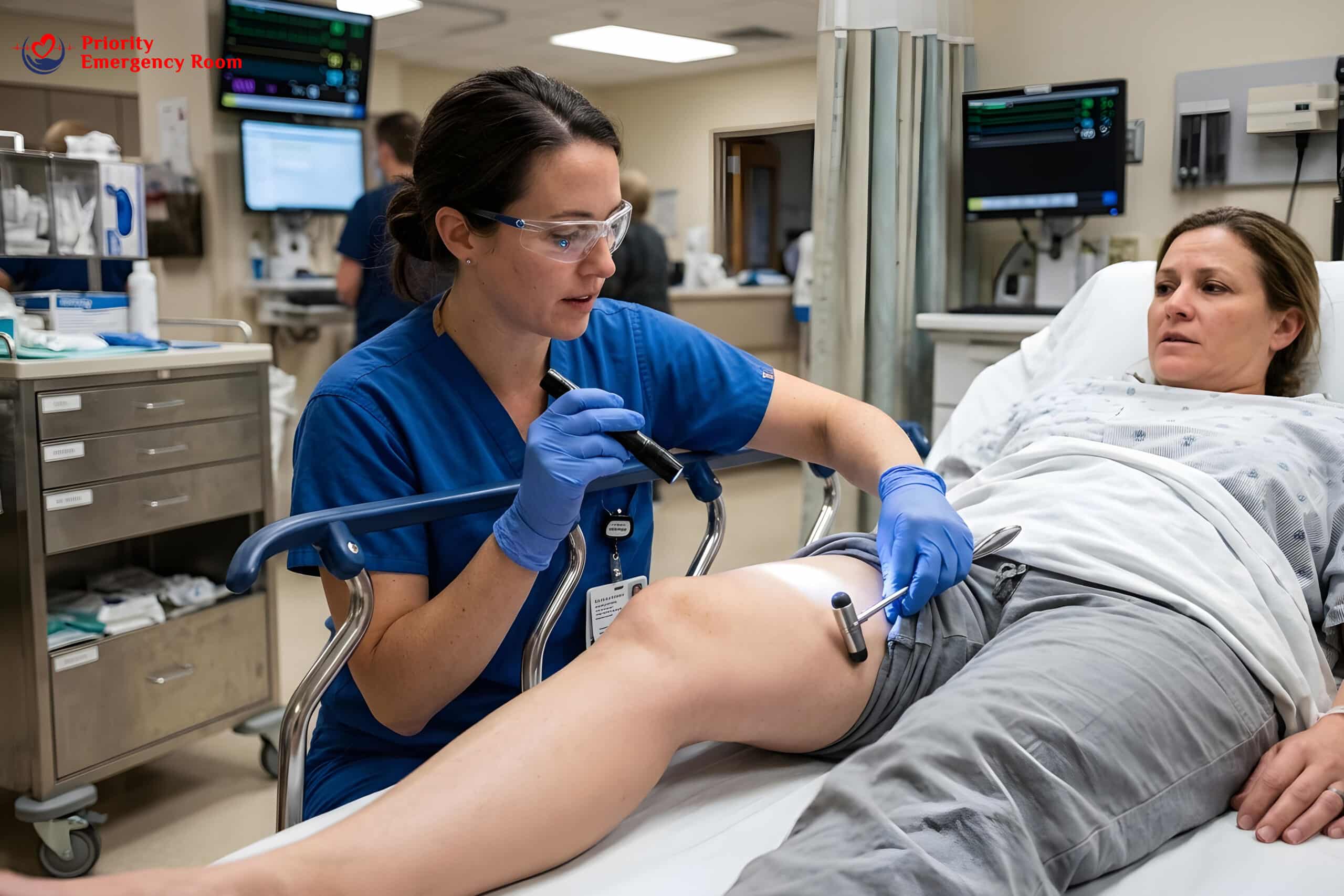
Numbness or Weakness in Legs
New numbness, tingling, or weakness in one or both legs may indicate nerve compression or spinal cord involvement requiring immediate evaluation.
Emergency
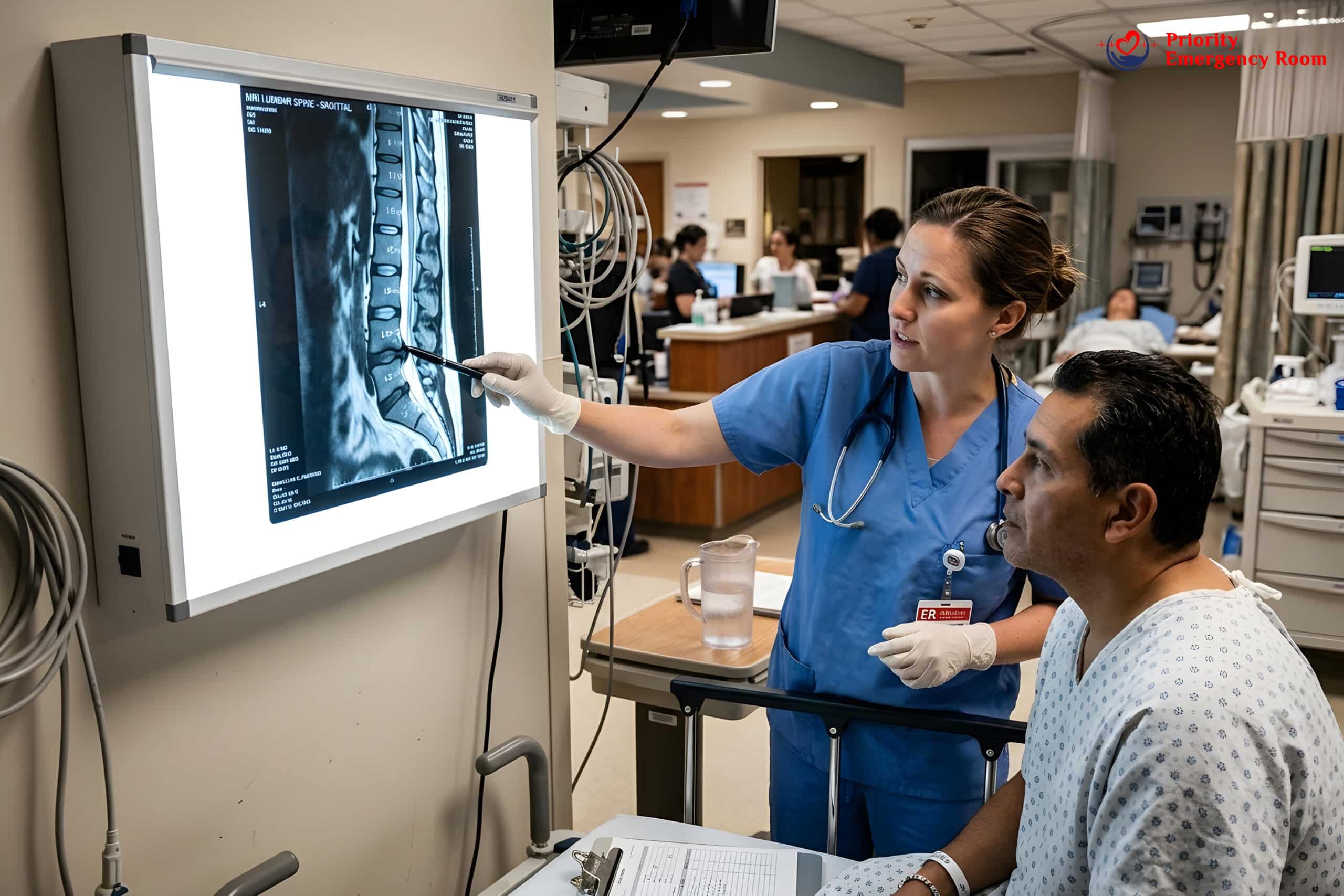
Loss of Bladder or Bowel Control
Inability to urinate, incontinence, or loss of bowel control with back pain is a medical emergency called cauda equina syndrome—requiring surgery within hours.
Emergency
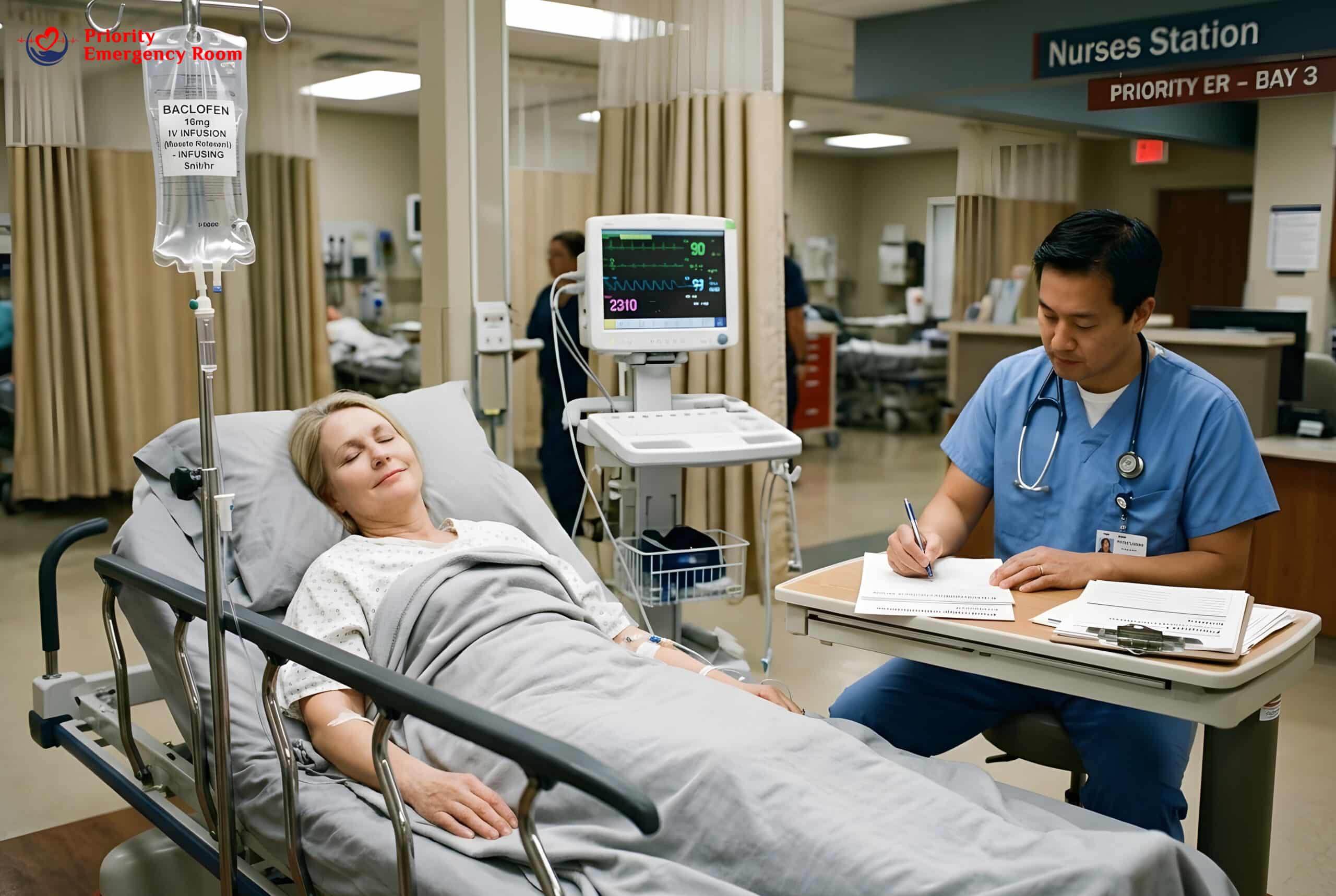
Fever with Back Pain
Fever combined with back pain may indicate a spinal infection (epidural abscess, discitis, or osteomyelitis) requiring IV antibiotics and possible surgery.
Emergency
Pain After Trauma or Fall
Back pain following an accident, fall, or direct injury needs imaging to rule out fractures, especially in older adults or those with osteoporosis.
Trust Your Instincts
If something feels really wrong—even if you can’t explain why—go to the ER. You know your body better than anyone. That gut feeling exists for a reason.
Built for Reliability When It Matters Most
When back pain strikes at 2 AM and you can’t move, you need certainty—not “maybe” or “we’ll see.” Here’s what makes Priority ER different:
The Difference at 2 AM
Hospital ER
3+ hours
Average wait in Texas
Priority ER
Minutes
Straight to a room
CT & X-Ray
On-site, results in minutes
Full Lab
No waiting for off-site results
Real ER
Board-certified ER physicians
Same capabilities as a hospital ER.
Without the chaos.
What to Expect When You Arrive
Knowing what happens next can help you feel calmer despite the pain. Here’s how a Priority ER back pain visit typically unfolds:
Your Priority ER Visit
From arrival to answers
0-2 minutes
2-5 minutes
5-15 minutes
15-30 minutes
30-60 minutes
Immediate Greeting (0-2 min)
You’re greeted the moment you walk in. No clipboard, no waiting for someone to notice you can barely move.
Private Room (2-5 min)
You go straight to a private treatment room where you can lie down comfortably.
Exam & Pain Control (5-15 min)
The physician performs a neurological exam while IV pain medication and muscle relaxants begin working.
Imaging & Labs (15-30 min)
X-rays, CT scan, or labs as needed—all done on-site with fast results to rule out serious conditions.
Diagnosis & Treatment Plan (30-60 min)
Your doctor explains findings, provides treatment, and creates a plan—whether that’s home care instructions or specialist referral.
Compare that to a typical hospital ER: wait for triage, wait for a room, wait for pain medication, wait for imaging, wait for results… You could spend 4-6 hours barely able to stand for the same care that takes under an hour at Priority ER.²
When Back Pain Needs Emergency Care
Board-certified emergency physicians. On-site X-ray and CT. IV pain management. Full lab on-site. Zero wait time. This is what real back pain emergency care looks like.
Priority ER Locations
All locations are equipped with X-ray and CT imaging, full laboratory services, and staffed by board-certified emergency physicians ready to evaluate your back pain. We also treat orthopedic injuries and fractures that may accompany back trauma.
🌵 Odessa (West Texas)
3800 E 42nd St, Suite 105
Odessa, TX 79762
Serving Odessa, Midland, Gardendale, Greenwood & the Permian Basin
🏛 Round Rock (Austin Area)
1700 Round Rock Ave
Round Rock, TX 78681
Serving Round Rock, Cedar Park, Pflugerville, Georgetown & North Austin
⭐ McKinney (North Dallas)
5000 Eldorado Pkwy
McKinney, TX 75072
Serving McKinney, Frisco, Allen, Prosper & Collin County
🏙 Pantego (Arlington)
1607 S Bowen Rd
Pantego, TX 76013
Serving Arlington, Pantego, Grand Prairie & Mid-Cities DFW
🌊 Rockwall (East Dallas)
2265 N Lakeshore Dr #100
Rockwall, TX 75087
Serving Rockwall, Heath, Rowlett, Fate & Lake Ray Hubbard area
The Bottom Line on ER Care for Back Pain
When you’re searching “what will the ER do for back pain” while barely able to move, you need real answers. The ER can provide IV pain relief, imaging to identify the cause, and evaluation for serious conditions that urgent care simply can’t handle.
Know the difference: simple muscle strains can wait for urgent care. But numbness, weakness, bladder problems, fever, or immobilizing pain mean you need an ER—now. And Priority ER gives you full emergency room capabilities—on-site imaging, complete lab work, IV pain management—without the chaos and wait times of a hospital ER.
When your back pain tells you something’s really wrong, trust it. And come to a place that can actually help.
Medical References
- American College of Emergency Physicians. (2024). “Clinical Policy: Critical Issues in the Evaluation and Management of Adult Patients Presenting to the Emergency Department with Nontraumatic Acute Abdominal Pain.” ACEP Clinical Policies. Retrieved from https://www.acep.org/
- American Academy of Orthopaedic Surgeons. (2024). “Low Back Pain.” OrthoInfo Patient Education. Retrieved from https://orthoinfo.aaos.org/
- North American Spine Society. (2024). “Evidence-Based Clinical Guidelines for Multidisciplinary Spine Care: Diagnosis and Treatment of Low Back Pain.” NASS Guidelines. Retrieved from https://www.spine.org/
- American College of Radiology. (2024). “ACR Appropriateness Criteria: Low Back Pain.” ACR Guidelines. Retrieved from https://www.acr.org/
- Priority ER Internal Data. (2024). “Annual Emergency Department Statistics: Back Pain Presentations.” Quality Assurance Report.
- National Institute of Neurological Disorders and Stroke. (2024). “Low Back Pain Fact Sheet.” NINDS Health Information. Retrieved from https://www.ninds.nih.gov/
- Mayo Clinic. (2024). “Back Pain: Diagnosis and Treatment.” Mayo Clinic Patient Care. Retrieved from https://www.mayoclinic.org/
- Healthcare Cost and Utilization Project. (2024). “Emergency Department Visits for Back Pain.” HCUP Statistical Brief. Retrieved from https://hcup-us.ahrq.gov/
- Texas Department of State Health Services. (2024). “Emergency Department Wait Time Statistics.” Regional Health Report. Retrieved from https://www.dshs.texas.gov/