

Can Urgent Care Detect Kidney Stones? Here’s the Honest Answer.
You know this feeling. That severe pain in your back or side has you desperately searching for answers. You’re wondering “can urgent care detect kidney stones” because you want to get diagnosed without the expense and hassle of an emergency room—if possible.
Stop. Before you spend time and money at the wrong place, you need to understand what urgent care can actually do for kidney stones—and what they can’t.
Here’s the honest answer: Most urgent care clinics cannot definitively diagnose kidney stones. They don’t have CT scanners—the gold standard for detecting stones. They can do a urinalysis (which may show blood suggesting a stone), but they can’t tell you where the stone is, how big it is, or if it’s causing dangerous blockage. For accurate kidney stone diagnosis, you need an ER with CT imaging capabilities.
Urgent Care vs. ER: What’s the Actual Difference?
This matters more for kidney stones than almost any other condition. The key difference: imaging capabilities. Understanding the clinic vs urgent care distinction is essential when deciding where to go.
What Urgent Care Can Do:
- Urinalysis (urine test) to check for blood—which suggests a stone but doesn’t confirm it
- Basic physical exam
- Oral pain medication prescriptions
- Referral to an ER or urologist if needed
What Urgent Care Usually Cannot Do:
- CT scan (the definitive test for kidney stones)
- IV pain medication
- IV fluids for dehydration
- Determine stone size, location, or if there’s blockage
- Rule out dangerous complications
The bottom line: urgent care can suspect you have a kidney stone, but they usually can’t confirm it or tell you anything about the stone itself.
Knowing your stone’s size and location changes everything about your treatment. Stones under 5mm usually pass on their own. Stones over 7mm often need intervention. Stones blocking your ureter can cause kidney damage. Without a CT scan, you’re flying blind—and urgent care typically can’t provide this critical information.
When Urgent Care Might Work
To be fair, there are some limited situations where urgent care might be an acceptable first step for suspected kidney stones. Here’s when it might make sense:
When Urgent Care Might Be Acceptable
Very mild symptoms • Known stone history • Primarily seeking a referral
The reality: most people searching about kidney stones are in significant pain and want answers now. For that, you need an ER with CT capabilities.
When You Need the ER Instead
For most kidney stone situations, the ER is the right choice. Here’s when you should skip urgent care entirely and go straight to an ER. Our emergency care team recommends the ER when:
Go to ER
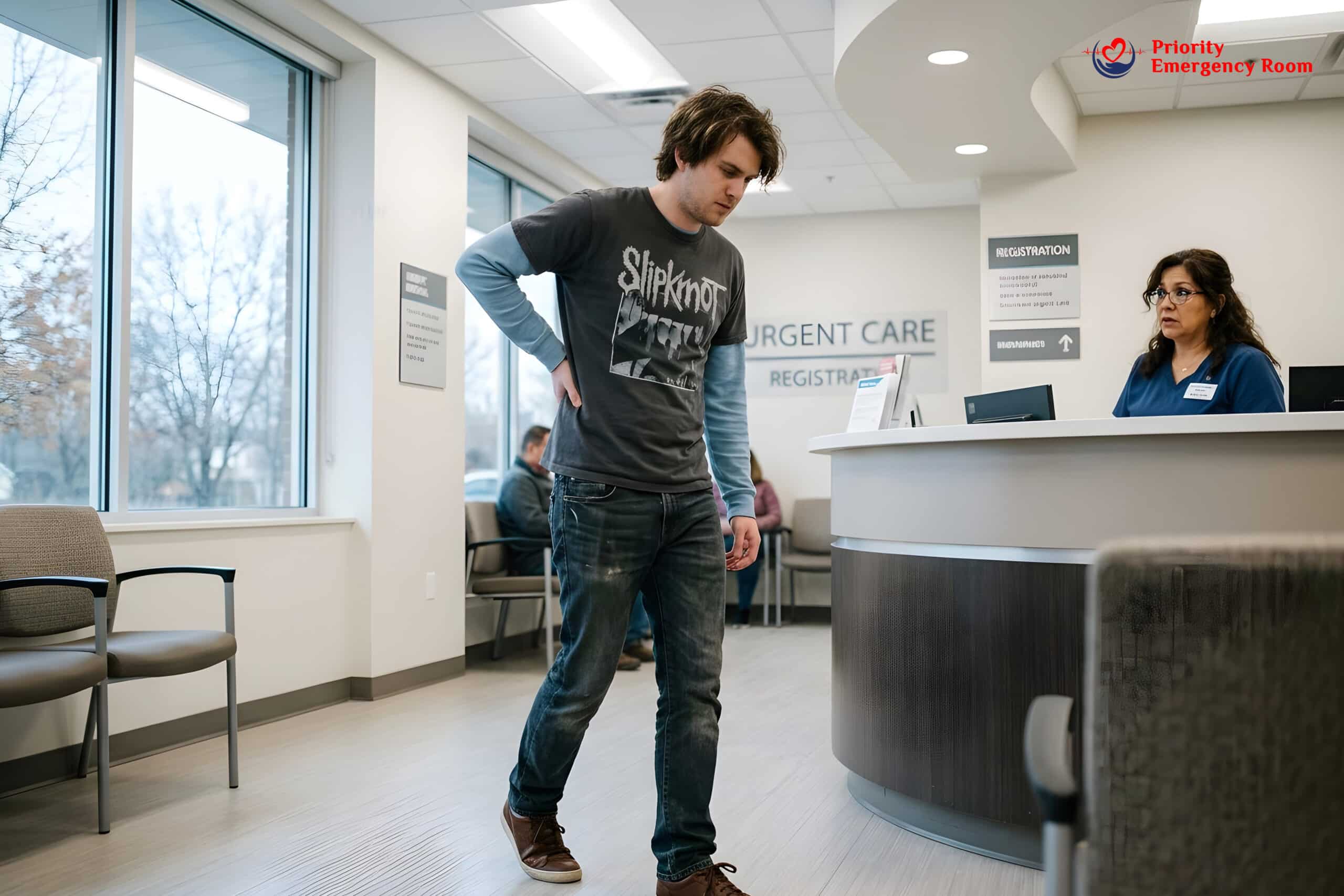
You Want a Definitive Diagnosis
If you want to know for sure whether you have a kidney stone—and how big it is and where it is—you need a CT scan. Urgent care can’t provide this.

Go to ER
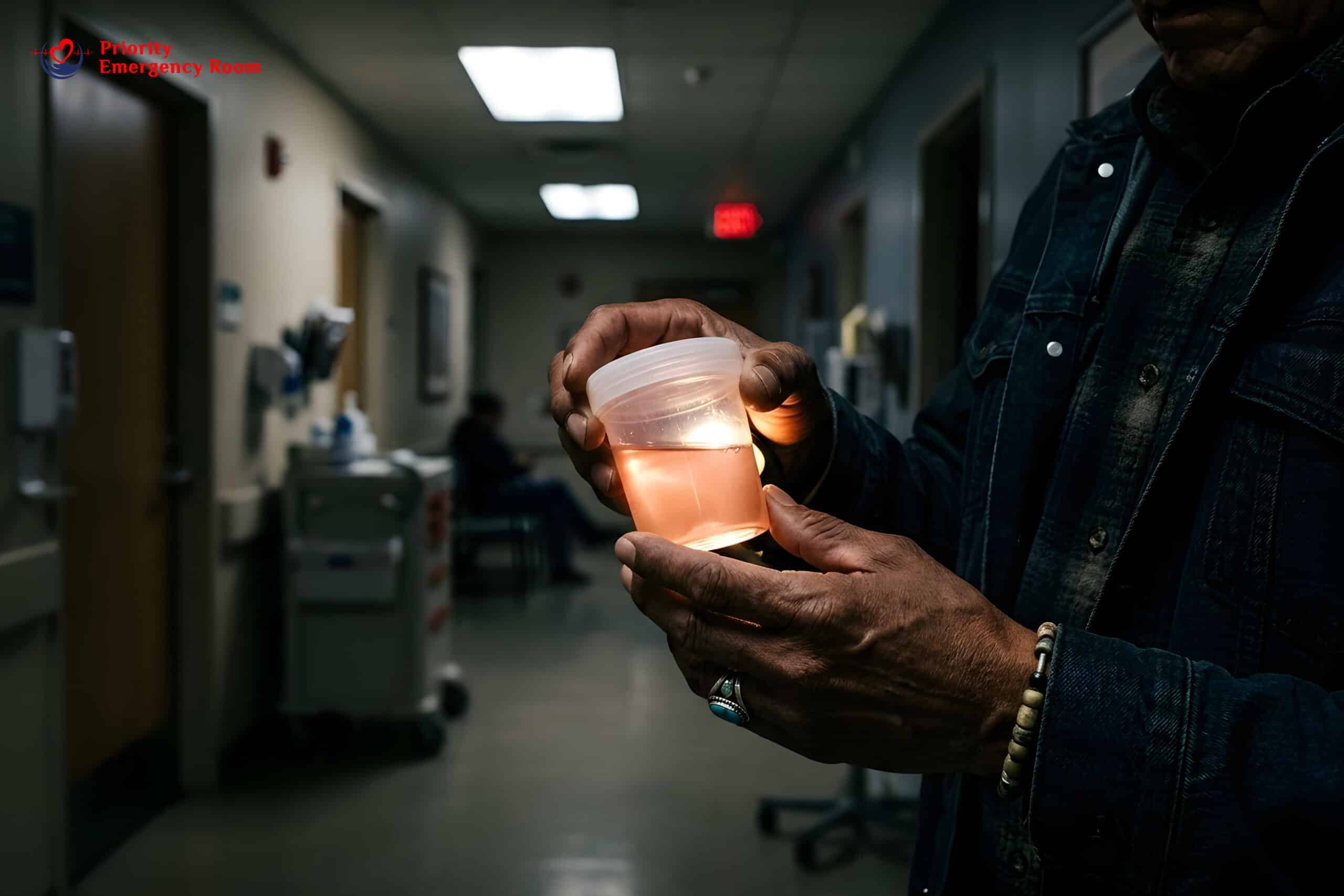
Your Pain is Severe
If OTC medications aren’t controlling your pain, you need IV pain medication. Urgent care can only prescribe oral meds—the ER can start IV relief immediately.
Go to ER
You Have Fever
Fever with kidney stone symptoms indicates possible infection—potentially life-threatening. This requires immediate ER evaluation and IV antibiotics, not urgent care.
Go to ER
You Can’t Urinate
Inability to urinate suggests complete blockage—which can permanently damage your kidney. Urgent care can’t evaluate or treat this. Go to the ER immediately.
The Real Question
Ask yourself: Do I want to maybe find out I have a kidney stone (urgent care), or do I want to definitely know, see exactly what’s going on, and get real pain relief (ER)? For most people, the answer is clear.
What Priority ER Can Do That Urgent Care Can’t
When you need a real diagnosis—not just a guess—here’s what Priority ER provides:
The Difference at 2 AM
Urgent Care
No CT
Can’t confirm diagnosis
Priority ER
Full CT
Definitive answers
CT Scans
See stone size & location
IV Pain Meds
Real relief, fast
24/7 Access
Open when urgent care isn’t
The diagnosis you need.
The relief you deserve.
What to Expect When You Arrive
Here’s how a Priority ER kidney stone visit typically unfolds:
Your Priority ER Visit
From arrival to definitive answers
0-2 minutes
2-5 minutes
5-15 minutes
15-30 minutes
30-60 minutes
Immediate Greeting (0-2 min)
You’re greeted the moment you walk in. No waiting room delays.
Private Room (2-5 min)
You go straight to a private treatment room.
Pain Control Started (5-15 min)
IV pain medication begins—the kind that actually works for kidney stone pain.
CT Scan & Labs (15-30 min)
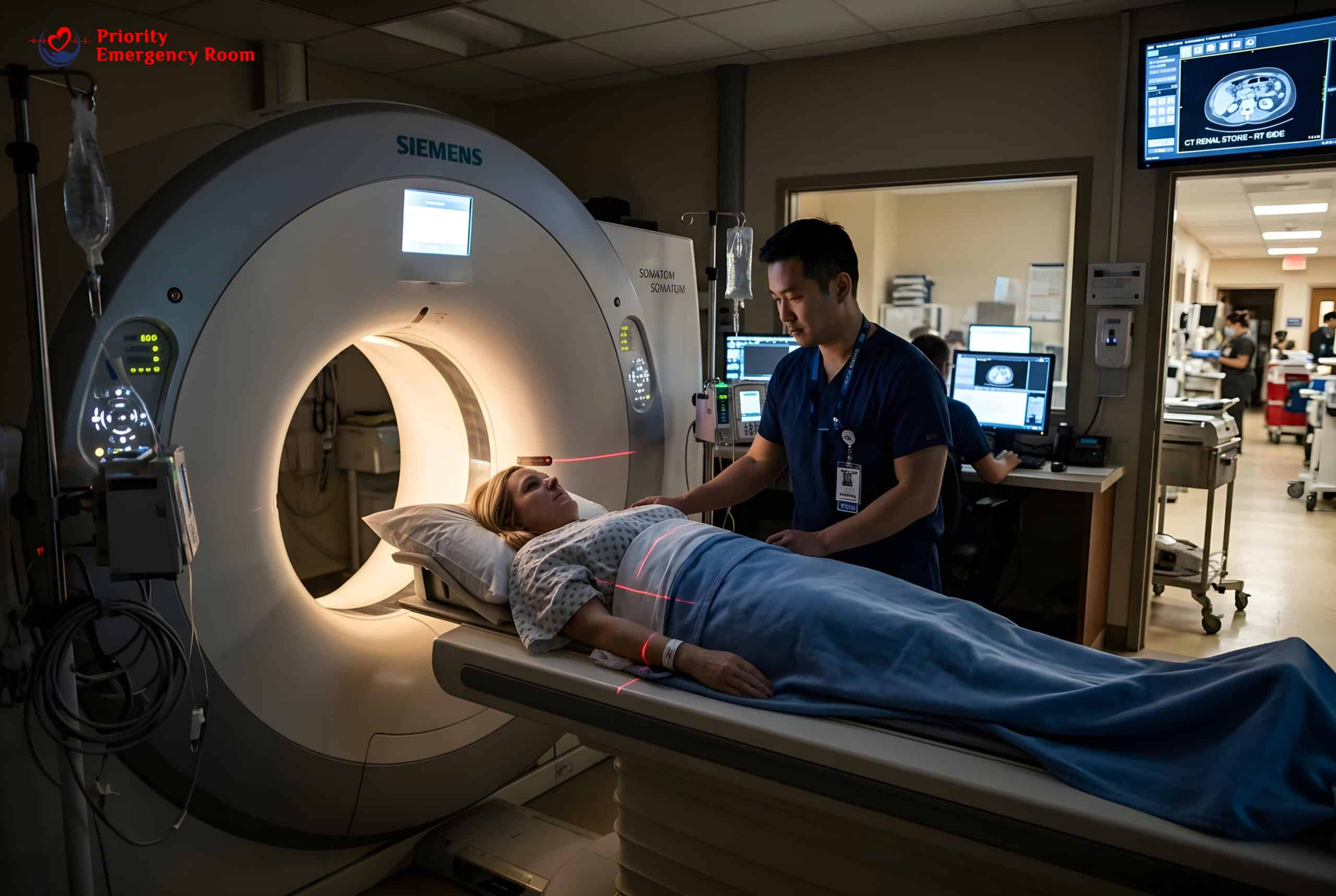
On-site CT scan shows exactly what’s going on. Labs check kidney function and infection.
Definitive Diagnosis (30-60 min)
You know exactly what’s happening: stone size, location, and your treatment plan.
Compare that to urgent care: they’ll examine you, do a urine test, maybe prescribe pills, and tell you to follow up for imaging later. You’ll leave without real answers. At Priority ER, you leave with definitive diagnosis and real relief.²
Get Real Answers, Not Guesswork
On-site CT scans. IV pain medication. Complete labs. Definitive diagnosis. This is what urgent care can’t do—and what Priority ER does every day.
Priority ER Locations
All locations have on-site CT scanners, complete lab services, and board-certified emergency physicians—everything urgent care lacks for kidney stone diagnosis. Find the 24-hour ER near you.
🌵 Odessa (West Texas)
3800 E 42nd St, Suite 105
Odessa, TX 79762
Serving Odessa, Midland, Gardendale, Greenwood & the Permian Basin
🏛 Round Rock (Austin Area)
1700 Round Rock Ave
Round Rock, TX 78681
Serving Round Rock, Cedar Park, Pflugerville, Georgetown & North Austin
⭐ McKinney (North Dallas)
5000 Eldorado Pkwy
McKinney, TX 75072
Serving McKinney, Frisco, Allen, Prosper & Collin County
🏙 Pantego (Arlington)
1607 S Bowen Rd
Pantego, TX 76013
Serving Arlington, Pantego, Grand Prairie & Mid-Cities DFW
🌊 Rockwall (East Dallas)
2265 N Lakeshore Dr #100
Rockwall, TX 75087
Serving Rockwall, Heath, Rowlett, Fate & Lake Ray Hubbard area
The Bottom Line: Urgent Care vs. ER for Kidney Stones
When you’re searching “can urgent care detect kidney stones,” here’s the honest answer: usually not definitively. Urgent care lacks CT scanning—the gold standard for kidney stone diagnosis. They can suspect you have a stone based on symptoms and urine tests, but they can’t confirm it, measure it, or locate it.
For most people with suspected kidney stones, an ER is the right choice. Priority ER provides on-site CT imaging, complete lab work, IV pain medication, and definitive diagnosis—all without the long waits of a hospital ER.
If you want real answers and real relief, come to a real ER.
Medical References
- American College of Radiology. (2024). “ACR Appropriateness Criteria: Acute Onset Flank Pain—Suspicion of Stone Disease.” ACR Guidelines. Retrieved from https://www.acr.org/
- American Urological Association. (2024). “Medical Management of Kidney Stones: AUA Guideline.” Journal of Urology. Retrieved from https://www.auanet.org/
- American College of Emergency Physicians. (2024). “Clinical Policy: Evaluation and Management of Suspected Renal Colic.” ACEP Clinical Policies. Retrieved from https://www.acep.org/
- Urgent Care Association. (2024). “Scope of Practice in Urgent Care Medicine.” UCA Guidelines. Retrieved from https://www.ucaoa.org/
- Priority ER Internal Data. (2024). “Annual Emergency Department Statistics: Kidney Stone Presentations.” Quality Assurance Report.
- National Institute of Diabetes and Digestive and Kidney Diseases. (2024). “Kidney Stones.” NIDDK Health Information. Retrieved from https://www.niddk.nih.gov/
- Mayo Clinic. (2024). “Kidney Stones: Diagnosis and Treatment.” Mayo Clinic Patient Care. Retrieved from https://www.mayoclinic.org/
- Radiological Society of North America. (2024). “CT Scan for Kidney Stones.” RSNA Patient Information. Retrieved from https://www.rsna.org/
- Texas Department of State Health Services. (2024). “Emergency and Urgent Care Facility Capabilities.” DSHS Regulations. Retrieved from https://www.dshs.texas.gov/