

High Fever ER: When Your Child’s Fever Needs the Emergency Room
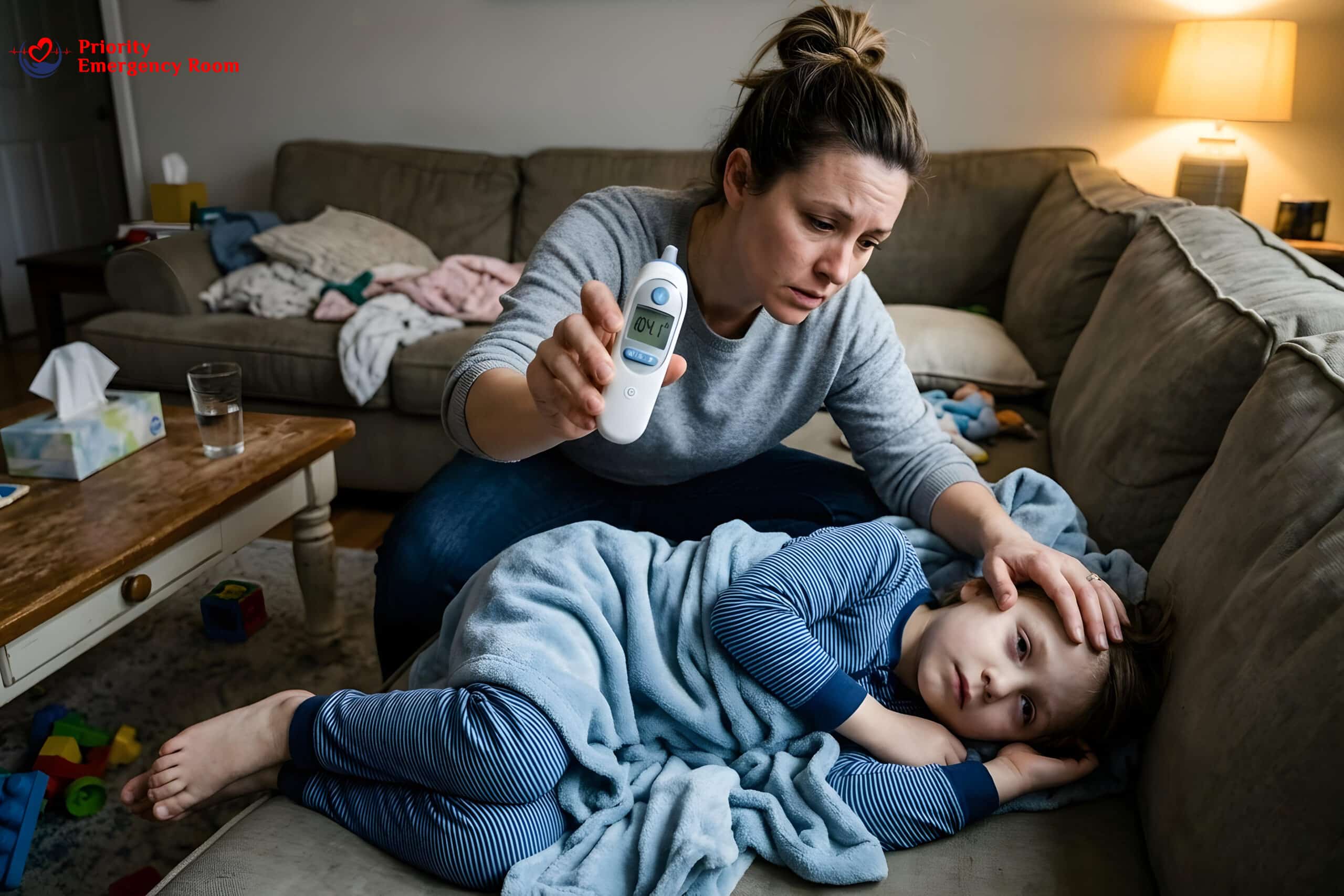
You know this feeling. You put your hand on your kid’s forehead and your stomach drops. The thermometer confirms it: 104.1°F. You gave Tylenol an hour ago. Nothing’s changing. Your child is limp on the couch, barely responding when you say their name. Their eyes look glassy. They won’t drink anything. It’s 2 AM and every pediatrician’s office is closed. You’re searching “high fever ER” because every parenting instinct you have is screaming that something is really wrong.
Stop. Before you spend another 30 minutes watching and rechecking the thermometer, you need to know something that could change everything about the next few hours.
Here’s what most parents don’t realize: The number on the thermometer matters, but it’s not the whole story. What matters more is how your child looks and acts with the fever. A child with 102°F who is alert, drinking fluids, and playing between episodes is usually fine with home care. But a child with 104°F who is limp, unresponsive, won’t drink, has a stiff neck, or has a rash that doesn’t blanch when you press on it—that child may have meningitis, sepsis, or another life-threatening infection. And any fever at all in an infant under 3 months old is a medical emergency. If your child has a high fever and looks seriously ill, you need an ER with complete blood work, IV fluids, IV antibiotics, and physicians who can identify life-threatening infections fast—not an urgent care with a rapid strep test.
Urgent Care vs. ER for High Fever: What’s the Actual Difference?
This isn’t about what sign is on the building. It’s about what’s inside the building—and whether they can figure out what’s causing your child’s fever and treat it before it becomes dangerous.
Emergency physicians use something called the Pediatric Assessment Triangle to evaluate children in under 30 seconds. You can use the same approach at home.
A — Appearance: Is your child alert and responsive? Look for eye contact, normal crying with tears, and good muscle tone. Warning signs: limp or floppy body, won’t make eye contact, unusually quiet or inconsolable.
B — Breathing: Is breathing quiet and effortless? Can they speak in full sentences? Warning signs: visible rib movement with each breath, nasal flaring, grunting sounds, can only speak one or two words at a time.
C — Circulation: Is skin color normal? Are hands and feet warm? Warning signs: pale or gray skin, blue lips or fingertips, blotchy appearance, cold extremities.
If all three look normal, your child is likely stable—even with a fever, a clinic visit may be appropriate. If any one of these looks abnormal alongside a high fever, seek emergency care immediately. A child who looks “toxic”—limp, pale, unresponsive, or inconsolable—needs full emergency evaluation to rule out serious bacterial infections.
Urgent care can check for strep throat and flu with rapid tests. But they cannot run the complete blood count, blood cultures, urinalysis, and inflammatory markers needed to identify bacteremia, meningitis, or sepsis. They cannot provide IV fluids when your child is dehydrated and refusing to drink. They cannot give IV antibiotics for serious bacterial infections. They cannot perform a lumbar puncture if meningitis is suspected. And they often close by 9 or 10 PM—while fevers almost always spike at night. If your child has a high fever and looks seriously sick, urgent care will send you to the ER anyway. Every Priority ER location has complete labs, IV fluids, IV antibiotics, and imaging—truly open 24 hours a day, 365 days a year.
When Urgent Care is Totally Fine
Not every fever is an emergency. Fever is actually the body’s natural defense against infection, and most childhood fevers are caused by common viruses that resolve on their own. Urgent care and clinics can handle many fever situations appropriately.
Conditions Appropriate for Urgent Care / Clinic
Stable vital signs • Alert and responsive • No respiratory distress
The key word is how your child looks. When your child has a fever but is still alert, making eye contact, drinking fluids, and perking up when the fever comes down with Tylenol or Motrin—a clinic or pediatrician visit is usually fine. Many fevers are caused by ear infections, sore throats, or common viruses that don’t need the ER. But when the fever is high and won’t respond to medication, when your child looks limp and glassy-eyed, when there’s a stiff neck, rash, or difficulty breathing—that’s when you need emergency-level evaluation.
When Your Child Needs the ER Right Now
Parents know. There’s a difference between “a little warm” and “something’s really wrong.” Trust that instinct. Here’s what our pediatric emergency team says warrants immediate ER care:
Emergency
High Fever (103°F+)
Especially dangerous in infants under 3 months. Seek ER care if fever comes with stiff neck, severe headache, or rash. We provide febrile seizures treatment.

Emergency
Severe Dehydration
No wet diapers for 8+ hours, no tears when crying, sunken soft spot in infants, or very dry mouth. We offer dehydration treatment with IV fluids.
Emergency
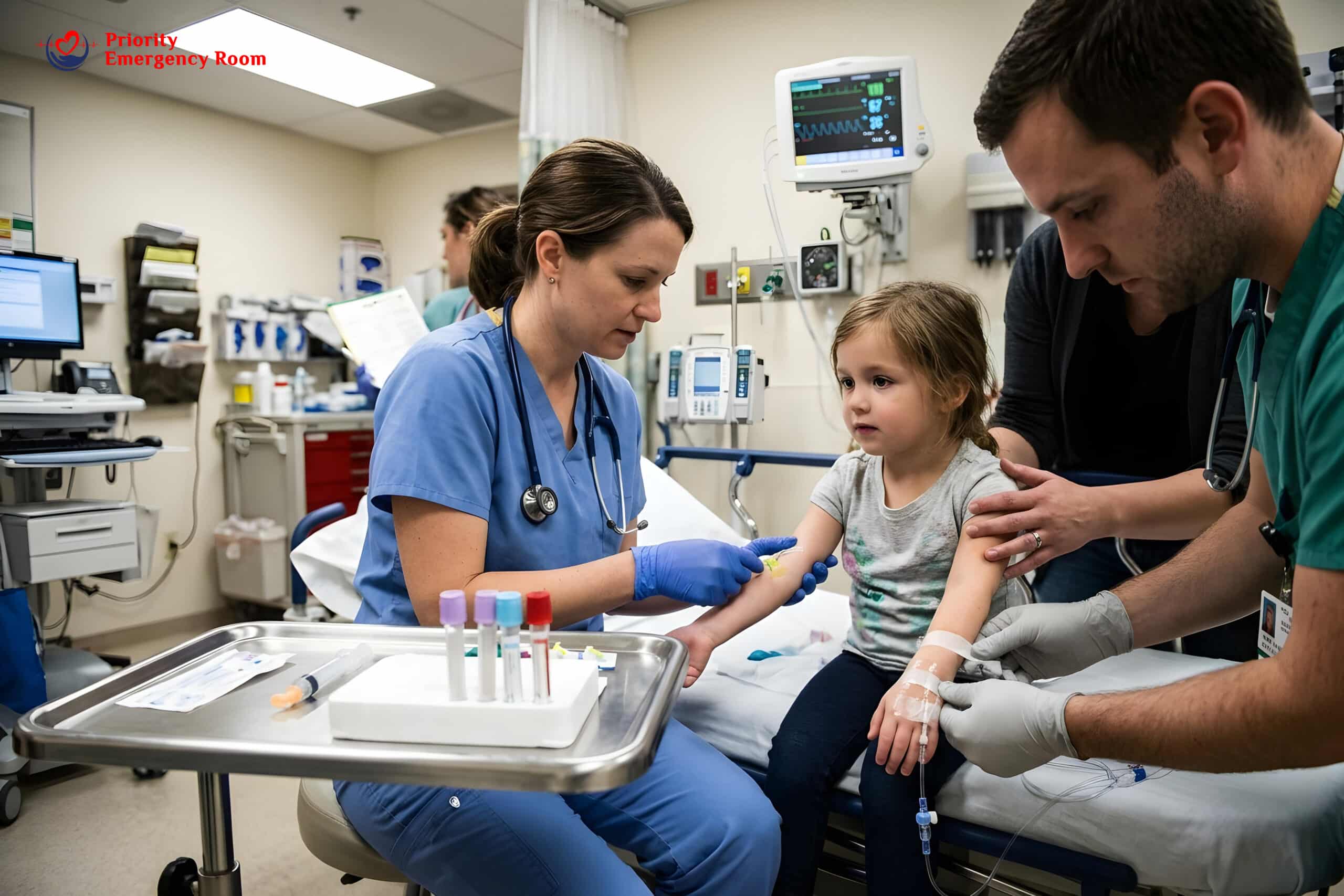
Febrile Seizures
Any seizure with fever requires immediate evaluation. Our team provides seizure emergency care with full monitoring and treatment.
Emergency
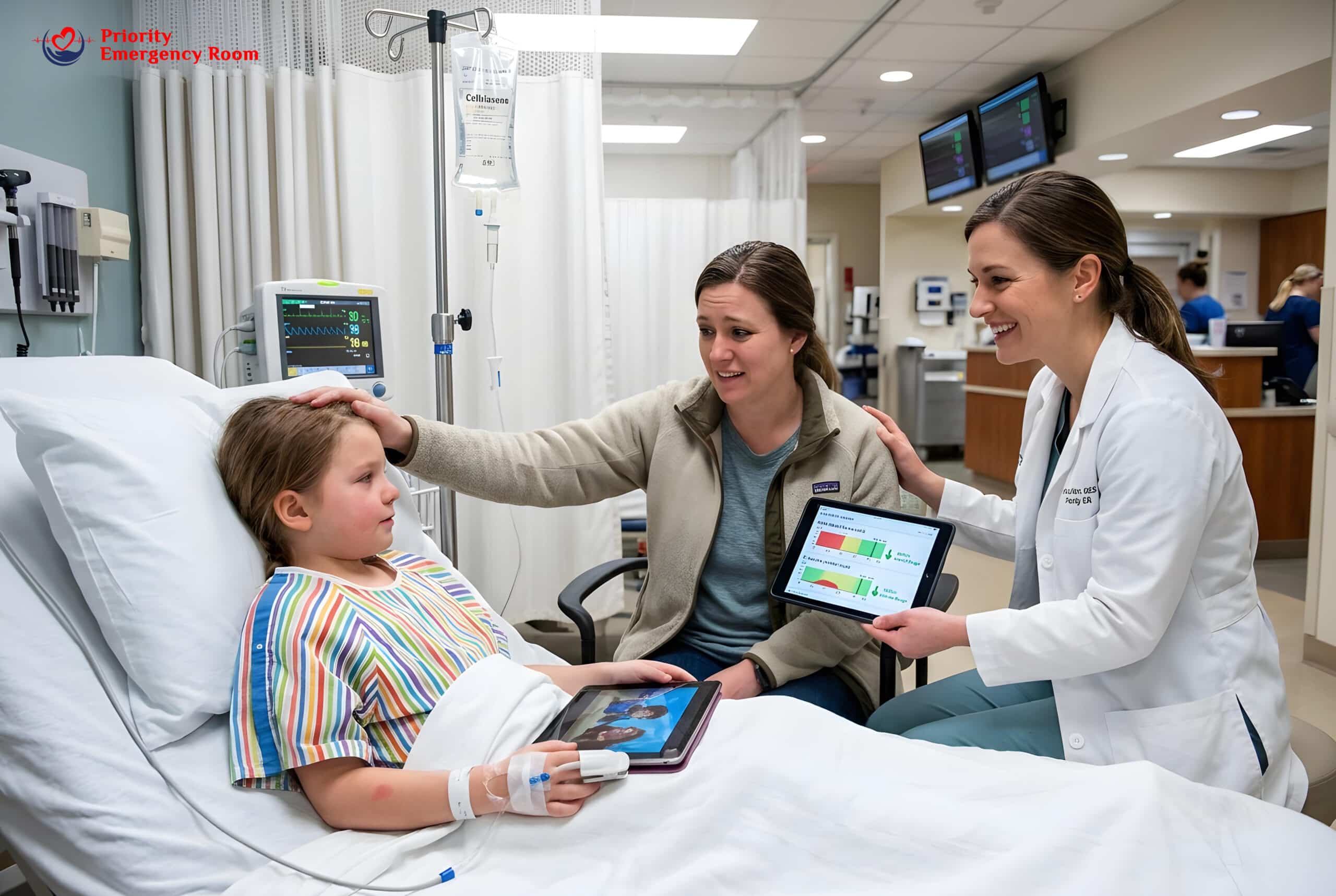
Extreme Lethargy
Child is limp, unresponsive, won’t wake up, or inconsolable. Our complete blood count testing helps identify serious infections fast.
Trust Your Parental Instincts
If your child has a high fever and just looks wrong—limp, glassy-eyed, unresponsive, inconsolable, or refusing all fluids—go to the ER. If their neck is stiff and they can’t touch their chin to their chest, go now. If there’s a rash with the fever that doesn’t fade when you press on it, go now. And any fever at all in a baby under 3 months old is an emergency. You don’t need to wait for the number to hit a certain threshold. Parents know their children better than anyone.
Built for Reliability When It Matters Most
When your child has a high fever and you need to know what’s causing it, you need certainty—not “maybe” or “we’ll see.” Here’s what makes Priority ER different:
The Difference When a High Fever Gets Serious
Urgent Care
Basic Tests
Rapid strep/flu only, no IV, no full labs
Priority ER
Full ER
Complete labs, IV fluids, IV antibiotics—24/7
CT Scans
On-site, results in minutes
Full Lab
No waiting for off-site results
Real ER
Board-certified ER physicians
Blood work to find the cause. IV fluids to rehydrate.
IV antibiotics if infection is serious—without the hospital chaos.
What to Expect When You Arrive
Knowing what happens next can help both you and your child feel calmer. Here’s how a Priority ER visit typically unfolds:
Your Priority ER Visit
From arrival to answers
0-2 minutes
2-5 minutes
5-10 minutes
10-30 minutes
30-60 minutes
Immediate Greeting (0-2 min)
You’re greeted the moment you walk in. No clipboard, no waiting for someone to notice you.
Private Room (2-5 min)
Your child goes straight to a private treatment room. Family stays together.
Physician Exam (5-10 min)
A board-certified ER doctor examines your child and explains what’s next.
Testing (10-30 min)
Any needed labs, imaging, or tests—all done on-site with fast results.
Answers & Treatment (30-60 min)
Diagnosis explained, treatment provided, discharge instructions given. You leave with answers.
Compare that to a typical hospital ER: wait for triage, wait for a room, wait for a doctor, wait for lab results, wait for imaging results… You could spend 4-6 hours for the same care that takes under an hour at Priority ER.²
When Your Child’s High Fever Needs More Than Tylenol
Board-certified emergency physicians. Pediatric expertise. Complete labs, IV fluids, IV antibiotics, and imaging on-site. Zero wait time. This is what real pediatric emergency care looks like.
Priority ER Locations
All locations are equipped with pediatric emergency capabilities and staffed by board-certified emergency physicians.
🌵 Odessa (West Texas)
3800 E 42nd St, Suite 105
Odessa, TX 79762
Serving Odessa, Midland, Gardendale, Greenwood & the Permian Basin
🏛 Round Rock (Austin Area)
1700 Round Rock Ave
Round Rock, TX 78681
Serving Round Rock, Cedar Park, Pflugerville, Georgetown & North Austin
⭐ McKinney (North Dallas)
5000 Eldorado Pkwy
McKinney, TX 75072
Serving McKinney, Frisco, Allen, Prosper & Collin County
🏙 Pantego (Arlington)
1607 S Bowen Rd
Pantego, TX 76013
Serving Arlington, Pantego, Grand Prairie & Mid-Cities DFW
🌊 Rockwall (East Dallas)
2265 N Lakeshore Dr #100
Rockwall, TX 75087
Serving Rockwall, Heath, Rowlett, Fate & Lake Ray Hubbard area
The Bottom Line for Parents
When you’re searching “high fever ER” because your child is burning up and you can’t get the fever down, here’s what you need to know: it’s not just about the number on the thermometer—it’s about how your child looks and acts. Go to the ER if fever is 100.4°F or higher in an infant under 3 months, if fever is 103°F or higher and won’t respond to medication, if your child has a stiff neck or severe headache with fever, if there’s a rash that doesn’t blanch when pressed, if your child is limp, unresponsive, or inconsolable, if they can’t keep fluids down and are becoming dehydrated, or if they have a febrile seizure.
Know the difference: a fever in an alert, active child who responds to Tylenol can usually wait for the pediatrician. A high fever in a child who looks seriously ill needs the ER. And Priority ER gives you full emergency room capabilities—fever emergency care, advanced imaging, on-site labs—without the chaos and wait times of a hospital ER.
When your instincts say your child’s fever is more than a common virus, trust them. And come to a place that can draw blood, identify the source of infection, start IV treatment, and give you real answers—any time, day or night.
Medical References
- American College of Emergency Physicians. (2024). “Emergency Management of Febrile Illness in Pediatric Patients.” ACEP Clinical Practice Guidelines. Retrieved from https://www.acep.org/
- Texas Department of State Health Services. (2024). “Emergency Department Utilization for Pediatric Febrile Illness in Texas.” Regional Health Report. Retrieved from https://www.dshs.texas.gov/
- Priority ER Internal Data. (2024). “Annual Patient Outcomes and Emergency Care Statistics.” Quality Assurance Report.
- American College of Radiology. (2024). “Imaging Standards for Pediatric Fever Source Evaluation.” ACR Technical Standards. Retrieved from https://www.acr.org/
- American Academy of Pediatrics. (2024). “Clinical Practice Guideline for Evaluation and Management of Well-Appearing Febrile Infants 8 to 60 Days Old.” AAP Clinical Guidelines. Retrieved from https://www.aap.org/
- National Emergency Medicine Association. (2024). “Identifying Serious Bacterial Infection in Febrile Children in the Emergency Department.” Journal of Emergency Medicine, 48(9), 542-549.
- Mayo Clinic. (2024). “Fever in Children: When to Seek Emergency Care.” Mayo Clinic Proceedings. Retrieved from https://www.mayoclinic.org/
- Healthcare Cost and Utilization Project. (2024). “Emergency Department Visits for Pediatric Febrile Illness.” HCUP Statistical Brief #182. Retrieved from https://hcup-us.ahrq.gov/
- Infectious Diseases Society of America. (2024). “Guidelines for Management of Febrile Illness and Serious Bacterial Infections in Children.” IDSA Guidelines. Retrieved from https://www.idsociety.org/