

Migraine Emergency Room: When Your Headache Needs More Than Home Remedies
You know migraines. You’ve managed them before—dark room, medication, waiting it out. But this one is different. Maybe it’s worse than usual, or it won’t respond to anything, or something just feels off. You’re wondering: is this migraine bad enough for the emergency room?
Stop. Most migraines aren’t emergencies—but some headaches that feel like migraines are actually dangerous conditions that need immediate care. Here’s how to know the difference.
Here’s when to go to the ER for a headache: Go immediately if it’s the worst headache of your life, if it came on suddenly (thunderclap), if you have fever or stiff neck, if you have new neurological symptoms (vision changes, weakness, confusion), or if your usual medications aren’t working at all. The ER can provide IV medications AND rule out dangerous conditions. A headache that’s “different” from your usual migraines deserves evaluation.
Home Care vs. ER: What’s the Difference?
The emergency room isn’t just for headaches that are “really bad”—it’s for headaches that might not be migraines at all. Dangerous conditions like stroke, aneurysm, and meningitis can present as severe headaches. The ER can tell the difference.
Here’s how to assess whether your headache needs the ER:
W — Worst Ever: Is this the worst headache you’ve ever had? Emergency sign: “Worst headache of my life” can indicate aneurysm or bleeding—always needs ER evaluation.
O — Onset: How did it start? Emergency sign: Sudden, severe onset (thunderclap headache reaching peak intensity within seconds to minutes) needs emergency evaluation.
R — Red Flags: Are there any warning signs? Emergency signs: fever, stiff neck, new neurological symptoms, confusion, first severe headache over age 50.
If you have any emergency signs, go to the ER. These could indicate conditions far more serious than migraine. Learn more about seizures and altered mental status emergency care.
A thunderclap headache—one that reaches maximum intensity within seconds, like a clap of thunder—can indicate a ruptured aneurysm or other brain bleed. This is a medical emergency. Even if the pain improves, you still need immediate evaluation with CT scan and possibly lumbar puncture.
When Migraines Can Be Managed at Home
If you have a history of migraines and this headache fits your usual pattern, home treatment may be appropriate. Here’s when staying home is likely okay.
Migraines That May Not Need the ER
Typical pattern • Medications working • No danger signs • Keeping fluids down
The key phrase is “this feels like my usual migraines.” If anything is different about this headache—the pattern, intensity, associated symptoms—it’s worth getting checked out.
When a Headache Needs the ER
These headache presentations are emergencies. Don’t wait. Our emergency care team says these need immediate evaluation:

Emergency
“Worst Headache of My Life”
If you’d describe this as the worst headache you’ve ever experienced, it needs ER evaluation. This phrase is a red flag for aneurysm or brain bleed.

Emergency
Thunderclap Onset
Headache that reaches maximum intensity within seconds—like being hit in the head. This can indicate ruptured aneurysm requiring immediate head CT scan.
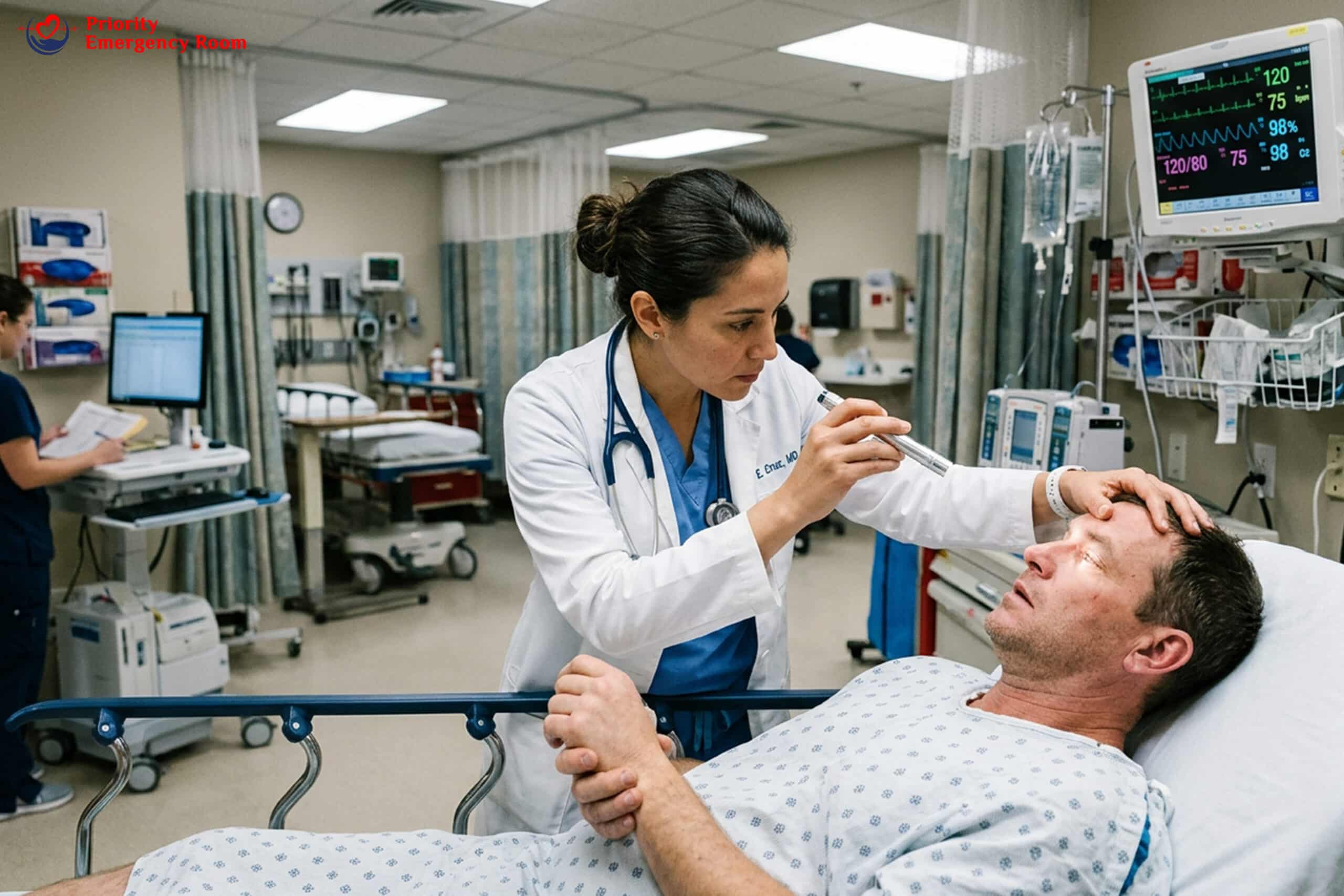
Emergency
Fever with Headache
Headache plus fever, especially with stiff neck or sensitivity to light, may indicate meningitis—a potentially life-threatening infection.
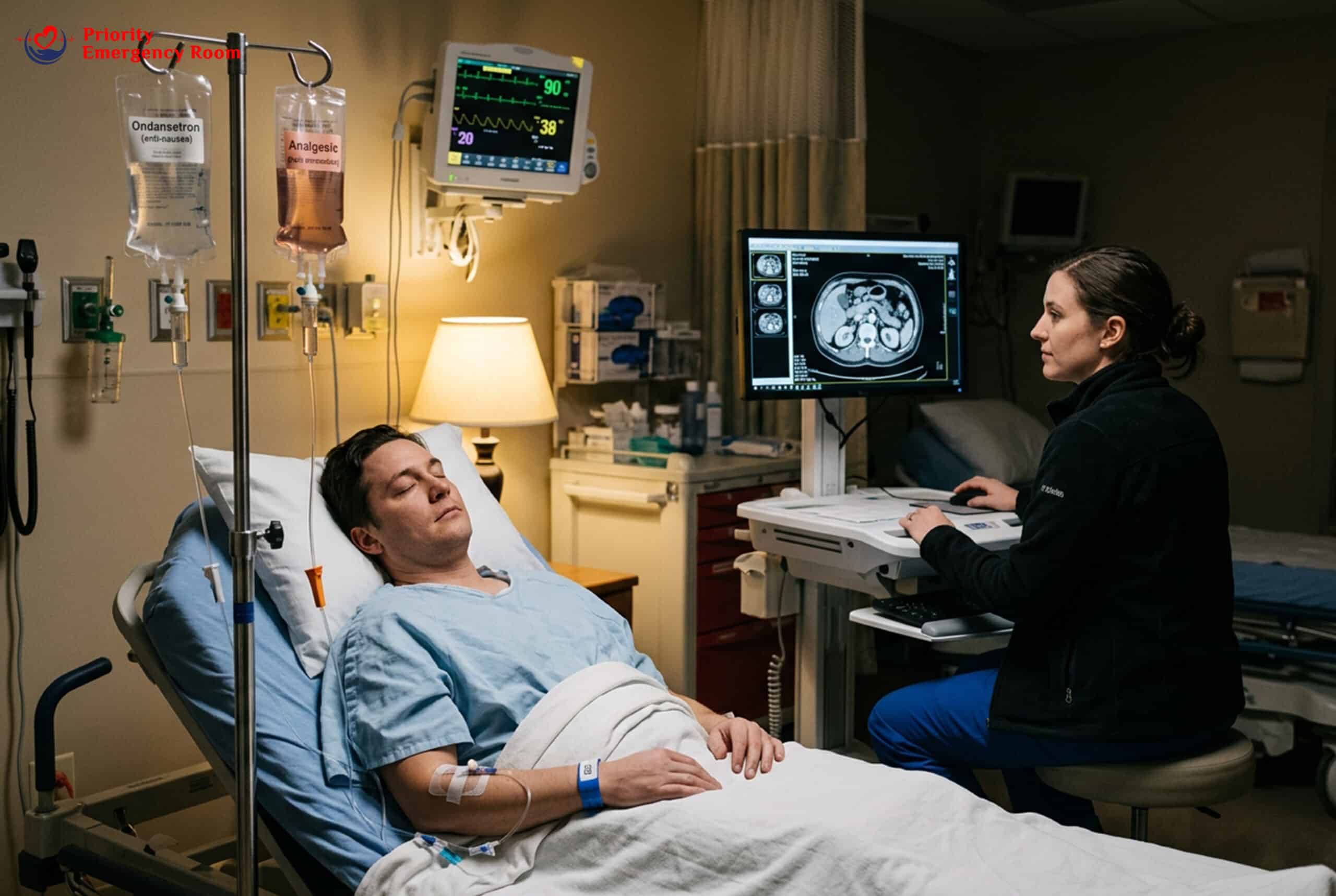
Emergency
New Neurological Symptoms
Weakness on one side, vision loss, slurred speech, severe confusion, or any neurological symptom different from your usual aura needs emergency evaluation.
Trust Your Instincts
If this headache feels different from your usual migraines—even if you can’t explain exactly how—go to the ER. You know your body. Something “different” is worth investigating.
Relief and Answers—Fast
When your migraine needs more than home treatment, you need relief fast. Here’s what makes Priority ER different:
The Difference at 2 AM
Hospital ER
3+ hours
Average wait in Texas
Priority ER
Minutes
Straight to a room
CT Scanner
Rule out serious causes
IV Treatment
Fast-acting relief
Quiet Rooms
Dim, calm environment
Same capabilities as a hospital ER.
Without the chaos.
What to Expect When You Arrive
Here’s how a Priority ER migraine visit unfolds:
Your Priority ER Visit
From arrival to relief
0-2 minutes
2-5 minutes
5-15 minutes
15-45 minutes
45-90 minutes
Immediate Greeting (0-2 min)
You’re greeted immediately. No waiting in bright, loud areas.
Quiet Room (2-5 min)
Private treatment room with lights dimmed for your comfort.
Evaluation (5-15 min)
Physician evaluates for danger signs and determines if CT is needed.
Treatment/CT (15-45 min)
IV medication started, CT scan if indicated. Treatment begins while tests process.
Relief & Discharge (45-90 min)
Most patients feel significantly better before leaving. Discharge with follow-up plan.
IV migraine treatment often provides relief within 30-60 minutes—far faster than oral medications.²
When Your Migraine Needs More Than Home Remedies
Board-certified emergency physicians. On-site CT. IV migraine treatment. Quiet, comfortable rooms. Zero wait time.
Priority ER Locations
All locations have CT imaging and IV migraine treatment available 24/7. We also provide IV fluid therapy for dehydration associated with severe migraines.
🌵 Odessa (West Texas)
3800 E 42nd St, Suite 105
Odessa, TX 79762
Serving Odessa, Midland, Gardendale, Greenwood & the Permian Basin
🏛 Round Rock (Austin Area)
1700 Round Rock Ave
Round Rock, TX 78681
Serving Round Rock, Cedar Park, Pflugerville, Georgetown & North Austin
⭐ McKinney (North Dallas)
5000 Eldorado Pkwy
McKinney, TX 75072
Serving McKinney, Frisco, Allen, Prosper & Collin County
🏙 Pantego (Arlington)
1607 S Bowen Rd
Pantego, TX 76013
Serving Arlington, Pantego, Grand Prairie & Mid-Cities DFW
🌊 Rockwall (East Dallas)
2265 N Lakeshore Dr #100
Rockwall, TX 75087
Serving Rockwall, Heath, Rowlett, Fate & Lake Ray Hubbard area
The Bottom Line: When Migraines Need the Emergency Room
Go to the ER for the “worst headache of your life,” thunderclap onset, fever with headache, new neurological symptoms, or migraines that won’t respond to treatment. The ER can rule out dangerous conditions and provide effective IV treatment.
Priority ER has on-site CT scans to rule out serious causes and IV medications that work faster than anything you can take at home—without the hours of waiting at a hospital ER.
When your migraine needs more than home remedies, come get relief.
Medical References
- American Headache Society. (2024). “Emergency Treatment of Migraine.” AHS Guidelines. Retrieved from https://americanheadachesociety.org/
- American College of Emergency Physicians. (2024). “Clinical Policy: Headache.” ACEP. Retrieved from https://www.acep.org/
- American Academy of Neurology. (2024). “Headache Red Flags.” AAN. Retrieved from https://www.aan.com/
- American College of Radiology. (2024). “ACR Appropriateness Criteria: Headache.” Retrieved from https://www.acr.org/
- Priority ER Internal Data. (2024). “Headache Presentations Statistics.” Quality Assurance Report.
- Mayo Clinic. (2024). “Migraine: When to Seek Emergency Care.” Retrieved from https://www.mayoclinic.org/
- National Headache Foundation. (2024). “Emergency Room Treatment.” Retrieved from https://headaches.org/
- Healthcare Cost and Utilization Project. (2024). “ED Visits for Headache.” Retrieved from https://hcup-us.ahrq.gov/
- Texas Department of State Health Services. (2024). “Emergency Department Statistics.” Retrieved from https://www.dshs.texas.gov/