
Is a Broken Bone an Emergency? When You Need the ER vs. Urgent Care
You know this moment. Something bent the wrong way. There was a crack, a pop, or just instant pain. Now you’re looking at a limb that doesn’t look right, wondering: is this an emergency room situation, or can it wait for urgent care tomorrow?
Stop. Some broken bones need the ER right now. Others can wait. Here’s exactly how to tell the difference.
Here’s the quick answer: A broken bone is an emergency if bone is visible through the skin, if the limb is obviously deformed, if you can’t feel or move your fingers/toes below the injury, or if the skin looks pale, blue, or cold. These situations need the ER immediately. Simple fractures without these danger signs may be okay for urgent care—but when in doubt, the ER is always the safer choice.
Urgent Care vs. ER: What’s the Actual Difference?
Both urgent care and emergency rooms can X-ray and splint broken bones. But emergency rooms have capabilities urgent care doesn’t: sedation for painful procedures, orthopedic surgery backup, and the ability to handle complicated fractures that need immediate intervention. If you’re wondering whether to choose urgent care or ER for a broken bone, the severity of your injury matters most.
Here’s how to assess whether your suspected fracture needs the ER:
L — Look: What does it look like? Emergency signs: bone visible through skin, obvious deformity (bent the wrong way), significant swelling, bruising spreading rapidly.
C — Circulation: Is blood getting past the injury? Emergency signs: fingers/toes below injury are pale, blue, or cold; can’t feel a pulse below the break; numbness or tingling.
M — Movement: Can you move what’s below the injury? Emergency signs: can’t move fingers/toes, can’t feel them, weakness below the injury.
If you have any emergency signs, go to the ER. These indicate the fracture may be affecting blood vessels or nerves, which requires immediate treatment.
If bone is visible through the skin—or if the skin is broken near the fracture site—this is an open (compound) fracture. These have high infection risk and typically require surgery. Go to the ER immediately. Don’t try to push the bone back in or clean the wound yourself.
When a Fracture Might Not Need the ER
Not every broken bone requires an emergency room visit. Some fractures can be safely evaluated at urgent care or even wait until you can see your doctor. Here’s when the ER might not be necessary.
Fractures That May Not Need the ER
Closed skin • Good circulation • Normal sensation • Minor deformity
The key factors are circulation, sensation, and skin integrity. If blood flow and nerve function appear normal and the skin isn’t broken, the fracture may not require emergency care. But children’s fractures, fractures near joints, and any uncertainty should go to the ER.
When a Broken Bone Needs the ER Now
These fracture presentations are emergencies requiring immediate ER care. Don’t wait. Our orthopedic emergency care team says these need urgent evaluation:

Emergency
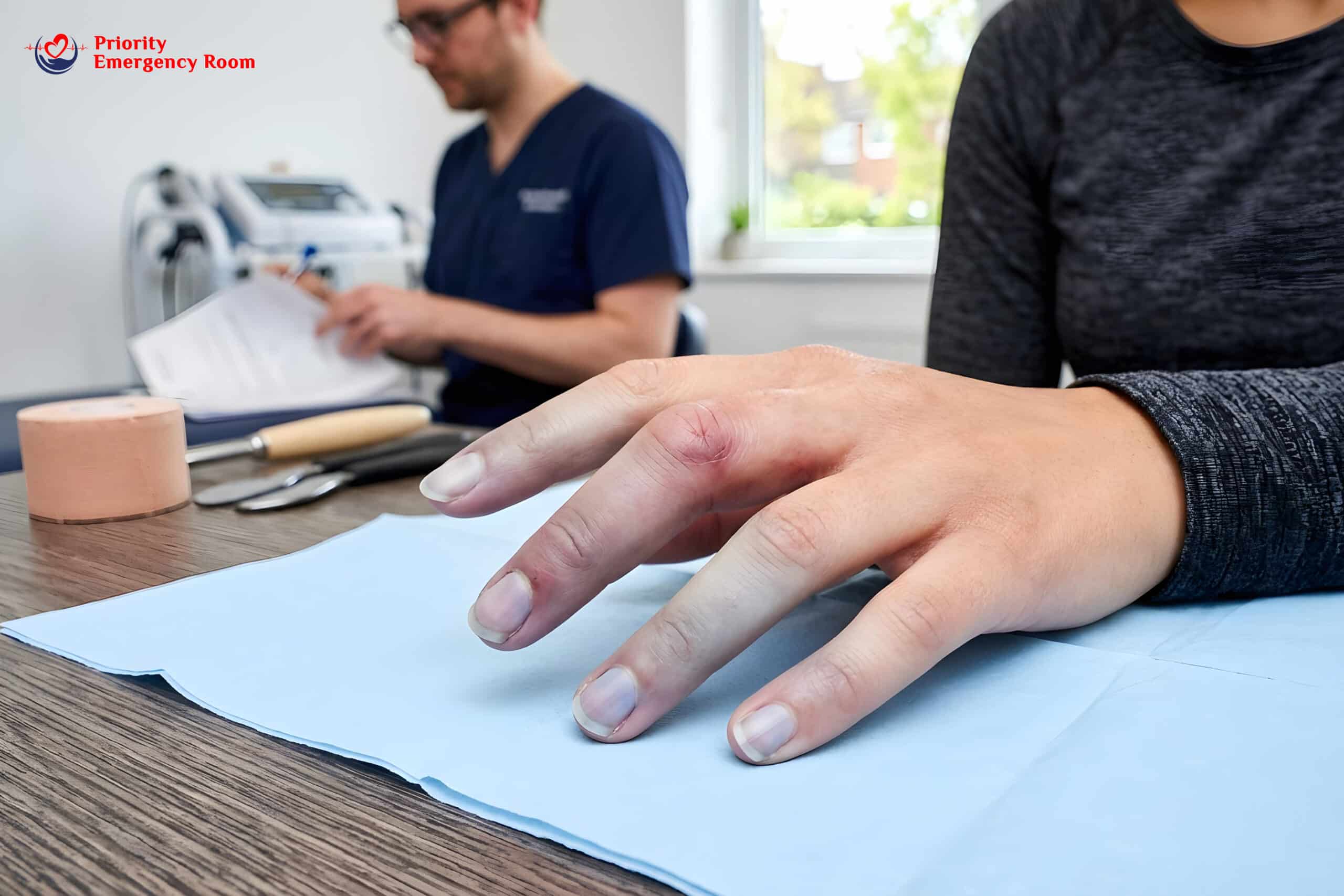
Open (Compound) Fracture
Bone visible through skin or any break in skin near the fracture. High infection risk—requires antibiotics and likely surgery. Do not push bone back in.
Emergency
Obvious Deformity
Limb is clearly bent the wrong way, shortened, or rotated abnormally. This indicates displaced fracture that needs reduction (realignment).

Emergency
Circulation Problems
Fingers or toes below the injury are pale, blue, white, or cold. No pulse felt below the break. This indicates blood vessel damage—minutes matter.
Emergency
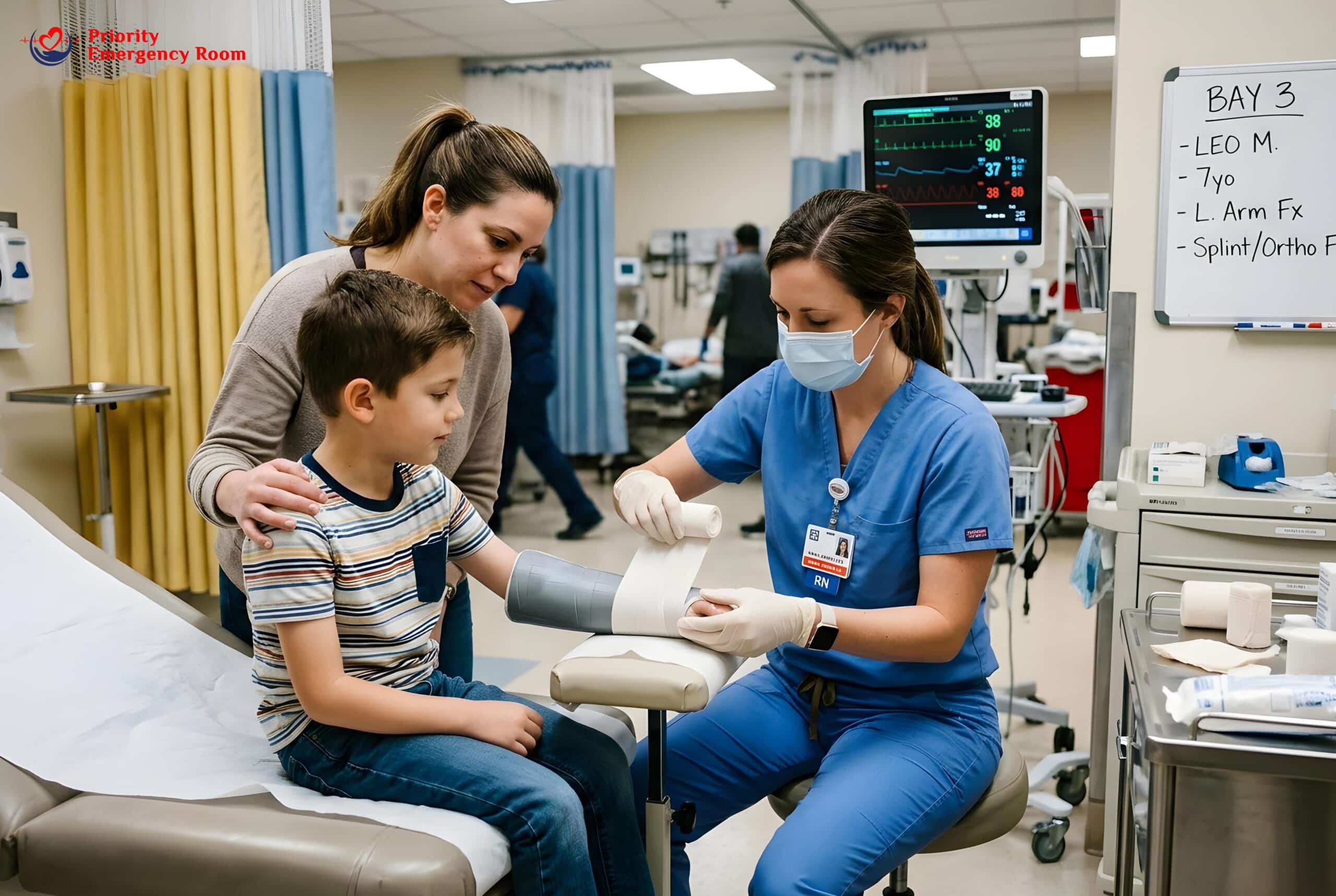
Numbness or Can’t Move
Loss of sensation or inability to move fingers/toes below the fracture indicates nerve damage or compartment syndrome. Needs immediate evaluation.
When in Doubt, Choose the ER
If you’re unsure whether your fracture needs the ER, go to the ER. It’s always better to be evaluated and reassured than to wait and have a problem get worse. Delayed treatment of certain fractures can lead to permanent complications. A 24-hour emergency room can evaluate you any time.
Built for Reliability When It Matters Most
When you have a fracture that needs emergency care, you need fast treatment. Here’s what makes Priority ER different:
The Difference at 2 AM
Hospital ER
3+ hours
Average wait in Texas
Priority ER
Minutes
Straight to a room
X-Ray
On-site, results in minutes
Splinting
Immediate stabilization
Real ER
Board-certified ER physicians
Same capabilities as a hospital ER.
Without the chaos.
What to Expect When You Arrive
Here’s how a Priority ER fracture visit typically unfolds:
Your Priority ER Visit
From arrival to answers
0-2 minutes
2-5 minutes
5-15 minutes
15-25 minutes
30-60 minutes
Immediate Greeting (0-2 min)
You’re greeted immediately. No waiting room delays.
Private Room (2-5 min)
Straight to a private treatment room.
Exam & Pain Control (5-15 min)
Physician examines injury, checks circulation and sensation, provides pain medication.
X-Ray (15-25 min)
On-site X-ray to confirm and characterize the fracture.
Splint & Discharge (30-60 min)
Fracture splinted or casted, reduction if needed, orthopedic follow-up arranged.
At Priority ER, you get X-ray, treatment, and discharge in the time it takes just to be seen at a hospital ER.²
When a Broken Bone Needs Emergency Care
Board-certified emergency physicians. On-site X-ray. Splinting and casting. Pain management. Zero wait time.
Priority ER Locations
All locations have on-site X-ray and board-certified emergency physicians ready to treat fracture emergencies.
🌵 Odessa (West Texas)
3800 E 42nd St, Suite 105
Odessa, TX 79762
Serving Odessa, Midland, Gardendale, Greenwood & the Permian Basin
🏛 Round Rock (Austin Area)
1700 Round Rock Ave
Round Rock, TX 78681
Serving Round Rock, Cedar Park, Pflugerville, Georgetown & North Austin
⭐ McKinney (North Dallas)
5000 Eldorado Pkwy
McKinney, TX 75072
Serving McKinney, Frisco, Allen, Prosper & Collin County
🏙 Pantego (Arlington)
1607 S Bowen Rd
Pantego, TX 76013
Serving Arlington, Pantego, Grand Prairie & Mid-Cities DFW
🌊 Rockwall (East Dallas)
2265 N Lakeshore Dr #100
Rockwall, TX 75087
Serving Rockwall, Heath, Rowlett, Fate & Lake Ray Hubbard area
The Bottom Line: Is a Broken Bone an Emergency?
Some broken bones are emergencies, others are not. The key factors: Is bone visible through skin? Is circulation or sensation affected? Is there obvious deformity? These situations need the ER immediately. Simple closed fractures with good circulation may be okay for urgent care.
When you need emergency fracture care, Priority ER has on-site X-ray, board-certified emergency physicians, and complete fracture treatment—without hospital ER wait times.
When in doubt, come get answers. We’re ready.
Medical References
- American College of Emergency Physicians. (2024). “Clinical Policy: Management of Fractures in the Emergency Department.” ACEP Clinical Policies. Retrieved from https://www.acep.org/
- American Academy of Orthopaedic Surgeons. (2024). “Fracture Treatment and Care.” AAOS Patient Information. Retrieved from https://www.aaos.org/
- American College of Radiology. (2024). “ACR Appropriateness Criteria: Suspected Fracture.” ACR Guidelines. Retrieved from https://www.acr.org/
- Orthopedic Trauma Association. (2024). “Open Fracture Guidelines.” OTA Clinical Guidelines. Retrieved from https://ota.org/
- Priority ER Internal Data. (2024). “Annual Statistics: Orthopedic Emergency Presentations.” Quality Assurance Report.
- Mayo Clinic. (2024). “Fractures: First Aid and When to Seek Help.” Mayo Clinic Patient Care. Retrieved from https://www.mayoclinic.org/
- American Academy of Pediatrics. (2024). “Pediatric Fracture Management.” AAP Clinical Guidelines. Retrieved from https://www.aap.org/
- Healthcare Cost and Utilization Project. (2024). “ED Visits for Fractures.” HCUP Statistical Brief. Retrieved from https://hcup-us.ahrq.gov/
- Texas Department of State Health Services. (2024). “Emergency Department Statistics.” Regional Health Report. Retrieved from https://www.dshs.texas.gov/