

Kidney Stones Emergency: When You Need the ER Right Now
You know this pain. It hits like a wave—intense, stabbing, radiating from your back to your groin. You can’t get comfortable no matter what position you try. You’re wondering: is this a kidney stone emergency that needs the ER, or can you ride it out at home?
Stop. Some kidney stone situations are true emergencies. Here’s how to know if yours is one of them.
Here’s when kidney stones become emergencies: Go to the ER if pain is severe and uncontrollable, if you have fever (infection risk), if you can’t urinate (complete blockage), or if you can’t keep fluids down. Kidney stones with infection can become life-threatening within hours. The ER has IV pain meds, CT scans, and the ability to identify dangerous complications—things you can’t get anywhere else.
Home Care vs. ER: What’s the Difference?
Many kidney stones pass on their own—but some don’t, and some cause dangerous complications. The question isn’t whether kidney stones can be emergencies; it’s whether YOUR kidney stone is an emergency right now.
Here’s how to assess your situation:
P — Pain Level: How bad is it? Can you manage with OTC meds? Emergency signs: pain rated 8-10/10, can’t sit still, OTC medication not helping at all.
I — Infection Signs: Do you have signs of infection? Emergency signs: fever over 101°F, chills, shaking, cloudy or foul-smelling urine.
U — Urinary Function: Can you urinate? Emergency signs: unable to urinate for several hours, only small amounts despite urge, heavy blood or clots.
If you have any emergency signs, go to the ER. Kidney stones with infection (obstructive pyelonephritis) can cause sepsis within hours. For severe cases, you may need to visit the emergency room for urinary tract complications.
Fever with kidney stone pain is a medical emergency. When a stone blocks the ureter and bacteria are present, infection can spread to the bloodstream rapidly. This condition requires emergency intervention—often a stent or nephrostomy tube—and IV antibiotics. Don’t wait to see if fever improves.
When Kidney Stones Can Be Managed at Home
Small kidney stones (under 5mm) often pass on their own within days to weeks. Here’s when home management may be appropriate.
When to Try Home Management
Manageable pain • No fever • Urinating normally • Keeping fluids down
The key is no danger signs. If pain is manageable, you have no fever, and you’re urinating normally, you may be able to pass the stone at home. But if anything changes—go to the ER.
When Kidney Stones Are an Emergency
These kidney stone presentations require emergency care. Don’t wait. Our emergency care team says these need immediate attention:
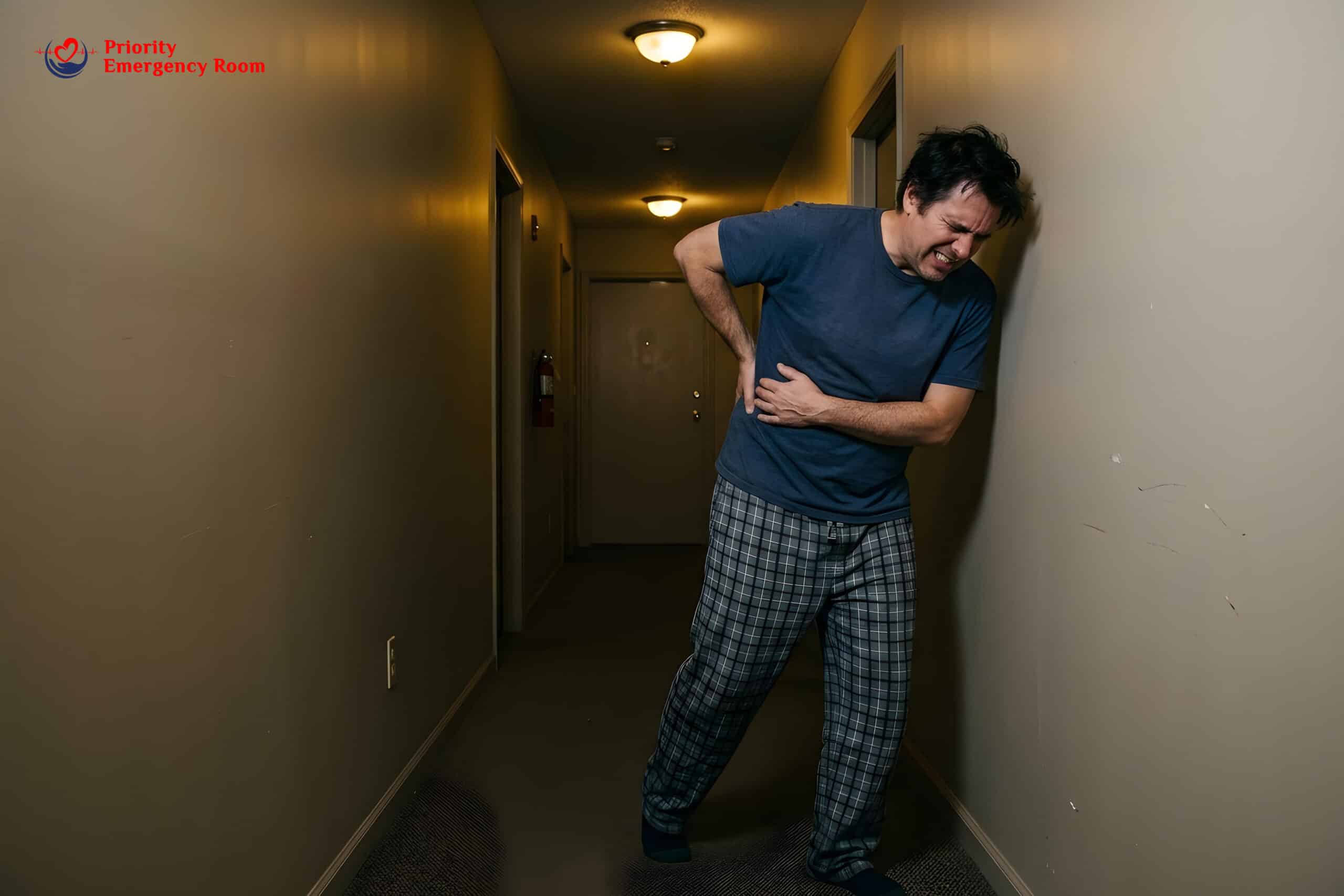
Emergency
Severe, Uncontrollable Pain
Pain so intense you can’t find any position of comfort, you’re writhing or pacing, and OTC medications aren’t making a dent. The ER has IV pain meds that actually work.
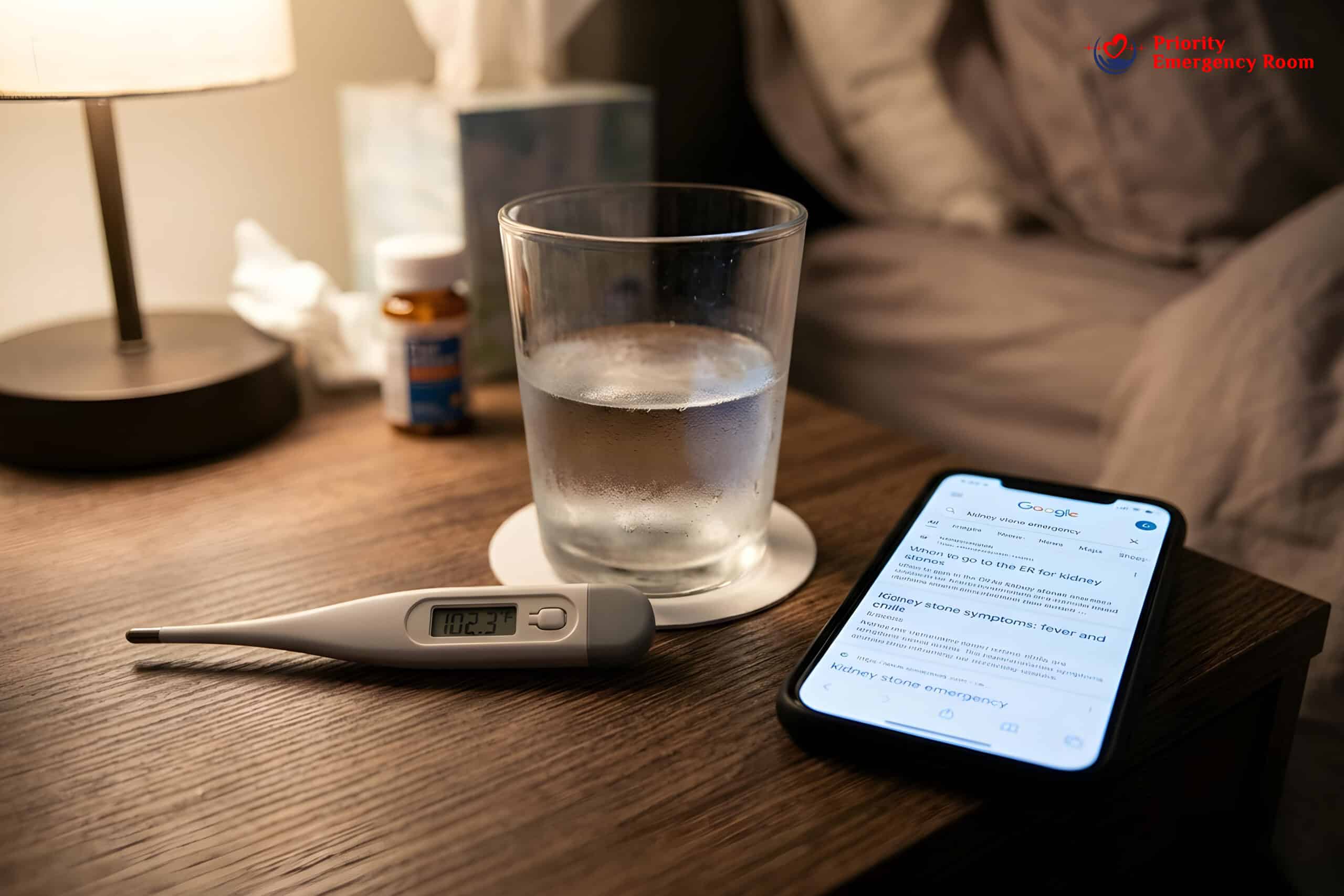
Emergency
Fever Over 101°F
Fever with kidney stone pain signals infection. This can rapidly progress to sepsis—a life-threatening emergency requiring IV antibiotics and often emergency intervention for dehydration.

Emergency
Inability to Urinate
Not urinating for several hours despite drinking fluids suggests complete obstruction. This can cause permanent kidney damage if not relieved.
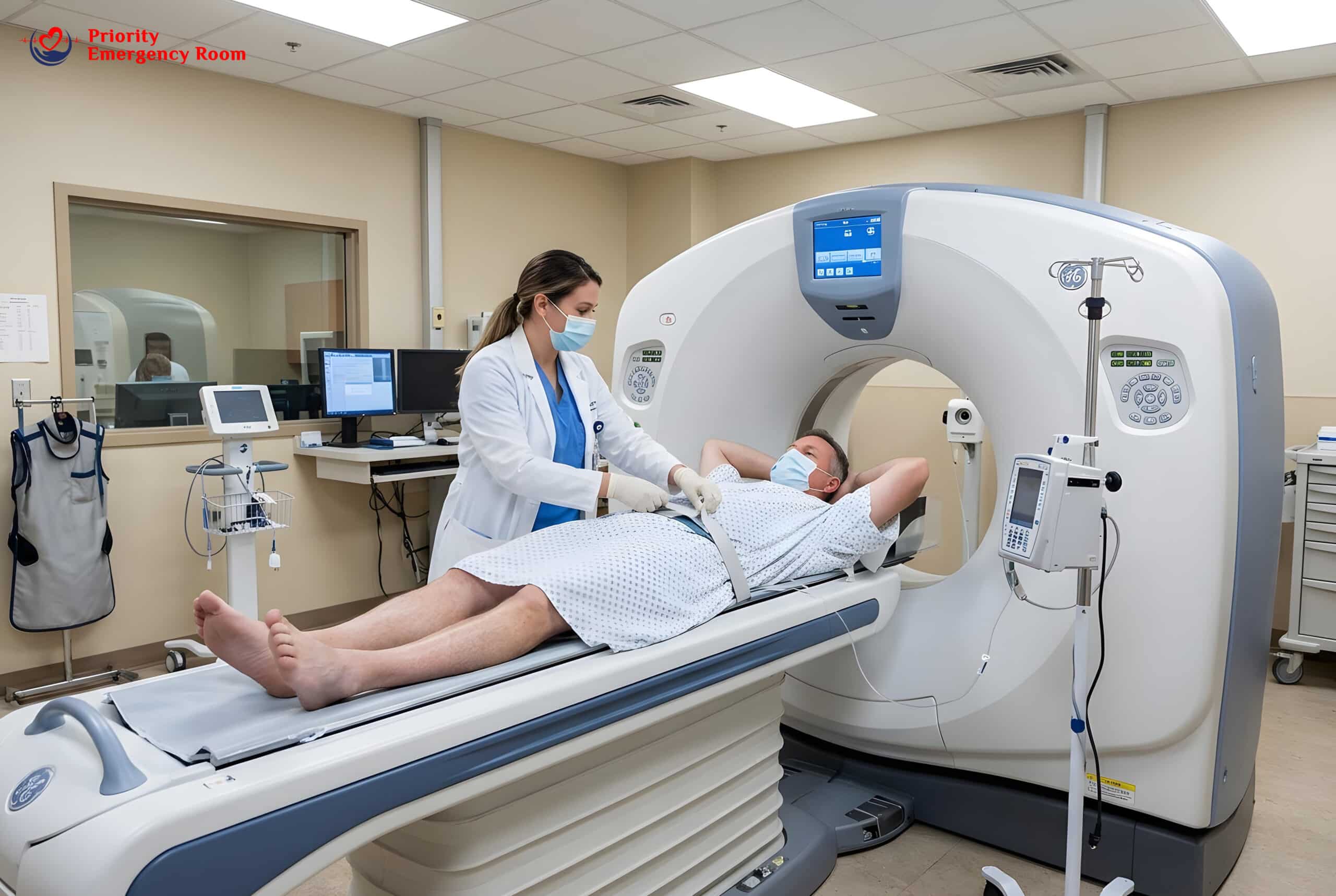
Emergency
Persistent Vomiting
Can’t keep any fluids or medications down. This leads to dehydration, makes stone passage harder, and prevents you from taking oral pain medication.
When in Doubt, Go
If you’re unsure whether your kidney stone is an emergency, it’s better to go to the ER. The ER can quickly determine if you’re safe to manage at home or if you need intervention. Don’t suffer at home wondering.
Built for Kidney Stone Emergencies
When kidney stones become an emergency, you need fast treatment. Here’s what makes Priority ER different:
The Difference at 2 AM
Hospital ER
3+ hours
Average wait in Texas
Priority ER
Minutes
Straight to a room
CT Scanner
On-site, results in minutes
IV Pain Meds
Real relief, fast
Real ER
Board-certified ER physicians
Same capabilities as a hospital ER.
Without the chaos.
What to Expect When You Arrive
Here’s how a Priority ER kidney stone visit unfolds:
Your Priority ER Visit
From arrival to answers
0-2 minutes
2-5 minutes
5-15 minutes
15-30 minutes
30-60 minutes
Immediate Greeting (0-2 min)
You’re greeted immediately. No waiting in pain.
Private Room (2-5 min)
Straight to a private treatment room.
Pain Control (5-15 min)
IV pain medication started—the kind that actually works for kidney stone pain.
CT & Labs (15-30 min)
CT scan shows stone size and location. Labs check kidney function and infection.
Diagnosis & Plan (30-60 min)
Treatment plan: medication to pass the stone, or urology referral for larger stones.
At Priority ER, you have answers and relief in under an hour—not the 4-6 hours typical at hospital ERs.²
When Kidney Stones Become Emergencies
Board-certified emergency physicians. On-site CT. IV pain management. Zero wait time. Real relief, fast.
Priority ER Locations
All locations have CT imaging, full comprehensive metabolic panel testing, and board-certified emergency physicians ready to treat kidney stone emergencies.
🌵 Odessa (West Texas)
3800 E 42nd St, Suite 105
Odessa, TX 79762
Serving Odessa, Midland, Gardendale, Greenwood & the Permian Basin
🏛 Round Rock (Austin Area)
1700 Round Rock Ave
Round Rock, TX 78681
Serving Round Rock, Cedar Park, Pflugerville, Georgetown & North Austin
⭐ McKinney (North Dallas)
5000 Eldorado Pkwy
McKinney, TX 75072
Serving McKinney, Frisco, Allen, Prosper & Collin County
🏙 Pantego (Arlington)
1607 S Bowen Rd
Pantego, TX 76013
Serving Arlington, Pantego, Grand Prairie & Mid-Cities DFW
🌊 Rockwall (East Dallas)
2265 N Lakeshore Dr #100
Rockwall, TX 75087
Serving Rockwall, Heath, Rowlett, Fate & Lake Ray Hubbard area
The Bottom Line: When Kidney Stones Are Emergencies
Kidney stones become emergencies when pain is uncontrollable, when there’s fever, when you can’t urinate, or when you can’t keep fluids down. These situations require immediate ER care.
Priority ER has on-site CT scans, IV pain medication, and complete labs—everything you need for kidney stone emergencies, without the hospital ER wait.
When kidney stone pain becomes an emergency, come get relief.
Medical References
- American Urological Association. (2024). “Medical Management of Kidney Stones.” AUA Guidelines. Retrieved from https://www.auanet.org/
- American College of Emergency Physicians. (2024). “Clinical Policy: Renal Colic.” ACEP. Retrieved from https://www.acep.org/
- National Institute of Diabetes and Digestive and Kidney Diseases. (2024). “Kidney Stones.” NIDDK. Retrieved from https://www.niddk.nih.gov/
- American College of Radiology. (2024). “ACR Appropriateness Criteria: Acute Flank Pain.” Retrieved from https://www.acr.org/
- Priority ER Internal Data. (2024). “Kidney Stone Statistics.” Quality Assurance Report.
- European Association of Urology. (2024). “EAU Guidelines on Urolithiasis.” Retrieved from https://uroweb.org/
- Mayo Clinic. (2024). “Kidney Stones.” Retrieved from https://www.mayoclinic.org/
- Healthcare Cost and Utilization Project. (2024). “ED Visits for Kidney Stones.” Retrieved from https://hcup-us.ahrq.gov/
- Texas Department of State Health Services. (2024). “Emergency Department Statistics.” Retrieved from https://www.dshs.texas.gov/