
Need the ER But Worried About Medicaid Coverage? Here’s What to Know.
You know this feeling. Something’s wrong—really wrong—but you’re hesitating because you’re on Medicaid and you’re not sure if you can afford an emergency room visit. You’re searching “Medicaid emergency room” trying to figure out if you’ll be stuck with a massive bill or if your coverage will help.
Stop. Your health comes first. Here’s what you need to know about emergency care and Medicaid coverage so you can make an informed decision—fast.
Here’s the most important thing: Federal law requires emergency rooms to evaluate and stabilize anyone with an emergency medical condition, regardless of insurance status or ability to pay. If you’re having a true medical emergency, get to an ER now—don’t let insurance concerns delay potentially life-saving care. Priority ER accepts most major insurance plans. Contact your Medicaid plan to verify coverage for freestanding ERs.
Urgent Care vs. ER: What’s the Actual Difference?
Understanding the difference between urgent care and emergency rooms can help you make better healthcare decisions—both medically and financially.
Urgent care clinics handle minor illnesses and injuries. Emergency rooms handle serious and life-threatening conditions. If you’re wondering about urgent care facilities that accept Medicaid, they may be appropriate for minor issues, but for true emergencies, you need an ER.
S — Severity: How bad are your symptoms? Minor discomfort or severe pain? ER indicators: severe pain, difficulty breathing, heavy bleeding, chest pain, stroke symptoms.
T — Time Sensitivity: Can this wait, or does it need immediate attention? ER indicators: symptoms that are getting worse rapidly, conditions where delays could cause permanent damage.
C — Capabilities Needed: What kind of testing or treatment might you need? ER indicators: CT scans, cardiac monitoring, IV medications, blood transfusions, trauma care.
For true emergencies, the ER is the right choice regardless of insurance concerns. For minor issues, urgent care may be more appropriate and potentially more affordable.
Priority ER accepts most major insurance plans. Medicaid coverage for freestanding emergency rooms varies by state and plan. We recommend contacting your Medicaid provider directly to understand your specific coverage. Our staff can also help answer billing questions when you arrive.
When Urgent Care Might Be a Better Option
Not everything requires an emergency room. For minor conditions, urgent care may be more appropriate. Knowing the difference between clinics and urgent care can help you get the right care at the right place.
Conditions Often Appropriate for Urgent Care
Stable condition • Minor symptoms • Not life-threatening
The key word is minor. When symptoms are manageable and there are no emergency warning signs, urgent care may be appropriate. But when things are serious, don’t let insurance concerns delay getting the care you need.
When You Need the ER Regardless of Coverage
Some conditions are true emergencies that require immediate ER care. Insurance concerns should never delay treatment for these situations. Here’s what our emergency care team says always warrants ER care:

Emergency
Chest Pain or Pressure
Any chest pain, tightness, or pressure—especially with shortness of breath, sweating, or pain in arm or jaw. Could be a heart attack.
Emergency
Difficulty Breathing
Shortness of breath at rest, can’t speak in full sentences, blue lips, severe wheezing. Your airway is compromised.
Emergency
Stroke Symptoms
Sudden face drooping, arm weakness, speech difficulty, severe headache. Time is critical—every minute matters.
Emergency
Serious Injuries
Broken bones with deformity, deep cuts, head injuries with vomiting or confusion, car accidents, falls from height.
Your Health Comes First
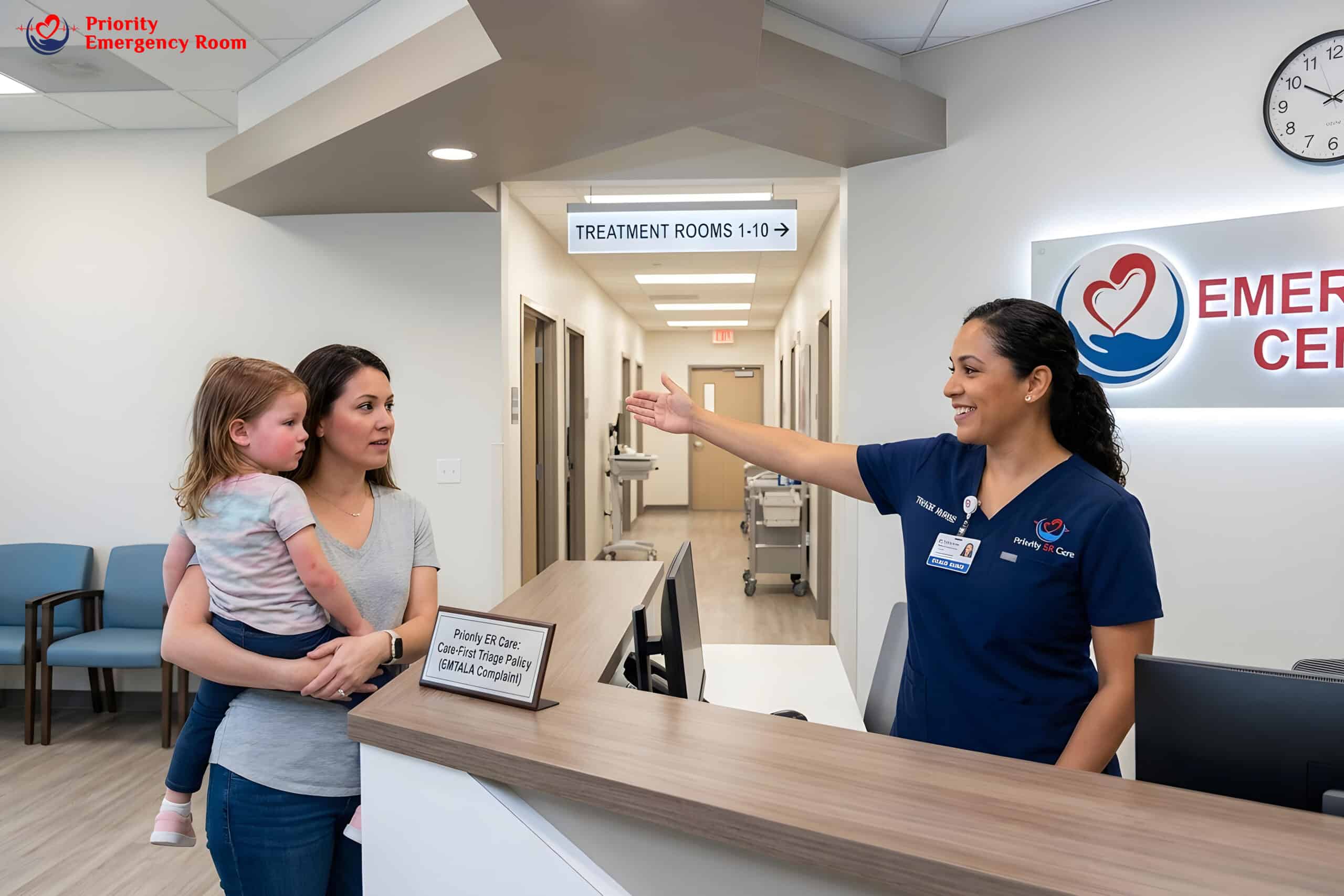
Federal law (EMTALA) requires emergency rooms to evaluate and stabilize anyone with an emergency condition, regardless of ability to pay. If you’re having a true emergency, don’t let insurance concerns stop you from getting care.
Built for Reliability When It Matters Most
When you need emergency care, you need certainty—not “maybe” or “we’ll see.” Here’s what makes Priority ER different:
The Difference at 2 AM
Hospital ER
3+ hours
Average wait in Texas
Priority ER
Minutes
Straight to a room
CT Scans
On-site, results in minutes
Full Lab
No waiting for off-site results
Real ER
Board-certified ER physicians
Same capabilities as a hospital ER.
Without the chaos.
What to Expect When You Arrive
Knowing what happens can help ease your concerns. Here’s how a Priority ER visit typically unfolds:
Your Priority ER Visit
From arrival to answers
0-2 minutes
2-5 minutes
5-10 minutes
10-30 minutes
30-60 minutes
Immediate Greeting (0-2 min)
You’re greeted the moment you walk in. No waiting room delays.
Registration & Room (2-5 min)
Quick registration while you’re taken to a private room. Bring your Medicaid card if you have it.
Physician Exam (5-10 min)
A board-certified ER physician examines you and determines what testing is needed.
Testing (10-30 min)
Any needed labs, imaging, or other tests—all done on-site with fast results.
Answers & Treatment (30-60 min)
Diagnosis explained, treatment provided, discharge instructions given. You leave with answers.
Compare that to a typical hospital ER: wait for triage, wait for a room, wait for a doctor, wait for lab results… You could spend 4-6 hours for the same care that takes under an hour at Priority ER.²
Questions About Coverage? We Can Help.
Priority ER accepts most major insurance plans. For Medicaid coverage questions, contact your plan directly or call us—our staff can help answer billing questions.
Priority ER Locations
All locations are equipped with full emergency capabilities and staffed by board-certified emergency physicians. Contact your Medicaid plan to verify coverage. Find out more about insurance options for emergency care.
🌵 Odessa (West Texas)
3800 E 42nd St, Suite 105
Odessa, TX 79762
Serving Odessa, Midland, Gardendale, Greenwood & the Permian Basin
🏛 Round Rock (Austin Area)
1700 Round Rock Ave
Round Rock, TX 78681
Serving Round Rock, Cedar Park, Pflugerville, Georgetown & North Austin
⭐ McKinney (North Dallas)
5000 Eldorado Pkwy
McKinney, TX 75072
Serving McKinney, Frisco, Allen, Prosper & Collin County
🏙 Pantego (Arlington)
1607 S Bowen Rd
Pantego, TX 76013
Serving Arlington, Pantego, Grand Prairie & Mid-Cities DFW
🌊 Rockwall (East Dallas)
2265 N Lakeshore Dr #100
Rockwall, TX 75087
Serving Rockwall, Heath, Rowlett, Fate & Lake Ray Hubbard area
The Bottom Line on Medicaid and Emergency Care
When you’re searching “Medicaid emergency room,” you’re trying to figure out how to get the care you need without a financial crisis. Here’s what matters most: if you’re having a true medical emergency, get to an ER—federal law requires emergency rooms to provide care regardless of insurance status. Learn more about ER costs compared to urgent care.
Priority ER accepts most major insurance plans. For Medicaid coverage at freestanding emergency rooms, coverage varies by plan and state. We recommend contacting your Medicaid provider directly to understand your specific benefits. Our staff can also help answer billing questions when you arrive.
Don’t let insurance concerns delay emergency care. Your health comes first. If you have questions about coverage, call us or your Medicaid plan—but if you’re having an emergency, come in now. We’re available 24 hours a day.
Medical References
- Centers for Medicare & Medicaid Services. (2024). “Emergency Medical Treatment and Labor Act (EMTALA).” CMS Regulations. Retrieved from https://www.cms.gov/
- Texas Health and Human Services. (2024). “Medicaid Emergency Services Coverage.” Texas Medicaid. Retrieved from https://www.hhs.texas.gov/
- American College of Emergency Physicians. (2024). “Emergency Department Patient Rights.” ACEP Patient Information. Retrieved from https://www.acep.org/
- Medicaid and CHIP Payment and Access Commission. (2024). “Emergency Department Use Among Medicaid Beneficiaries.” MACPAC Reports. Retrieved from https://www.macpac.gov/
- Priority ER Internal Data. (2024). “Annual Emergency Department Statistics.” Quality Assurance Report.
- Healthcare Cost and Utilization Project. (2024). “Emergency Department Utilization by Payer.” HCUP Statistical Brief. Retrieved from https://hcup-us.ahrq.gov/
- Kaiser Family Foundation. (2024). “Medicaid Emergency Services Coverage.” KFF Health Policy. Retrieved from https://www.kff.org/
- Texas Department of State Health Services. (2024). “Emergency Department Statistics.” Regional Health Report. Retrieved from https://www.dshs.texas.gov/
- U.S. Department of Health and Human Services. (2024). “Your Rights Under EMTALA.” HHS Patient Rights. Retrieved from https://www.hhs.gov/