
When to Go to the ER with Pneumonia: Signs Your Child Needs Emergency Care Now
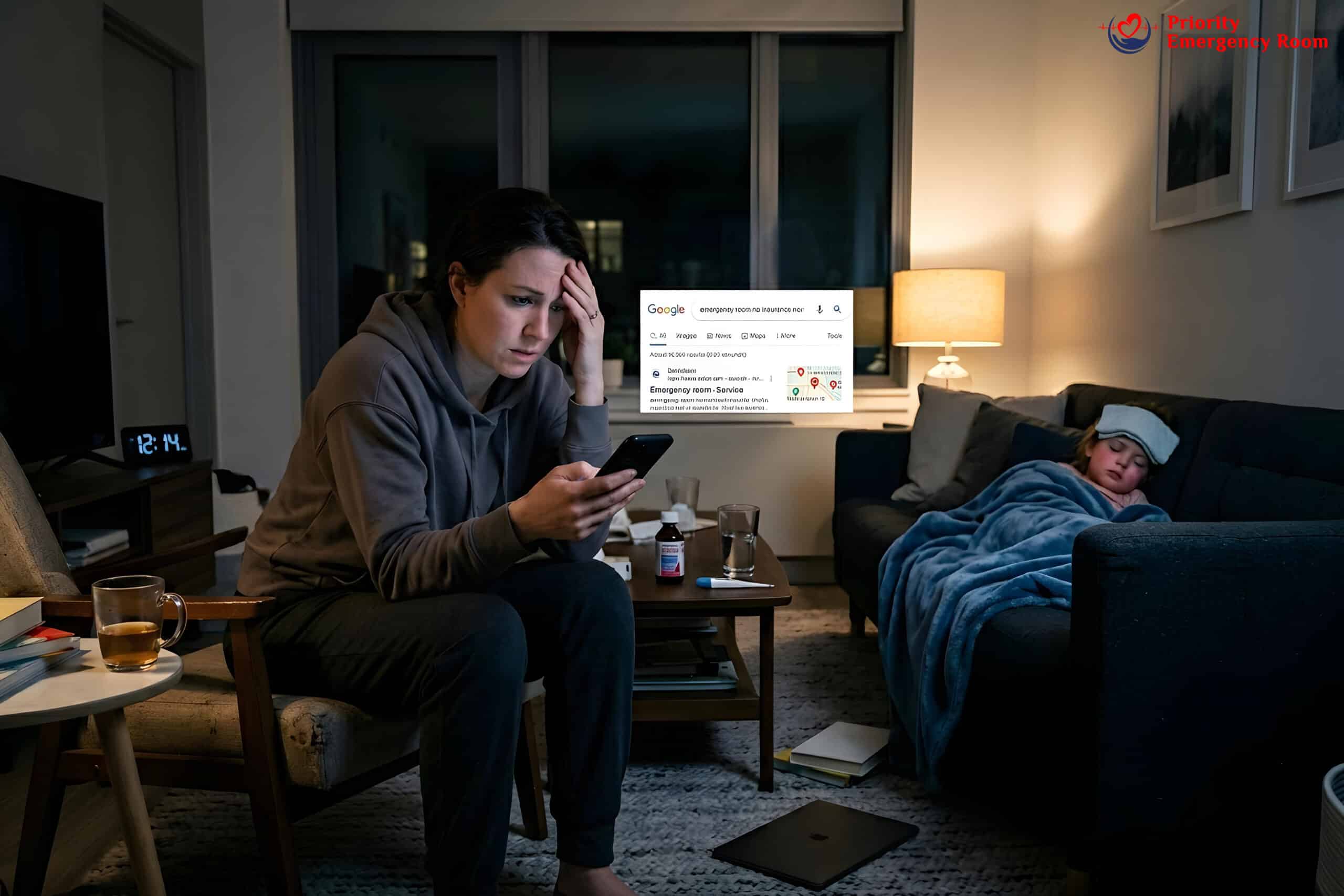
You know this feeling. The pediatrician said it was pneumonia and sent you home with antibiotics. You’ve been doing everything right—giving the medicine on schedule, pushing fluids, keeping them resting. But something has shifted. Your child’s breathing is faster than before. You can hear a wheeze that wasn’t there yesterday. They barely touched dinner and just threw up the evening dose of antibiotics. Now it’s late, the pediatrician’s office is closed, and you’re watching your child’s chest rise and fall way too quickly, wondering: when is it time to go to the ER with pneumonia?
Stop. Before you talk yourself into waiting until morning, you need to know something that could change everything about the next few hours.
Here’s what most parents don’t realize: Pneumonia doesn’t always follow a straight line from sick to better. Sometimes it plateaus. Sometimes it gets suddenly worse—even after antibiotics have started. The moment your child’s body starts visibly working to breathe—chest pulling in, nostrils widening, belly pumping with each breath—that’s your child’s respiratory system telling you it can’t keep up. Add in a fever that won’t respond to medication, vomiting that prevents keeping antibiotics down, or a child who’s too exhausted to stay awake, and you’ve crossed the line from “watch and wait” to “go now.” If your child is struggling to breathe or deteriorating despite treatment, you need an ER with chest imaging, oxygen support, IV antibiotics, and real-time monitoring—tonight, not tomorrow morning.
Watching at Home vs. Going to the ER: What’s the Actual Difference?
This isn’t about panicking or second-guessing the pediatrician. It’s about understanding what changes in your child’s condition mean the at-home plan is no longer enough—and what the ER can do that your kitchen table can’t.
Emergency physicians use something called the Pediatric Assessment Triangle to evaluate children in under 30 seconds. You can use the same approach at home—right now, tonight.
A — Appearance: Is your child alert and responsive? Look for eye contact, normal crying with tears, and good muscle tone. Warning signs: limp or floppy body, won’t make eye contact, unusually quiet or inconsolable.
B — Breathing: Is breathing quiet and effortless? Can they speak in full sentences? Warning signs: visible rib movement with each breath, nasal flaring, grunting sounds, can only speak one or two words at a time.
C — Circulation: Is skin color normal? Are hands and feet warm? Warning signs: pale or gray skin, blue lips or fingertips, blotchy appearance, cold extremities.
If all three look normal, your child is likely stable enough to continue home care and follow up with the pediatrician. If any one of these looks off—especially breathing—that’s your answer. It’s time to go to the ER. With pneumonia, “B” for breathing is the one that matters most, and changes can happen fast.
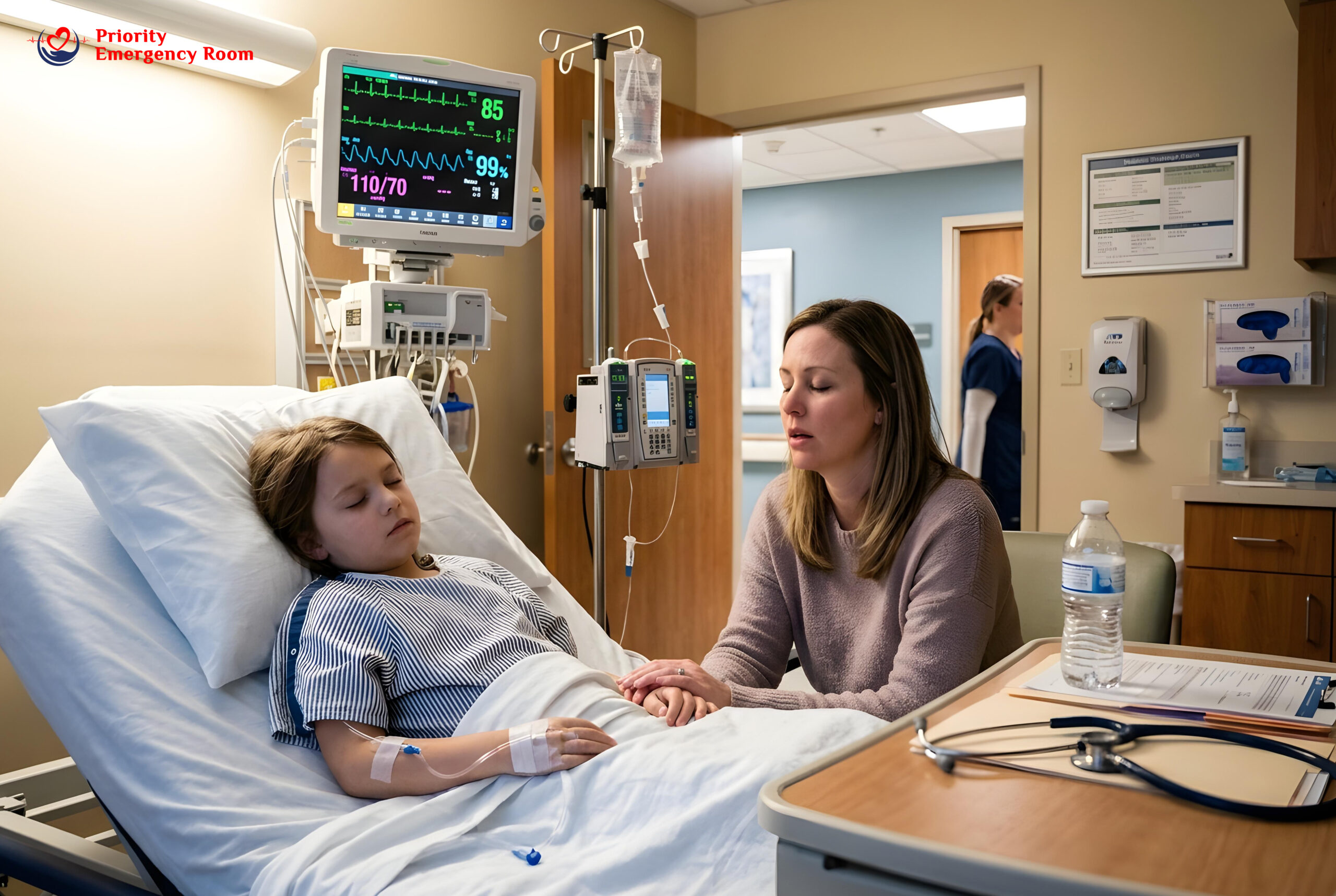
If your child’s pneumonia has gotten bad enough that you’re ready to leave the house at night, don’t waste time at urgent care. Urgent care cannot provide oxygen when your child’s levels are dropping. They cannot start IV antibiotics when oral medication won’t stay down. They cannot give IV fluids for dehydration. They cannot continuously track oxygen saturation. And most close by 9 or 10 PM—exactly when pneumonia symptoms tend to spike. If breathing is labored, urgent care will just tell you to go to the ER. Skip the detour. Every Priority ER location has on-site chest X-ray, oxygen therapy, IV antibiotics, and continuous monitoring—truly open 24 hours a day, 365 days a year.
When Staying Home is Totally Fine
Not every rough night with pneumonia means a trip to the ER. Many children recover fully at home with antibiotics, rest, and fluids. Knowing what “normal recovery” looks like helps you recognize when things have gone off track.
Conditions Appropriate for Urgent Care / Clinic
Stable vital signs • Alert and responsive • No respiratory distress
The key word is improving. When your child with pneumonia is breathing comfortably at rest, keeping antibiotics and fluids down, has a fever that responds to Tylenol or Motrin, and is slowly perking up over the first couple of days—the home plan is working. But when that trajectory reverses—when breathing gets harder instead of easier, when fever climbs instead of falling, when they stop eating and drinking—that’s when you need to go to the ER with pneumonia. Don’t wait for it to become obvious.
When Your Child Needs the ER Right Now
Parents know. There’s a difference between “slow recovery” and “this is going the wrong direction.” Trust that instinct. Here’s what our pediatric emergency team says warrants going to the ER immediately:
Emergency
High Fever (103°F+)
Especially dangerous in infants under 3 months. Seek ER care if fever comes with stiff neck, severe headache, or rash. We provide febrile seizure treatment when needed.
Emergency
Difficulty Breathing
Ribs showing with each breath, lips turning blue, grunting, or unable to speak in full sentences. Get help for respiratory distress immediately.

Emergency
Severe Dehydration
No wet diapers for 8+ hours, no tears when crying, sunken soft spot in infants, or very dry mouth and lips. We offer dehydration and vomiting treatment.
Emergency
Worsening Despite Antibiotics
If symptoms are getting worse after 48-72 hours on prescribed antibiotics, your child may need IV medications and respiratory support.
Trust Your Parental Instincts
You’ve been watching your child breathe all night. You know what their breathing sounds like when it’s manageable and when it’s getting worse. If you’re counting breaths, if you’re checking their lips for color changes, if you can’t sleep because something feels wrong—that’s your answer. Go to the ER. You don’t need to justify it. Parents know their children better than anyone.
Built for Reliability When It Matters Most
When you’ve decided it’s time to go to the ER with pneumonia, you need certainty—not a 3-hour wait in a crowded hospital lobby. Here’s what makes Priority ER different:
The Difference at 2 AM with Pneumonia
Hospital ER
3+ hours
Average wait in Texas
Priority ER
Minutes
Straight to a room
CT Scans
On-site, results in minutes
Full Lab
No waiting for off-site results
Real ER
Board-certified ER physicians
Imaging to see what’s happening in the lungs. Oxygen to help them breathe.
IV antibiotics and fluids to turn it around—without the hospital ER wait.
What to Expect When You Arrive
Knowing what happens next can help both you and your child feel calmer. Here’s how a Priority ER visit typically unfolds:
Your Priority ER Visit
From arrival to answers
0-2 minutes
2-5 minutes
5-10 minutes
10-30 minutes
30-60 minutes
Immediate Greeting (0-2 min)
You’re greeted the moment you walk in. No clipboard, no waiting for someone to notice you.
Private Room (2-5 min)
Your child goes straight to a private treatment room. Family stays together.
Physician Exam (5-10 min)
A board-certified ER doctor examines your child and explains what’s next.
Testing (10-30 min)
Any needed labs, imaging, or tests—all done on-site with fast results.
Answers & Treatment (30-60 min)
Diagnosis explained, treatment provided, discharge instructions given. You leave with answers.
Compare that to a typical hospital ER: wait for triage, wait for a room, wait for a doctor, wait for lab results, wait for imaging results… You could spend 4-6 hours for the same care that takes under an hour at Priority ER.²
When Your Child’s Pneumonia Takes a Turn
Board-certified emergency physicians. Pediatric expertise. Chest imaging, oxygen support, IV antibiotics, and full lab on-site. Zero wait time. This is what real pediatric emergency care looks like.
Priority ER Locations
All locations are equipped with pediatric emergency capabilities and staffed by board-certified emergency physicians.
🌵 Odessa (West Texas)
3800 E 42nd St, Suite 105
Odessa, TX 79762
Serving Odessa, Midland, Gardendale, Greenwood & the Permian Basin
🏛 Round Rock (Austin Area)
1700 Round Rock Ave
Round Rock, TX 78681
Serving Round Rock, Cedar Park, Pflugerville, Georgetown & North Austin
⭐ McKinney (North Dallas)
5000 Eldorado Pkwy
McKinney, TX 75072
Serving McKinney, Frisco, Allen, Prosper & Collin County
🏙 Pantego (Arlington)
1607 S Bowen Rd
Pantego, TX 76013
Serving Arlington, Pantego, Grand Prairie & Mid-Cities DFW
🌊 Rockwall (East Dallas)
2265 N Lakeshore Dr #100
Rockwall, TX 75087
Serving Rockwall, Heath, Rowlett, Fate & Lake Ray Hubbard area
The Bottom Line for Parents
When you’re searching “when to go to the ER with pneumonia” while watching your child struggle to breathe at 2 AM, here’s the answer: go now if breathing is rapid or labored with visible chest retractions, if their lips or fingernails are changing color, if fever is above 103°F and not responding to medication, if they’re vomiting and can’t keep antibiotics or fluids down, if they’re showing signs of dehydration, or if they seem unusually sleepy or hard to rouse. Also go if symptoms are getting worse after two to three days on prescribed antibiotics—that may mean the infection isn’t responding.
Know the difference: pneumonia that’s slowly improving at home is manageable. Pneumonia that’s going the wrong direction needs the ER. And Priority ER gives you full emergency room capabilities—pneumonia emergency care, advanced imaging, on-site labs—without the chaos and hours-long wait of a hospital ER.
When your gut says your child’s pneumonia is heading in the wrong direction, trust it. And come to a place that can image the lungs, check oxygen levels, start IV antibiotics and fluids, and monitor your child continuously—any time, day or night.
Medical References
- American College of Emergency Physicians. (2024). “Emergency Management of Pediatric Pneumonia.” ACEP Clinical Practice Guidelines. Retrieved from https://www.acep.org/
- Texas Department of State Health Services. (2024). “Emergency Department Utilization for Pediatric Respiratory Conditions in Texas.” Regional Health Report. Retrieved from https://www.dshs.texas.gov/
- Priority ER Internal Data. (2024). “Annual Patient Outcomes and Emergency Care Statistics.” Quality Assurance Report.
- American College of Radiology. (2024). “Chest Imaging Standards for Pediatric Pneumonia Evaluation.” ACR Technical Standards. Retrieved from https://www.acr.org/
- American Academy of Pediatrics. (2024). “Clinical Practice Guideline for the Management of Community-Acquired Pneumonia in Infants and Children.” AAP Clinical Guidelines. Retrieved from https://www.aap.org/
- National Emergency Medicine Association. (2024). “Recognizing Pneumonia Deterioration in Pediatric Patients: Emergency Department Guidelines.” Journal of Emergency Medicine, 48(9), 542-549.
- Mayo Clinic. (2024). “Pneumonia in Children: Signs That Home Care Is Not Enough.” Mayo Clinic Proceedings. Retrieved from https://www.mayoclinic.org/
- Healthcare Cost and Utilization Project. (2024). “Emergency Department Visits and Hospitalizations for Pediatric Pneumonia.” HCUP Statistical Brief #182. Retrieved from https://hcup-us.ahrq.gov/
- Infectious Diseases Society of America. (2024). “Guidelines for Management of Community-Acquired Pneumonia in Children.” IDSA Guidelines. Retrieved from https://www.idsociety.org/