
Tooth Pain at 2 AM. Your Face is Swelling. Will the ER Help?
You know this feeling. That throbbing tooth pain that’s been building for days has now turned into something worse—your face is swelling, the pain is unbearable, and you’re desperately searching “ER tooth extraction” hoping someone can just pull the tooth and end this nightmare tonight.
Stop. Before you drive to the wrong place with the wrong expectations, you need to know something that could change everything about the next few hours.
Here’s what most people don’t realize: Emergency rooms don’t perform tooth extractions—that’s not what they’re equipped for. But that doesn’t mean the ER can’t help you. When dental problems become life-threatening—spreading infections, dangerous swelling, uncontrolled bleeding—the ER can save your life with antibiotics, pain control, and stabilization before you see a dentist.
ER vs. Dentist: What’s the Actual Difference?
This isn’t about what you want—it’s about what each place can actually do for you. Understanding this difference can save you time, money, and frustration at 2 AM. Many people wonder “do emergency rooms pull teeth“—the short answer is no, but they can provide critical emergency care.
Use this quick assessment to determine where you should go:
S — Swelling: Is any swelling limited to the gum area? Can you open your mouth normally? Warning signs: swelling spreading to cheek, eye, or neck; difficulty opening mouth; swelling under tongue.
B — Breathing/Swallowing: Can you breathe and swallow normally? Is your voice normal? Warning signs: difficulty breathing, trouble swallowing, muffled voice, drooling.
F — Fever: Is your temperature normal? Do you feel generally okay aside from tooth pain? Warning signs: fever over 101°F, chills, feeling very sick, confusion.
If all three look okay, you likely need a dentist (possibly an emergency dentist). If any one of these looks concerning, go to the ER immediately—the infection may be spreading dangerously.
The ER cannot extract teeth, fill cavities, or provide definitive dental treatment. But they CAN provide IV antibiotics for dangerous infections, drain abscesses, control severe pain, stop bleeding, and stabilize life-threatening situations. If you’re wondering “what will the ER do for tooth pain,” know that after the ER stabilizes you, you’ll still need to see a dentist for the actual extraction.
When You Just Need a Dentist
Not every dental emergency requires the ER. Many situations—even painful ones—are best handled by a dentist or urgent dental care. Save yourself time and money when the situation calls for it.
Situations That Need a Dentist, Not the ER
No spreading swelling • No breathing difficulty • No high fever
The key word is localized. When the problem stays at the tooth and you’re otherwise okay—find a dentist, even an emergency dental clinic. But when infection spreads, when breathing gets difficult, or when you’re getting sicker—that’s when you need emergency-level care.
When Dental Problems Need the ER Right Now
Some dental problems become medical emergencies. There’s a difference between “need a dentist” and “need emergency care now.” Trust that instinct. Here’s what our intense toothache treatment team says warrants immediate ER care:

Emergency
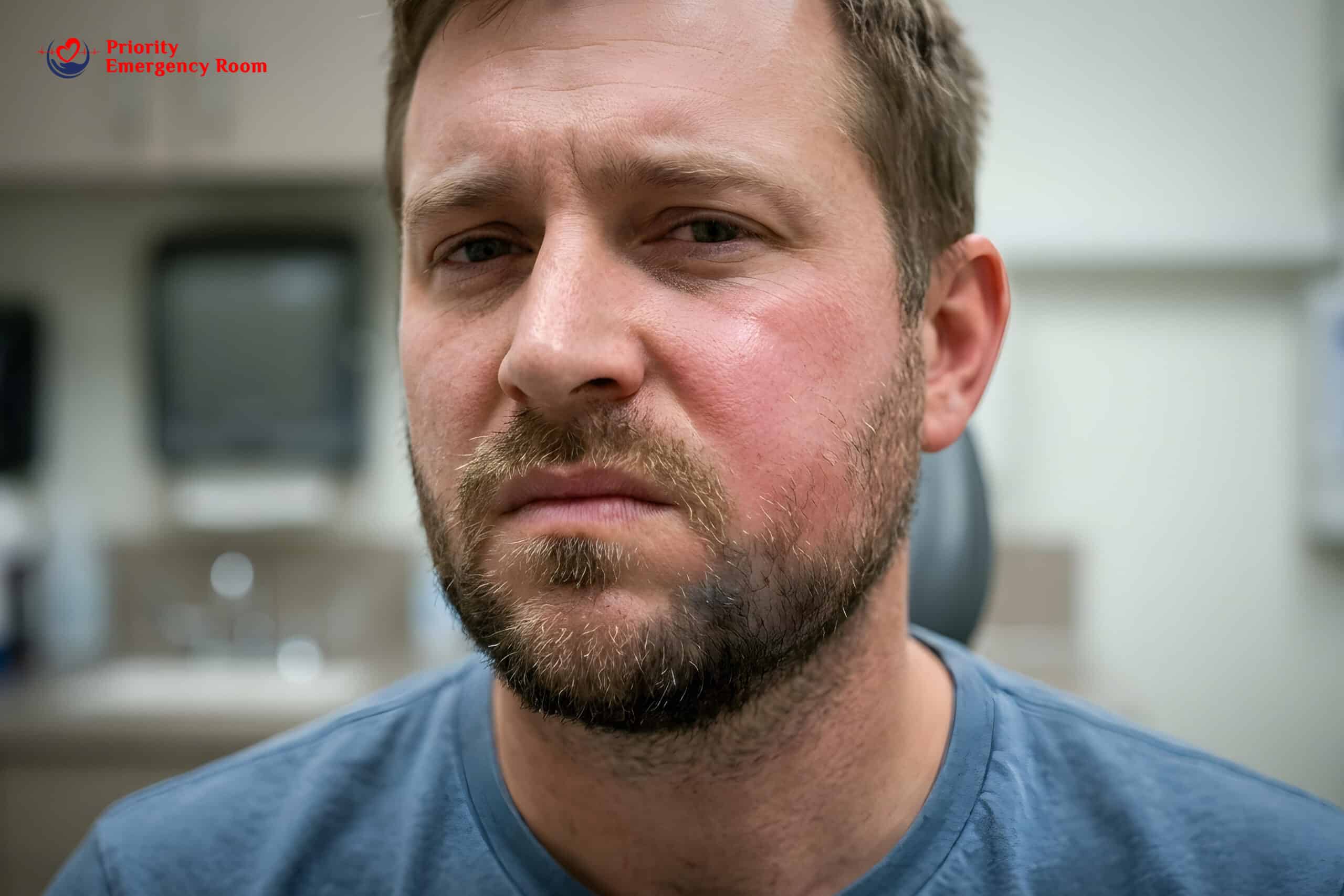
Spreading Facial Swelling
Swelling that has spread beyond the gum to your cheek, under your eye, down your neck, or under your tongue. This indicates a spreading infection that can become life-threatening.
Emergency
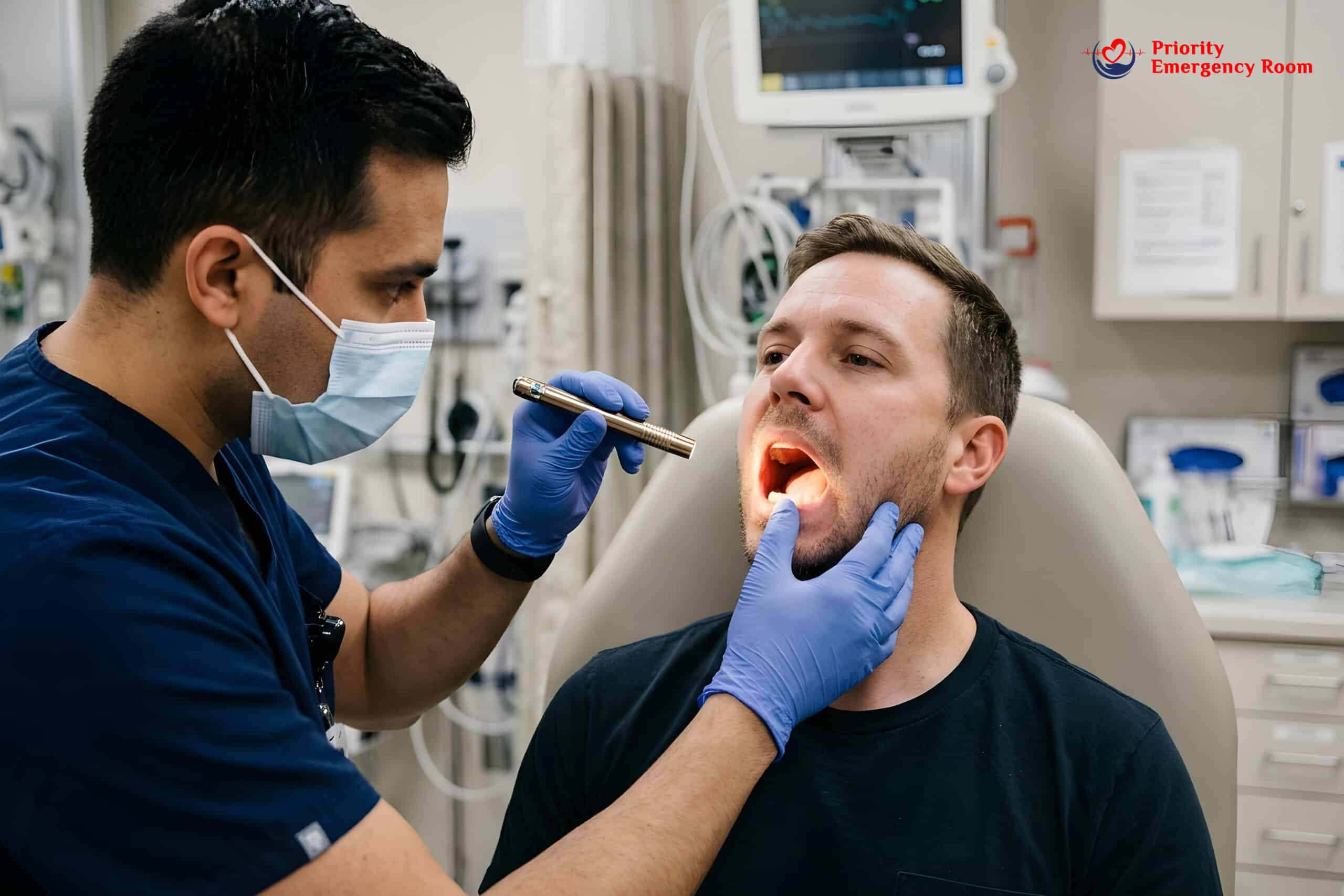
Difficulty Breathing or Swallowing
If swelling is making it hard to breathe, swallow, or open your mouth, the infection may be compromising your airway—this is a life-threatening emergency.
Emergency
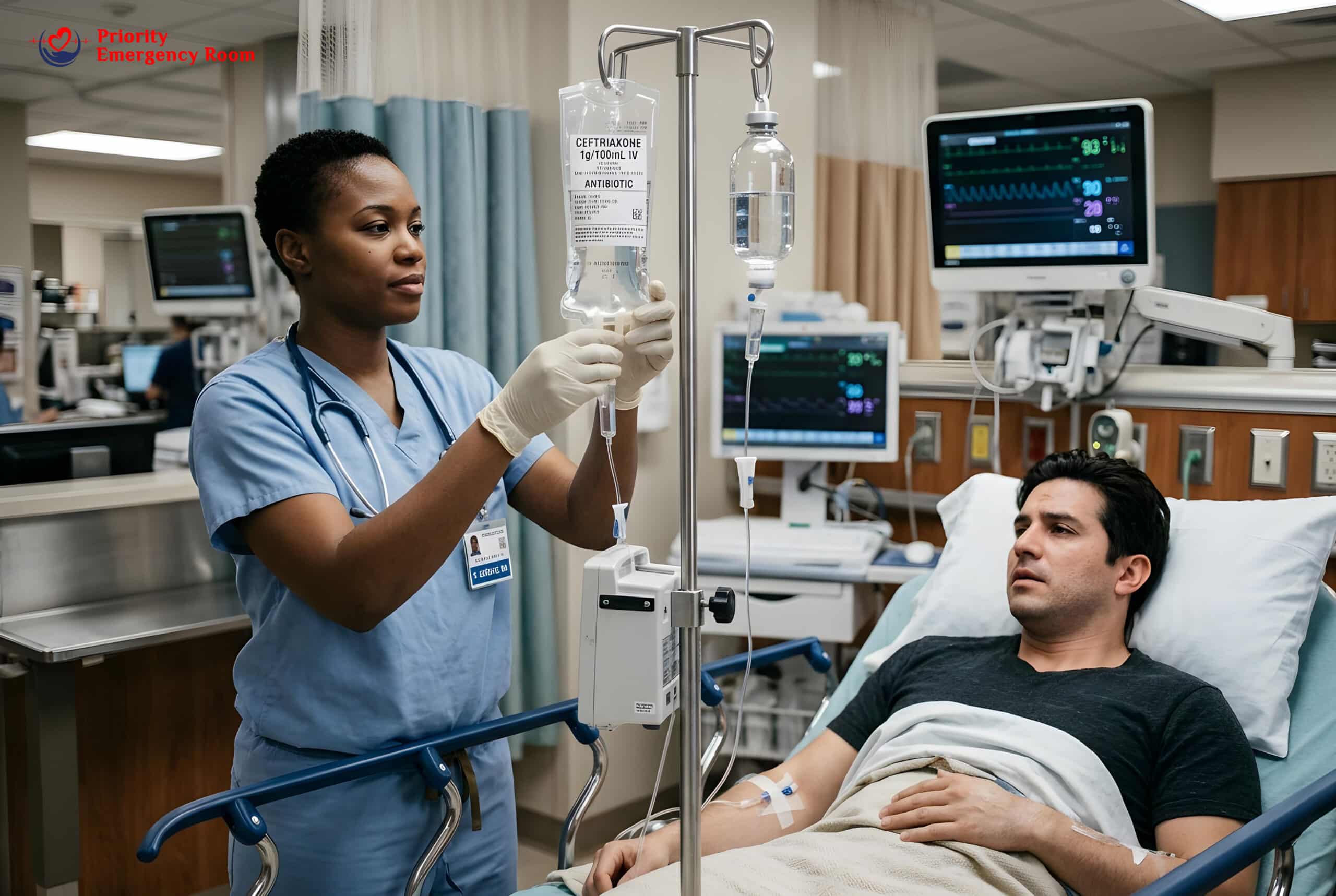
Fever Over 101°F
High fever with dental pain or swelling indicates the infection has entered your bloodstream. This can progress to sepsis without IV antibiotics.
Emergency
Trauma to Face or Jaw
Injury causing possible broken jaw, multiple knocked-out teeth, or deep lacerations to mouth, lips, or tongue needs emergency evaluation and imaging.
Trust Your Instincts
If something feels really wrong—even if you can’t explain why—go to the ER. They may not extract your tooth, but they can treat dangerous infections and control severe pain. That gut feeling exists for a reason.
Built for Reliability When It Matters Most
When a dental problem becomes a medical emergency at 2 AM, you need certainty—not “maybe” or “we’ll see.” Here’s what makes Priority ER different:
The Difference at 2 AM
Hospital ER
3+ hours
Average wait in Texas
Priority ER
Minutes
Straight to a room
IV Antibiotics
For dangerous infections
Pain Control
When OTC meds fail
Real ER
Board-certified ER physicians
Same capabilities as a hospital ER.
Without the chaos.
What to Expect When You Arrive
Knowing what happens next can help you understand what the ER can do for dental emergencies. Here’s how a Priority ER visit typically unfolds:
Your Priority ER Visit
From arrival to stabilization
0-2 minutes
2-5 minutes
5-15 minutes
15-45 minutes
45-90 minutes
Immediate Greeting (0-2 min)
You’re greeted the moment you walk in. No clipboard, no waiting for someone to notice your swollen face.
Private Room (2-5 min)
You go straight to a private treatment room for evaluation.
Exam & Pain Control (5-15 min)
The physician examines your mouth, checks for airway concerns, and starts pain management.
Antibiotics & Treatment (15-45 min)
If infection is present, IV antibiotics begin working. Abscesses may be drained. Pain is controlled.
Discharge & Dental Referral (45-90 min)
You’re discharged with prescriptions, pain control, and referral to a dentist or oral surgeon for definitive treatment (extraction).
Compare that to a typical hospital ER: wait for triage, wait for a room, wait for evaluation, wait for antibiotics… You could spend 4-6 hours in agony for the same care that takes under 90 minutes at Priority ER.²
When Dental Problems Become Medical Emergencies
Board-certified emergency physicians. IV antibiotics for dangerous infections. Pain management that works. Zero wait time. We stabilize dental emergencies—then connect you with a dentist for extraction.
Priority ER Locations
All locations are staffed by board-certified emergency physicians who can treat dental emergencies with IV antibiotics, pain management, and abscess drainage when needed.
🌵 Odessa (West Texas)
3800 E 42nd St, Suite 105
Odessa, TX 79762
Serving Odessa, Midland, Gardendale, Greenwood & the Permian Basin
🏛 Round Rock (Austin Area)
1700 Round Rock Ave
Round Rock, TX 78681
Serving Round Rock, Cedar Park, Pflugerville, Georgetown & North Austin
⭐ McKinney (North Dallas)
5000 Eldorado Pkwy
McKinney, TX 75072
Serving McKinney, Frisco, Allen, Prosper & Collin County
🏙 Pantego (Arlington)
1607 S Bowen Rd
Pantego, TX 76013
Serving Arlington, Pantego, Grand Prairie & Mid-Cities DFW
🌊 Rockwall (East Dallas)
2265 N Lakeshore Dr #100
Rockwall, TX 75087
Serving Rockwall, Heath, Rowlett, Fate & Lake Ray Hubbard area
The Bottom Line on ER Care for Dental Emergencies
When you’re searching “ER tooth extraction” at 2 AM with a swollen face, here’s the truth: the ER won’t extract your tooth. But that doesn’t mean they can’t help. When dental infections spread, when swelling threatens your airway, when you’re getting sicker—the ER can save your life with IV antibiotics and stabilization.
Know the difference: if you just need a tooth pulled without emergency symptoms, find a dentist. But spreading swelling, high fever, difficulty breathing or swallowing, or severe uncontrolled pain means you need an ER—now. Priority ER will stabilize you, control your pain, treat your infection, and connect you with a dentist for the extraction.
When your body tells you something’s really wrong, trust it. And come to a place that can actually help.
Medical References
- American College of Emergency Physicians. (2024). “Clinical Policy: Critical Issues in the Evaluation and Management of Adult Patients Presenting to the Emergency Department with Odontogenic Infections.” ACEP Clinical Policies. Retrieved from https://www.acep.org/
- American Dental Association. (2024). “Dental Emergency Guidelines.” ADA Clinical Practice Guidelines. Retrieved from https://www.ada.org/
- American Association of Oral and Maxillofacial Surgeons. (2024). “Management of Odontogenic Infections.” AAOMS Clinical Guidelines. Retrieved from https://www.aaoms.org/
- Journal of Emergency Medicine. (2024). “Ludwig’s Angina: Emergency Department Management.” Emergency Medicine Literature. Retrieved from https://www.jem-journal.com/
- Priority ER Internal Data. (2024). “Annual Emergency Department Statistics: Dental Emergency Presentations.” Quality Assurance Report.
- Centers for Disease Control and Prevention. (2024). “Oral Health Conditions.” CDC Oral Health Division. Retrieved from https://www.cdc.gov/
- Mayo Clinic. (2024). “Tooth Abscess: Diagnosis and Treatment.” Mayo Clinic Patient Care. Retrieved from https://www.mayoclinic.org/
- Healthcare Cost and Utilization Project. (2024). “Emergency Department Visits for Dental Conditions.” HCUP Statistical Brief. Retrieved from https://hcup-us.ahrq.gov/
- Texas Department of State Health Services. (2024). “Oral Health Statistics.” Regional Health Report. Retrieved from https://www.dshs.texas.gov/