

Asthma Attack ER: When to Go to the Emergency Room for Asthma
You know this feeling. Your chest is tight. You’re wheezing. Your rescue inhaler isn’t giving the relief it usually does. You’re working harder and harder to breathe. Is this asthma attack bad enough for the emergency room?
Stop. Severe asthma attacks can become life-threatening. Knowing when to go to the ER—and going quickly—can save your life. Here’s exactly how to know when you need emergency care.
Here’s when an asthma attack needs the ER: Go immediately if your rescue inhaler isn’t working after 15-20 minutes, if you can’t speak in full sentences, if your lips or fingernails are turning blue, or if you’re using your neck and chest muscles to breathe. These are signs of a severe attack that requires emergency treatment. Asthma can go from bad to life-threatening quickly. Don’t wait too long.
Home Treatment vs. ER: What’s the Difference?
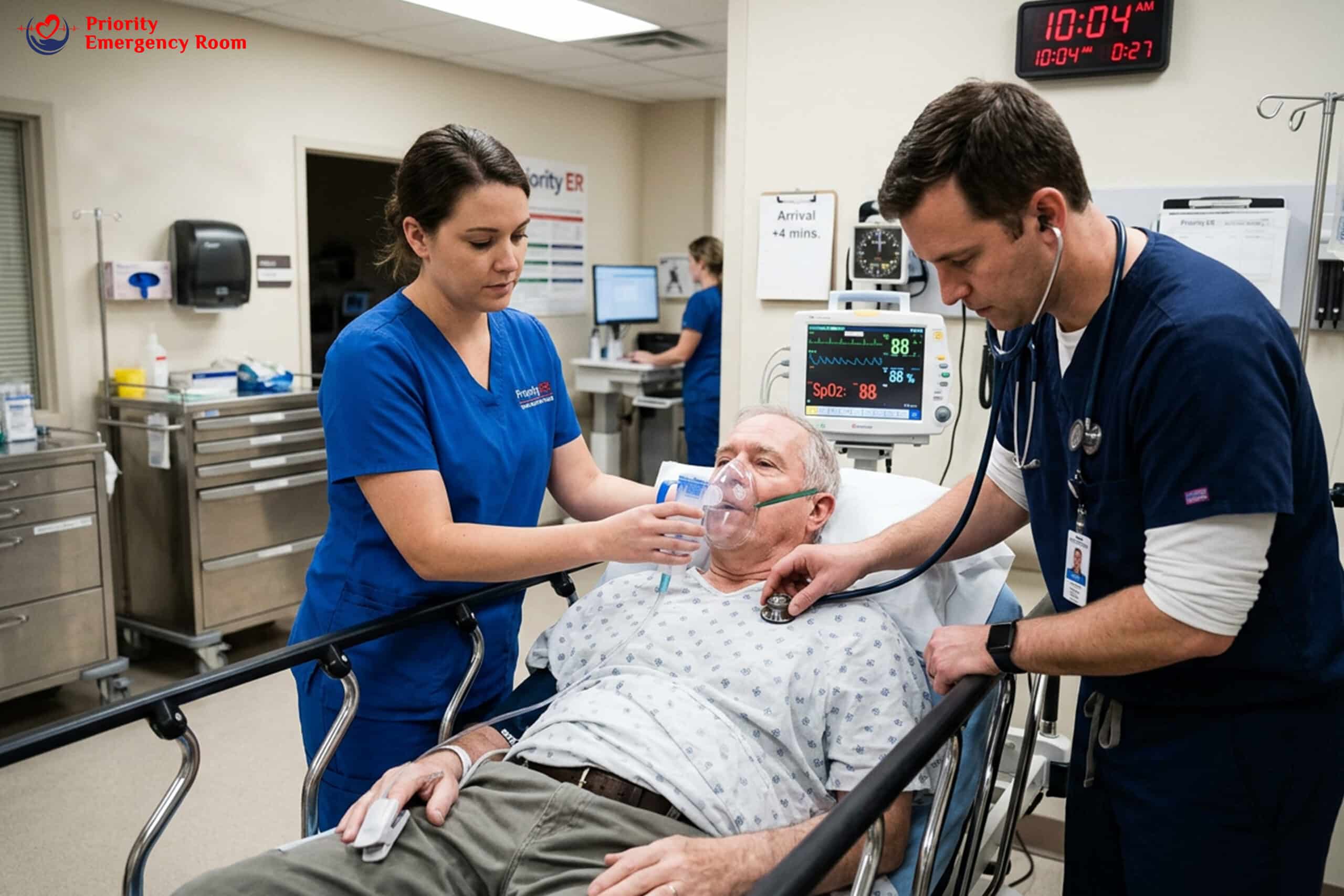
Most asthma attacks can be managed at home with your rescue inhaler. But some attacks don’t respond—and those need emergency treatment that only an ER can provide, including respiratory distress emergency care.
Here’s how to assess whether your asthma attack needs the ER:
R — Response to Rescue Inhaler: Is your inhaler working? Emergency sign: No significant improvement after using your rescue inhaler properly 2-3 times over 15-20 minutes.
E — Effort to Breathe: How hard are you working? Emergency signs: using neck/chest muscles to breathe, shoulders moving up and down with each breath, ribs visible with breathing.
S — Speech: Can you talk normally? Emergency sign: can only speak in short phrases or single words, too breathless to complete sentences.
T — Tissue Color: What color are your lips and nails? Emergency sign: blue, gray, or pale lips, tongue, or fingernails indicates dangerous oxygen levels.
If you have ANY emergency signs, go to the ER immediately. Don’t wait to see if things improve.
Blue or gray lips, tongue, or fingernails mean your oxygen levels are dangerously low. This is a medical emergency. Call 911 or have someone drive you to the ER immediately. Don’t drive yourself if you’re having severe breathing difficulty.
When Asthma Can Be Managed at Home
Most asthma attacks can be controlled with your rescue inhaler and your asthma action plan. Here’s when home management is appropriate.
Asthma Symptoms That May Not Need the ER
Rescue inhaler working • Speaking normally • Normal color • Mild to moderate symptoms
The key factor is whether your rescue inhaler is working. If it’s providing relief and you’re improving, you can likely manage at home. If it’s not working, you need the ER.
When an Asthma Attack Needs the ER
These asthma symptoms require immediate emergency care. Don’t wait. Our asthma exacerbation treatment team says these need urgent attention:

Emergency
Rescue Inhaler Not Working
If your rescue inhaler isn’t providing relief after 2-3 uses over 15-20 minutes, you need emergency treatment—nebulizers and steroids that work faster and stronger.

Emergency
Can’t Speak in Full Sentences
If you’re too breathless to speak in complete sentences—only getting out a few words at a time—your oxygen is being compromised. Go to the ER.
Emergency
Blue Lips or Fingernails
Blue, gray, or pale coloring of lips, tongue, or fingernails indicates dangerously low oxygen levels. Call 911 or go to the ER immediately.
Emergency
Using Neck/Chest Muscles to Breathe
Visible muscles in your neck straining, ribs showing with each breath, or shoulders hunching up and down means you’re working dangerously hard to breathe.
When in Doubt, Go
If you’re scared, if something feels different about this attack, or if you’re unsure whether you should go to the ER—go. Severe asthma attacks can progress rapidly. It’s always better to be evaluated and sent home than to wait too long at home.
Built for Respiratory Emergencies
When your asthma attack needs more than your rescue inhaler, you need immediate treatment. Here’s what makes Priority ER different:
The Difference at 2 AM
Hospital ER
3+ hours
Average wait in Texas
Priority ER
Minutes
Straight to a room
Nebulizers
Stronger than home inhaler
IV Steroids
Fast-acting treatment
Oxygen
Immediate supplementation
Same capabilities as a hospital ER.
Without the chaos.
What to Expect When You Arrive
Here’s how a Priority ER asthma visit unfolds:
Your Priority ER Visit
From arrival to breathing easier
0-2 minutes
2-5 minutes
5-10 minutes
10-60 minutes
60-120 minutes
Immediate Triage (0-2 min)
Breathing problems are top priority. You’re seen immediately.
Oxygen & Nebulizer (2-5 min)
Oxygen placed, nebulizer treatment started immediately. Relief begins.
Physician Exam (5-10 min)
Doctor listens to your lungs, checks oxygen levels, orders additional treatment.
Treatment (10-60 min)
Continued nebulizers, steroids, additional medications as needed.
Breathing Better (60-120 min)
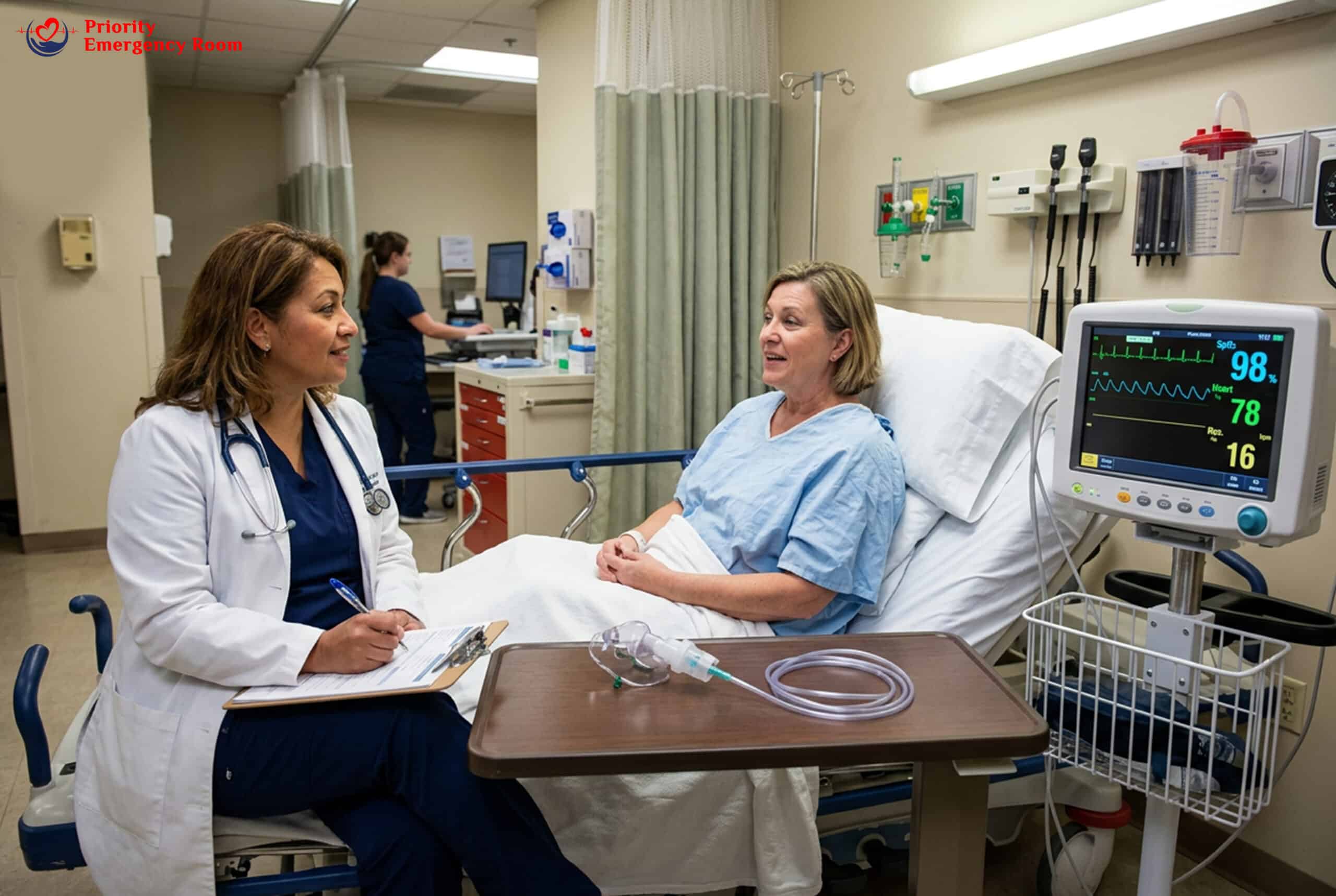
Once breathing is stable, discharged with prescriptions and follow-up plan.
At Priority ER, treatment begins within minutes of arrival—no waiting hours while struggling to breathe. Find a 24-hour emergency room near you.²
When Your Inhaler Isn’t Enough
Board-certified emergency physicians. Nebulizers. IV steroids. Oxygen. Immediate treatment. Zero wait time.
Priority ER Locations
All locations have nebulizers, IV medications, oxygen, and board-certified emergency physicians ready to treat asthma emergencies.
🌵 Odessa (West Texas)
3800 E 42nd St, Suite 105
Odessa, TX 79762
Serving Odessa, Midland, Gardendale, Greenwood & the Permian Basin
🏛 Round Rock (Austin Area)
1700 Round Rock Ave
Round Rock, TX 78681
Serving Round Rock, Cedar Park, Pflugerville, Georgetown & North Austin
⭐ McKinney (North Dallas)
5000 Eldorado Pkwy
McKinney, TX 75072
Serving McKinney, Frisco, Allen, Prosper & Collin County
🏙 Pantego (Arlington)
1607 S Bowen Rd
Pantego, TX 76013
Serving Arlington, Pantego, Grand Prairie & Mid-Cities DFW
🌊 Rockwall (East Dallas)
2265 N Lakeshore Dr #100
Rockwall, TX 75087
Serving Rockwall, Heath, Rowlett, Fate & Lake Ray Hubbard area
The Bottom Line: When to Go to the ER for an Asthma Attack
Go to the ER for an asthma attack when your rescue inhaler isn’t working, when you can’t speak in full sentences, when your lips or nails are turning blue, or when you’re using neck and chest muscles to breathe. These indicate a severe attack requiring emergency treatment.
Priority ER has nebulizers, IV steroids, oxygen, and board-certified emergency physicians ready to help you breathe—without the hours of waiting at a hospital ER. We also offer arterial blood gas testing and rapid infection panels to ensure accurate diagnosis.
When your inhaler isn’t enough, come get treatment that works.
Medical References
- National Heart, Lung, and Blood Institute. (2024). “Guidelines for the Diagnosis and Management of Asthma.” NHLBI. Retrieved from https://www.nhlbi.nih.gov/
- American College of Emergency Physicians. (2024). “Clinical Policy: Acute Asthma Exacerbations.” ACEP. Retrieved from https://www.acep.org/
- Global Initiative for Asthma. (2024). “GINA Guidelines for Asthma Management.” Retrieved from https://ginasthma.org/
- American Academy of Allergy, Asthma & Immunology. (2024). “Asthma Emergency Care.” Retrieved from https://www.aaaai.org/
- Priority ER Internal Data. (2024). “Respiratory Emergency Statistics.” Quality Assurance Report.
- American Lung Association. (2024). “Asthma Attack.” Retrieved from https://www.lung.org/
- Asthma and Allergy Foundation of America. (2024). “Asthma Action Plans.” Retrieved from https://www.aafa.org/
- Healthcare Cost and Utilization Project. (2024). “ED Visits for Asthma.” Retrieved from https://hcup-us.ahrq.gov/
- Texas Department of State Health Services. (2024). “Emergency Department Statistics.” Retrieved from https://www.dshs.texas.gov/