

Emergency Room vs Hospital: What’s the Difference and Where Should You Go?
You’re facing a medical emergency and need help fast. But should you go to the hospital, or is there an emergency room nearby that can help? Are they the same thing? Does it matter which one you choose?
Stop. Understanding the difference between emergency rooms and hospitals—and knowing which to choose—can save you time, money, and potentially your life. Here’s what you need to know.
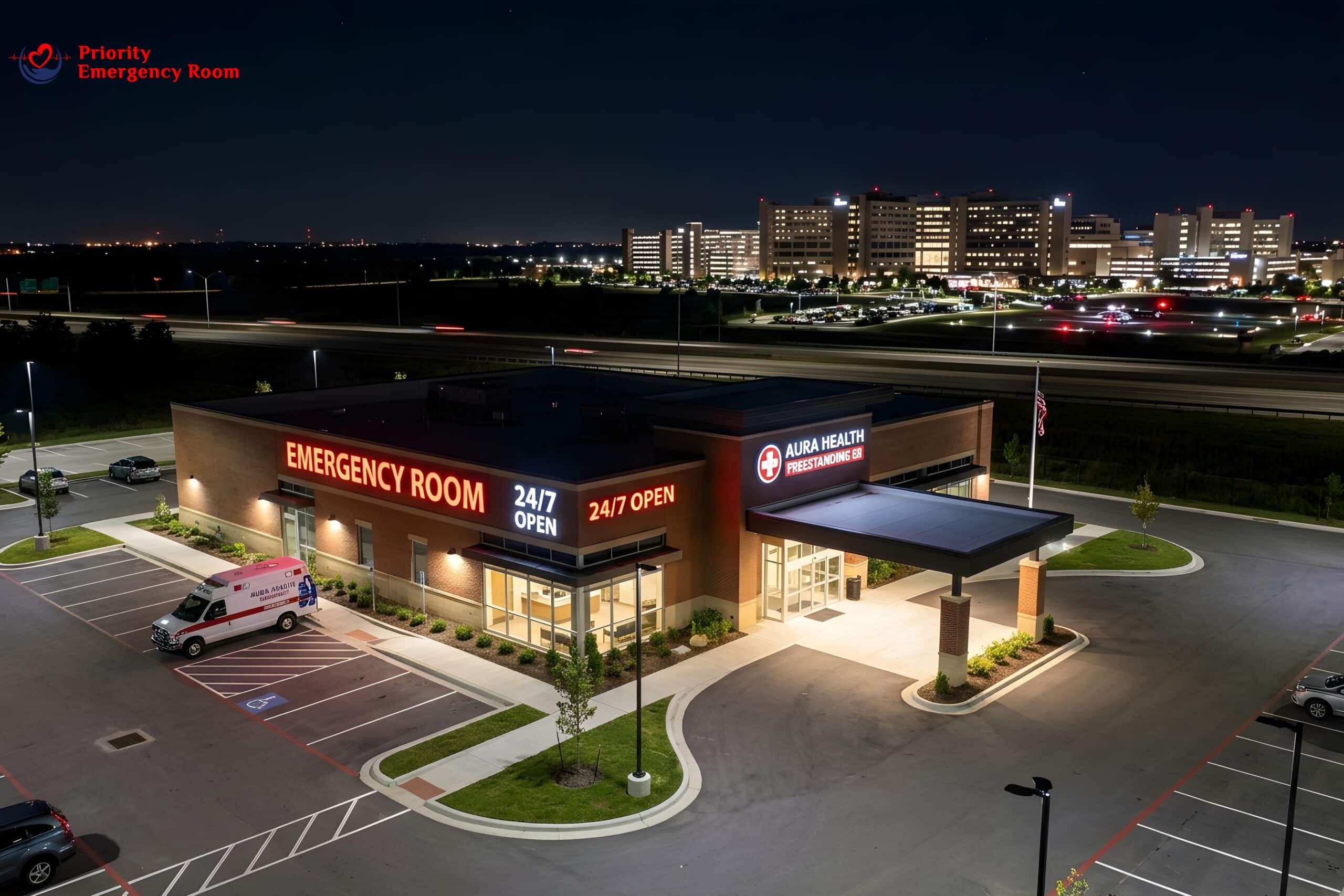
Here’s the key difference: A hospital is a large facility with inpatient beds, operating rooms, and many departments. An emergency room (ER) is the department that handles emergencies—it can be inside a hospital OR in a freestanding building. Freestanding ERs like Priority ER have the same capabilities as hospital ERs (CT, labs, ER physicians) but typically with much shorter wait times. For most emergencies, the closest ER is your best choice.
Hospital ER vs. Freestanding ER: The Real Differences
Understanding these facilities helps you make the right choice in an emergency. Here’s what each type offers:
Hospital Emergency Room: Part of a large hospital with inpatient beds, operating rooms, ICU, and specialist departments. Can admit patients directly. Typically has longer wait times due to high volume.
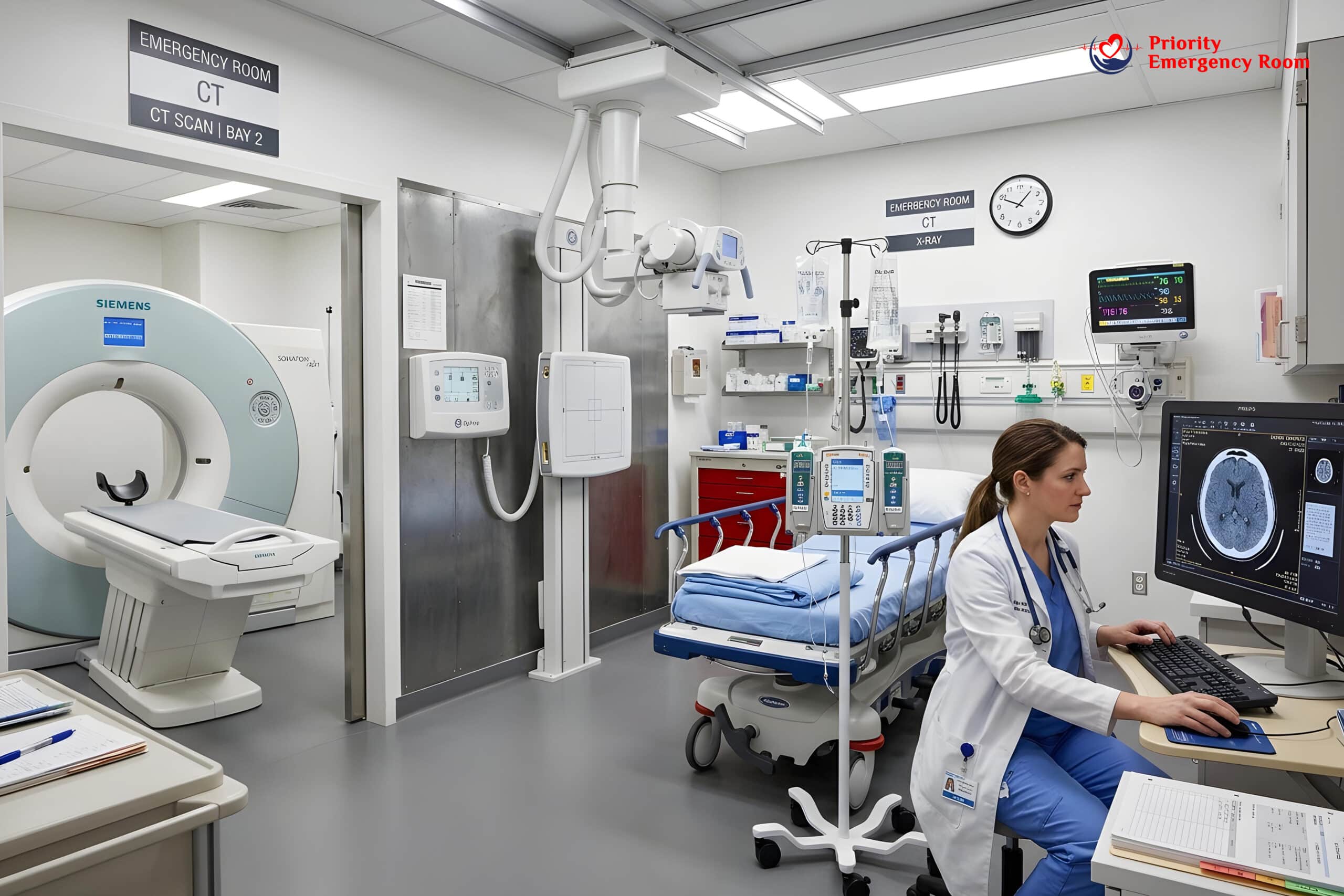
Freestanding Emergency Room: Independent facility with full ER capabilities—board-certified ER physicians, CT/X-ray, labs, emergency medications. Cannot admit patients (transfers if needed). Typically has much shorter wait times.
What They Have in Common:
- Board-certified emergency physicians
- CT scanners and X-ray
- On-site laboratory
- Emergency medications and treatments
- Ability to stabilize any emergency
- Open 24/7/365
Don’t confuse freestanding emergency rooms with urgent care clinics. Urgent care centers are NOT ERs—they typically don’t have CT scanners, can’t handle serious emergencies, and may not be open 24 hours. If you have a true emergency, you need an actual emergency room. Learn more about the differences between ER and urgent care.
When a Freestanding ER is the Right Choice
For most emergency situations, a freestanding ER like Priority ER provides everything you need—often with significantly shorter wait times. Our 24-hour emergency rooms handle the same conditions as hospital ERs.
Conditions a Freestanding ER Can Handle
Full emergency capabilities • Shorter wait times • Same equipment as hospital ER
For most emergencies, the faster you get evaluated and treated, the better. Freestanding ERs like Priority ER often have wait times measured in minutes rather than hours—that difference can matter.
When You Might Need a Hospital ER
Some situations may benefit from going directly to a hospital ER. Here’s when a hospital might be the better choice:
Hospital ER
Major Trauma
Severe car accidents, gunshot wounds, falls from significant heights, or multi-system trauma may benefit from hospital trauma centers with immediate surgical capability.
Hospital ER
Known Heart Attack or Stroke
If you’re certain you’re having a heart attack or stroke and need immediate catheterization or clot-busting treatment, a hospital with those capabilities may be preferred.
Hospital ER
Known Need for Surgery
If you already know you need emergency surgery (like a ruptured appendix or complicated fracture), a hospital ER can take you directly to the operating room.

Hospital ER
Pregnancy Emergencies
If you’re pregnant and having complications—especially in the third trimester—a hospital with labor & delivery services can provide immediate obstetric care.
The Most Important Factor: Time
In most emergencies, the speed of treatment matters more than which facility you choose. A freestanding ER with a 5-minute wait time is often a better choice than a hospital ER with a 3-hour wait—especially when the freestanding ER has the same diagnostic and treatment capabilities.
Full ER Capabilities Without the Hospital Wait
Priority ER is a freestanding emergency room with everything you’d find in a hospital ER—minus the hours of waiting:
The Wait Time Difference
Hospital ER
3+ hours
Average wait in Texas
Priority ER
Minutes
Straight to a room
CT & X-Ray
On-site, results in minutes
Full Lab
Same tests as hospital ER
Real ER
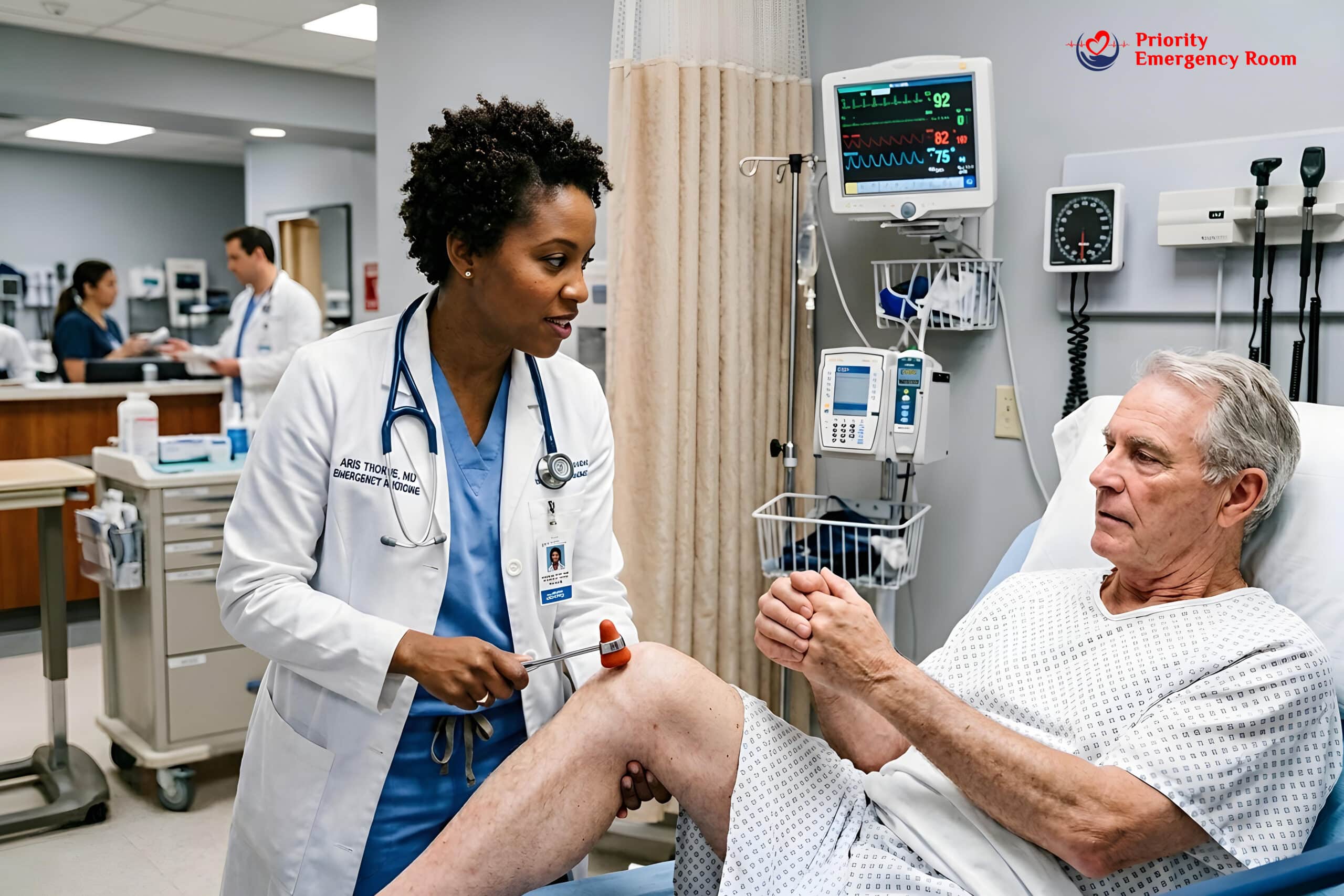
Board-certified ER physicians
Same capabilities as a hospital ER.
Without the chaos.
What to Expect at a Freestanding ER
Here’s how a visit to Priority ER typically unfolds:
Your Priority ER Visit
From arrival to answers
0-2 minutes
2-5 minutes
5-10 minutes
10-30 minutes
30-60 minutes
Immediate Greeting (0-2 min)
You’re greeted the moment you walk in. No clipboard, no waiting.
Private Room (2-5 min)
Straight to a private treatment room.
Physician Exam (5-10 min)
Board-certified ER doctor examines you and orders appropriate tests.
Testing (10-30 min)
Labs, imaging, and any needed tests—all done on-site.
Answers & Treatment (30-60 min)
Diagnosis explained, treatment provided, and follow-up arranged.
Total time from arrival to discharge is often under an hour—compared to 4-6 hours at a typical hospital ER.²
Hospital ER Capabilities. Without the Wait.
Board-certified emergency physicians. CT and X-ray on-site. Full laboratory. Same care as a hospital ER, in minutes instead of hours.
Priority ER Locations
All locations have CT scanners, X-ray, full laboratory, and board-certified emergency physicians—everything you’d find in a hospital ER. We can perform comprehensive blood work and diagnostic testing on-site.
🌵 Odessa (West Texas)
3800 E 42nd St, Suite 105
Odessa, TX 79762
Serving Odessa, Midland, Gardendale, Greenwood & the Permian Basin
🏛 Round Rock (Austin Area)
1700 Round Rock Ave
Round Rock, TX 78681
Serving Round Rock, Cedar Park, Pflugerville, Georgetown & North Austin
⭐ McKinney (North Dallas)
5000 Eldorado Pkwy
McKinney, TX 75072
Serving McKinney, Frisco, Allen, Prosper & Collin County
🏙 Pantego (Arlington)
1607 S Bowen Rd
Pantego, TX 76013
Serving Arlington, Pantego, Grand Prairie & Mid-Cities DFW
🌊 Rockwall (East Dallas)
2265 N Lakeshore Dr #100
Rockwall, TX 75087
Serving Rockwall, Heath, Rowlett, Fate & Lake Ray Hubbard area
The Bottom Line: Emergency Room vs Hospital
A hospital is a full medical facility; an emergency room is the department that handles emergencies—whether inside a hospital or as a freestanding facility. For most emergencies, a freestanding ER like Priority ER provides the same diagnostic and treatment capabilities as a hospital ER, but with significantly shorter wait times.
Priority ER has on-site CT and X-ray, complete laboratory, and board-certified emergency physicians—everything you need for emergency care, without the wait.
When you need emergency care, come to Priority ER. We’re ready.
Medical References
- American College of Emergency Physicians. (2024). “Freestanding Emergency Departments.” ACEP Policy Statements. Retrieved from https://www.acep.org/
- Texas Department of State Health Services. (2024). “Freestanding Emergency Medical Care Facilities.” DSHS Regulations. Retrieved from https://www.dshs.texas.gov/
- Centers for Medicare & Medicaid Services. (2024). “Emergency Department Operations.” CMS Guidelines. Retrieved from https://www.cms.gov/
- Healthcare Cost and Utilization Project. (2024). “Emergency Department Wait Times.” HCUP Statistical Brief. Retrieved from https://hcup-us.ahrq.gov/
- Priority ER Internal Data. (2024). “Annual Emergency Department Statistics.” Quality Assurance Report.
- American Hospital Association. (2024). “Hospital Statistics.” AHA Annual Survey. Retrieved from https://www.aha.org/
- Emergency Medicine Practice. (2024). “Freestanding Emergency Departments: A Review.” EM Practice Journal. Retrieved from https://www.ebmedicine.net/
- Texas Hospital Association. (2024). “Emergency Services in Texas.” THA Reports. Retrieved from https://www.tha.org/
- Urgent Care Association. (2024). “Urgent Care vs Emergency Care.” UCA Resources. Retrieved from https://www.ucaoa.org/